
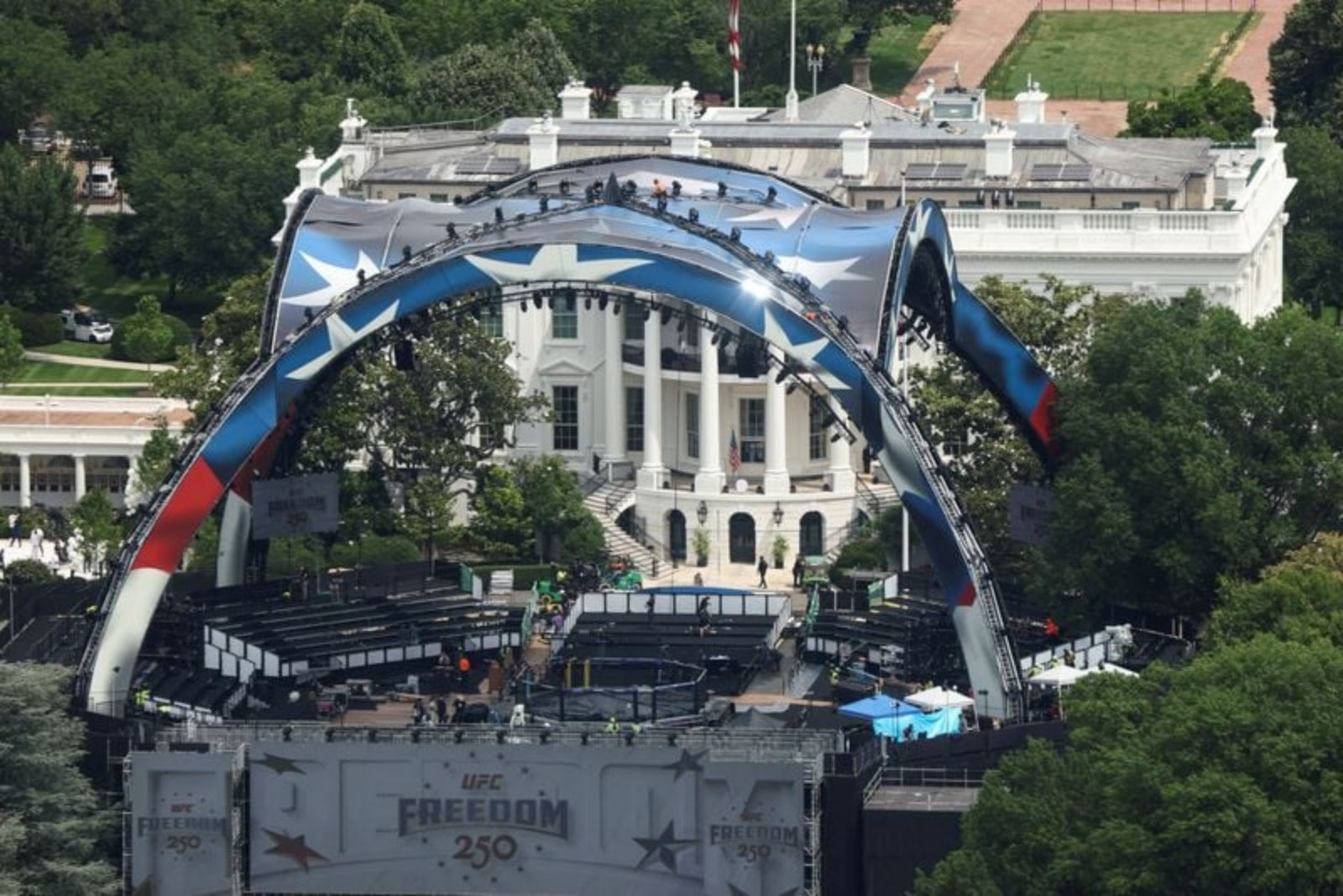
President Donald Trump has launched a sequence of widely publicized sporting events in the nation’s capital, beginning with a mixed martial arts card staged on the South Lawn of the White House this Sunday. The event, organized at the president’s request, coincides with Flag Day and falls near his 80th birthday, placing high-profile athletics at the center of a week of pageantry.
The White House UFC card is one component of a larger program of events organized under the Freedom 250 banner, a body created by the Trump administration alongside a separate, congressionally mandated commission set up to mark the country’s 250th anniversary. Freedom 250 has scheduled multiple activities including the UFC fights and an IndyCar Grand Prix around the National Mall planned for later in the summer.
Organizers and administration officials say the cluster of sports spectacles is intended to showcase the country and to build momentum toward future diplomatic and sporting goals. Bud Denker, chair of the Freedom 250 Grand Prix and president of Penske Corp., said the events will "showcase our country that whole weekend because of the surroundings that we have," adding that the atmosphere and visibility appear to energize the president. "I really think it excites him that it provides this positivity to our country when we need it," he said.
Government planners and allies view the events as complementary to U.S. roles in international sport. Officials are seeking to leverage the attention around the UFC card and other activities to promote the 2028 Summer Olympics in Los Angeles and to amplify the president’s geopolitical brand. The United States, Canada and Mexico won the right to host the FIFA World Cup in 2018, a decision that is referenced by supporters as part of a broader sporting narrative involving U.S. leadership on the global stage.
Support for the White House events has emerged from some corners of government. U.S. Secretary of State Marco Rubio described the White House fights and the UFC’s growth as "the definition of American soft diplomatic power." Rubio announced a public-private partnership with the UFC to incorporate combat sports into the State Department’s diplomatic activities, while leaving financial specifics undisclosed.
International and diplomatic observers have taken note of the administration’s use of athletic events as visible instruments of influence. FIFA President Gianni Infantino awarded President Trump the inaugural FIFA Peace Prize in December 2025. In the months that followed, the administration ordered a military mission in Venezuela aimed at unseating Nicolás Maduro and later carried out strikes on Iran, events that occurred on the calendar after the prize announcement.
Domestic logistics and scheduling have also been affected. French officials reportedly delayed the start of a G7 meeting to avoid overlapping with the UFC card in Washington, according to local media, and the president planned to travel to France for the gathering almost immediately after the UFC event.
Trump has publicly celebrated the spectacle. He called the White House fights "the greatest show on Earth" and likened the temporary "Claw" arena erected over the South Lawn to Paris’ Eiffel Tower. The visible imprint of a large combat-sports venue on the presidential grounds has become a focal point for both supporters and detractors.
Critics argue the White House staging risks conflating entertainment with statecraft and amounts to a form of sportswashing - the use of sport to burnish an image amid contested policy areas. "We tend to talk about sportswashing when we talk about dictators or oil-rich countries," said Nick Watanabe, who studies sport and entertainment management at the University of South Carolina. "It definitely applies to the United States," he said.
Advocacy groups alarmed by the greater political context emphasize the stakes. Andrea Florence, executive director of the Sport & Rights Alliance, a nonprofit human rights organization, said that rising authoritarian tendencies, large-scale conflicts, and retreats from multilateralism have direct consequences for sport. "Global actors vie for power, but they use sports as a weapon, and we have seen Donald Trump and the U.S. under his administration using sports in different ways," Florence said.
Some voices defending the events frame them as unifying and emblematic of a long-standing American affinity for athletics. Julia Friedland, a spokesperson for Freedom 250, said sports serve as "a common language that brings Americans together, and that spirit is reflected throughout the nation’s 250th anniversary celebrations." Former Major League Baseball player Mark Teixeira, who is a Texas Republican, dismissed objections tied to Trump’s involvement, saying critics are overreacting. "If you’re getting bent out of shape about a sporting event in Washington, D.C. - we have a lot bigger problems in our country," Teixeira said.
Not all commentators with sports backgrounds are supportive. Representative Sharice Davids, a Kansas Democrat who competed in two professional MMA bouts, said the sight of a massive temporary arena at the White House gives her cause for concern, particularly as consumer costs rise and the nation remains engaged in armed conflict. Davids said she worries Trump’s close alignment with the UFC could politicize and potentially tarnish the sport. "My main concern is seeing the politicization of a sport that I hope continues to grow and that people continue to find and fall in love with," she said.
The relationship between Trump and mixed martial arts predates his political career. The UFC held its first officially sanctioned event at Trump’s Taj Mahal casino in Atlantic City in 2000. Trump later attempted to promote MMA himself in 2008 and 2009, and some of UFC’s early shows took place at his casino. His long-standing public interest in contact sports and repeated efforts to involve himself in major-league football ventures have been part of that history, including an ownership stake in a franchise of a failed football league that competed with the NFL.
Among the fighters scheduled to compete on the lawn, reactions vary on how they will navigate the mix of spectacle and politics. Lightweight Michael Chandler, who has praised Trump publicly in the past, said he would try to treat the occasion like any other fight and tune out the surrounding theatrics. Canadian bantamweight Aiemann Zahabi, who expects to face American Sean O’Malley - an avowed Trump supporter - said he anticipates boos from the crowd but also intends to acknowledge the unique setting and the president. "It’s something that’s probably never going to be repeated again," Zahabi said. "It’s a one-off, and you know, Trump’s an eccentric guy, and you know, he loves MMA. He loves UFC... I think of it as just one big celebration."
Advocacy and human rights organizations, as well as some athletes and politicians, remain skeptical about the optics of staging combat sports on presidential grounds. Their concerns center on whether the events serve national unity or are primarily tools for enhancing a president’s personal and geopolitical profile. The public-private structure of some of the partnerships involved has also drawn scrutiny because financial arrangements and the degree of formal government endorsement have not been fully specified by officials.
White House representatives did not provide comment in response to multiple requests. For the moment, supporters emphasize the unifying potential of sport and the attention that high-visibility athletic events bring to the capital. Detractors emphasize the risks of politicization and the precedent set by placing commercial sports spectacles in the immediate shadow of national political symbolism.
Summary
President Trump has initiated a series of major sporting events in Washington, starting with UFC fights on the White House South Lawn timed with Flag Day and his 80th birthday. The activities, organized under Freedom 250, also include an IndyCar Grand Prix and are meant to boost the nation’s celebratory calendar, promote the 2028 Los Angeles Olympics, and raise the president’s international profile. The events have prompted praise for their unifying potential and criticism over politicization and sportswashing.
- Key Points
- High-visibility sporting events - including UFC fights on the White House lawn and an IndyCar Grand Prix on the National Mall - are being staged as part of Freedom 250 and broader U.S. sporting diplomacy.
- Officials and allies argue the events will help promote the 2028 Los Angeles Olympics and advance American soft power; the State Department announced a partnership with UFC for diplomatic efforts, with financial terms unspecified.
- Critics and advocacy groups warn the events risk politicizing sport and amount to "sportswashing," raising reputational and human-rights concerns that could affect perceptions of U.S. leadership.
- Risks and Uncertainties
- Political optics - The highly visible placement of commercial sporting events at the presidential residence may deepen partisan divisions and affect public perception of government use of national symbols; impacts could extend to event organizers, sponsors, and the sports industry.
- Reputational risk - Ties between government entities and combat-sports organizations may prompt scrutiny from human-rights groups and international observers, with potential implications for diplomatic relationships and sports diplomacy initiatives.
- Operational and financial transparency - Public-private arrangements announced around these events, including the State Department-UFC partnership, lack disclosed financial details, creating uncertainty about funding, liabilities, and the role of private actors in government-endorsed programming.