
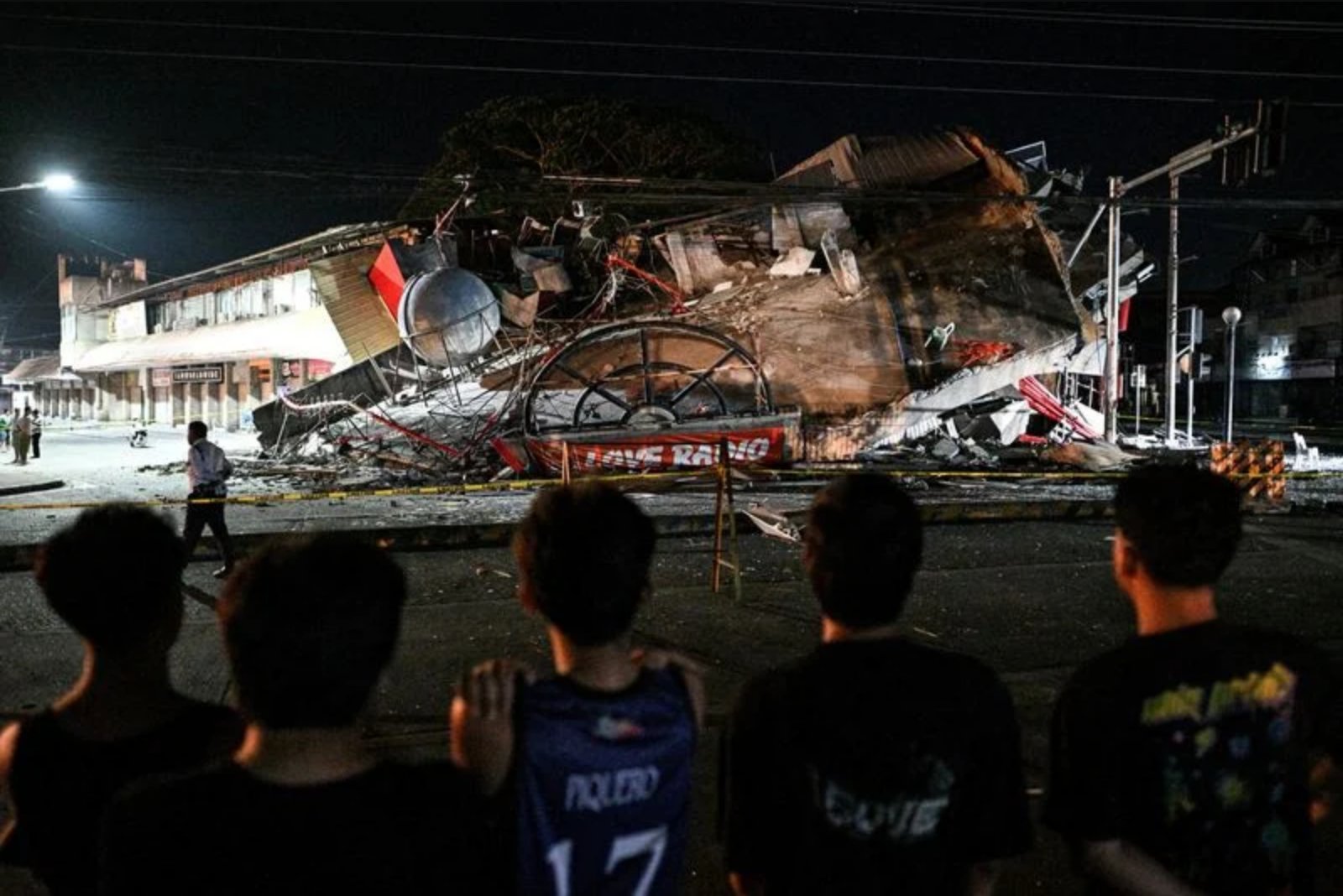
A strong earthquake measuring 7.8 on the Richter scale hit off the southern Philippine island of Mindanao early on Monday, killing at least 32 people and leaving dozens injured, authorities said as search-and-rescue teams intensified operations.
The quake struck roughly 20 km (12.4 miles) off the coast of Sarangani province and was widely felt across Mindanao as well as in Manado on Indonesia’s Sulawesi island, about 420 km away. The initial event prompted tsunami warnings for parts of the southern Philippines, northern Indonesia and Malaysia’s Sabah state on Borneo, though authorities later cancelled the alerts after more than six hours.
General Santos City, a coastal urban centre of roughly 700,000 residents and one of the worst-hit locations, saw buildings sustain significant damage and residents recounting intense fear as tremors rocked the area.
Jojo Calma, 44, described the shaking as unprecedented in his experience. “It was the first time I experienced something that strong, that I really couldn’t stop myself from tearing up. I thought about my children and my niece, what if something had happened to them?” he said. Calma was driving his motorised tricycle taxi when a building housing a fast-food outlet collapsed nearby. He said his children, who were at school at the time, are safe, although a relative’s home was destroyed.
The collapse of the fast-food outlet was captured on video released by local authorities, showing panicked onlookers fleeing as a cloud of dust spread through the air.
Officials reported preliminary figures of 32 people killed and 134 injured across Mindanao, with most casualties attributed to falling debris and landslides, according to civil defence officials. The Philippines mobilised military and disaster response teams, and agencies were directed to prepare relief supplies, evacuation centres and be ready for possible rescue operations.
President Ferdinand Marcos Jr ordered an immediate disaster response in Mindanao and said the national government was moving to assist. “The national government is moving and we will not leave Mindanao behind,” Marcos said in a statement.
Authorities in the affected provinces continued to assess damage to buildings, utilities and other infrastructure. However, officials said the pace of structural inspections in General Santos was being hampered by ongoing aftershocks.
The Philippine seismology agency reported more than 200 aftershocks, including at least nine that were strong enough to be widely felt across Mindanao. The largest of those aftershocks registered a magnitude of 6.7.
Local reports described a range of disruptions. Shops and commercial properties in General Santos sustained damage, with some facades and windows shattered and other structures reduced to rubble. One hospital was evacuated because of concerns about cracks on upper floors. Notre Dame of Dadiangas University reported that one of its buildings collapsed, although no one was inside at the time.
A video released by a school showed children seated on the floor swaying side to side as the quake hit; many hugged teachers before fleeing when part of a makeshift shelter collapsed. In Alabel town in Sarangani province, police chief Benjie Ancheta said the quake had interrupted a police flag-raising ceremony, causing several people to faint.
Residents described immediate shortages of basic services in the quake’s aftermath. “When I got home, there was no electricity and water. We are all affected, we don’t have anything to drink,” said 30-year-old tricycle driver Jayson Manarca.
Across the region, tsunami warnings prompted coastal evacuations in multiple areas. The U.S. Tsunami Warning System had indicated that several countries could be affected. Japan’s meteorological agency issued an advisory and recorded a small tsunami of 0.2 m or lower that caused some ferry disruptions and precautionary closures of beaches. Australia initially warned of potential waves on its northern coasts.
In Indonesia’s North Sulawesi, authorities reported a tsunami with waves up to 0.75 m in some locations. Residents in parts of North Sulawesi, including those on remote Sangihe Islands close to the Philippines, moved to higher ground. Witnesses in Manado said they had felt the quake strongly, though Indonesian disaster mitigation officials reported only minor damage.
Local disaster officer Bong Dacera told a media briefing that full structural assessments were still pending in some areas due to persistent aftershocks. Rescue teams and military units remain engaged in search operations while authorities verify casualty and damage reports.
The quake struck as schools were resuming after a long break, placing large numbers of children and staff at immediate risk in education facilities. Video and local reports highlighted vulnerable points in public infrastructure as evacuations and emergency responses continued.
Authorities emphasised caution as aftershocks continued and relief agencies prepared to deliver assistance to affected communities. The confirmed preliminary casualty and injury figures remain subject to verification as search-and-rescue and damage assessment efforts progress.
($1 = 61.6620 Philippine pesos)