
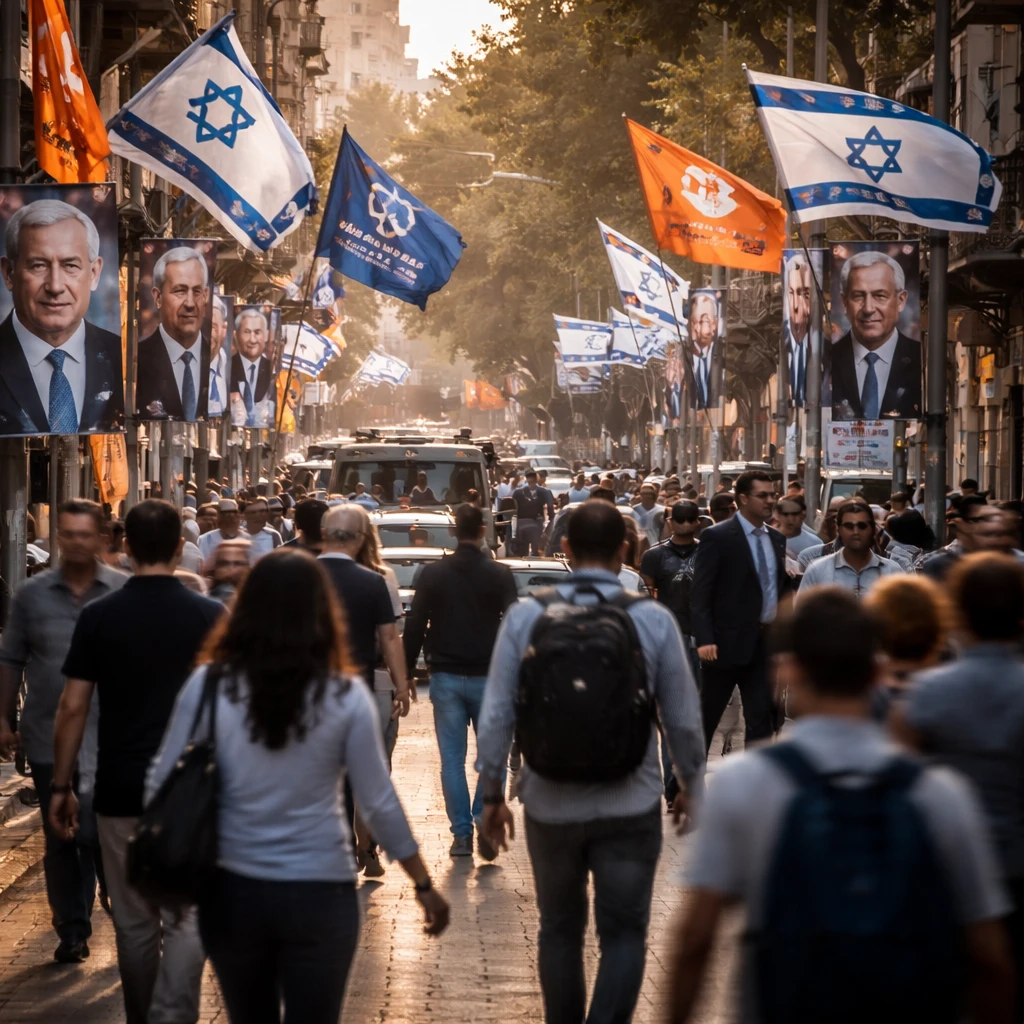
Prime Minister Benjamin Netanyahu is working to bring together Israel’s divided right-wing camp before a statutory deadline for final candidate lists, in an urgent bid to blunt opinion-poll projections that forecast his coalition’s defeat. Netanyahu, who is seeking a record seventh term on October 27, has confronted mounting political pressure since the Hamas-led 2023 attack and the subsequent military engagements in Gaza, Iran and Lebanon.
Opinion surveys over recent months have pointed to a likely setback for the nationalist-religious alliance that has underpinned his government. In response, Netanyahu has been actively encouraging his allies to merge their lists to minimize the risk of small parties siphoning votes without passing the 3.25% threshold - a level that translates to roughly four Knesset seats under Israel’s 120-member parliament.
The legal cutoff for submitting candidate lists is the coming Tuesday night, an inflection point that could determine how many right-wing votes translate into parliamentary representation. Netanyahu has publicly framed list consolidation as the central tactical requirement for victory. "When we unite, we win. When we splinter, we lose," he told Channel 14, a pro-Netanyahu station, on August 30. "I am doing all I can, as I did in the previous election, to unite these parties."
Mergers achieved and resistance encountered
Under Netanyahu’s encouragement - and, according to two political sources, with his assistance - Religious Zionism, led by Finance Minister Bezalel Smotrich, combined its list on September 1 with Zehut, the small party led by Moshe Feiglin, a former libertarian and ex-Likud member. Religious Zionism has been polling between zero and six seats, down from seven seats it currently controls.
However, the effort to create a single right-wing bloc has not been uniform. National Security Minister Itamar Ben-Gvir has rebuffed calls to join his Jewish Power party with Religious Zionism. Jewish Power currently holds six seats and Ben-Gvir has maintained that the parties are stronger running separately - a position at odds with Netanyahu’s push for consolidation. Ben-Gvir had previously run jointly with Religious Zionism in the last election at Netanyahu’s behest.
Another complication for Netanyahu is a right-wing newcomer, Ofer Winter, a former brigadier general whose platform aligns largely with Smotrich’s positions. Winter has rejected proposals to merge his list with other right-wing factions, explicitly refusing to run alongside anyone he believes could have been responsible for the security failures that allowed the 2023 Hamas-led attack. Winter has cast his candidacy as a protest option for right-wing voters seeking a fresh start; recent polls place him at either four seats or none.
Netanyahu has warned directly of the electoral peril presented by such fragmentation. "He chose to go separately and we are now in danger," he said on Channel 14, adding that he risks "wasting" vital right-wing votes if allied lists fail to secure enough seats to enter the Knesset.
Electoral math and shifting fortunes
No single party has ever won an outright majority in the 120-seat Knesset, and coalition governments are the norm. Polls indicate that Likud may experience a substantial reduction in parliamentary strength - losing about a third of its seats - though it could remain the largest party with an expected 20-23 seats. Even if Likud retains plurality, Netanyahu would probably still require the support of allied parties, including the far-right Jewish Power and Religious Zionism, to form a governing coalition.
Political newcomer consolidation, defections, and the separate ambitions of right-wing leaders have combined to create an unusually uncertain electoral landscape for Netanyahu. His position is also weakened by public perceptions of security performance and the political fallout from prolonged regional conflict.
Security setbacks and political consequences
Netanyahu’s reputation as a hawkish leader was dealt a blow by the security failure of the October 7, 2023 Hamas attack. Critics have faulted his response and objected to his refusals to accept responsibility for the lapse. The subsequent wars in Gaza, and operations involving Iran and Lebanon, produced military achievements but no definitive outcomes that could restore his previous political dominance.
Amotz Asa-El, a political analyst at the Shalom Hartman Institute in Jerusalem, observed of Netanyahu: "He’s never faced anything like what he faces now. Everyone in Israel shares a sense of historical crisis, and his name is all over it. And he knows this." Asa-El added a comparison that underscores the shift in public perception: "When he first ran in ’96, he was the Israeli Kennedy. Now he’s running as the Israeli Biden."
Compounding political difficulties, Israel’s military death toll has reached its highest level in decades, and Netanyahu’s concessions to ultra-Orthodox allies over exemptions from conscription have estranged segments of his traditional base. These dynamics have opened an electoral window for rivals.
Netanyahu’s most prominent opponent at present is Gadi Eisenkot, the former military chief whose son was killed in Gaza. Eisenkot’s Yashar party has enjoyed a steady rise in the polls for months and has, at times, matched or overtaken Likud in survey results. Nonetheless, Eisenkot’s path to a governing coalition remains uncertain.
Outlook
With the candidate-list deadline looming, the right-wing camp faces a decisive few days. Netanyahu’s strategy centers on maximizing the translation of votes into Knesset seats by reducing list fragmentation, but his success depends on persuading leaders who currently believe they are stronger standing alone. How those negotiations resolve will be central to whether Netanyahu can overcome the political damage from recent security events and secure a new mandate in October.
Key points
- Netanyahu is pressing right-wing parties to merge before the candidate-list deadline to avoid losing seats in the 120-seat Knesset; the electoral threshold is 3.25%, equal to four seats.
- Polls suggest Likud could be reduced to 20-23 seats and lose about a third of its parliamentary strength; coalition allies such as Jewish Power and Religious Zionism remain critical to forming government.
- Political dynamics are influenced by security setbacks from the October 7, 2023 Hamas-led attack and subsequent wars, which have weakened Netanyahu’s previously hawkish standing and opened space for rivals such as Gadi Eisenkot.
Risks and uncertainties
- Fragmentation of right-wing votes could result in wasted ballots and fewer Knesset seats for the bloc, affecting coalition formation and government stability - this has implications for defense and domestic policy sectors.
- Key right-wing figures refusing to merge lists, including Itamar Ben-Gvir and Ofer Winter, increase the risk that Netanyahu’s coalition will lack sufficient seats, creating political uncertainty that can impact markets sensitive to security and governance.
- Public dissatisfaction over security failures and concessions on conscription may continue to erode traditional support, leaving election outcomes uncertain and potentially affecting sectors tied to government fiscal and security priorities.