
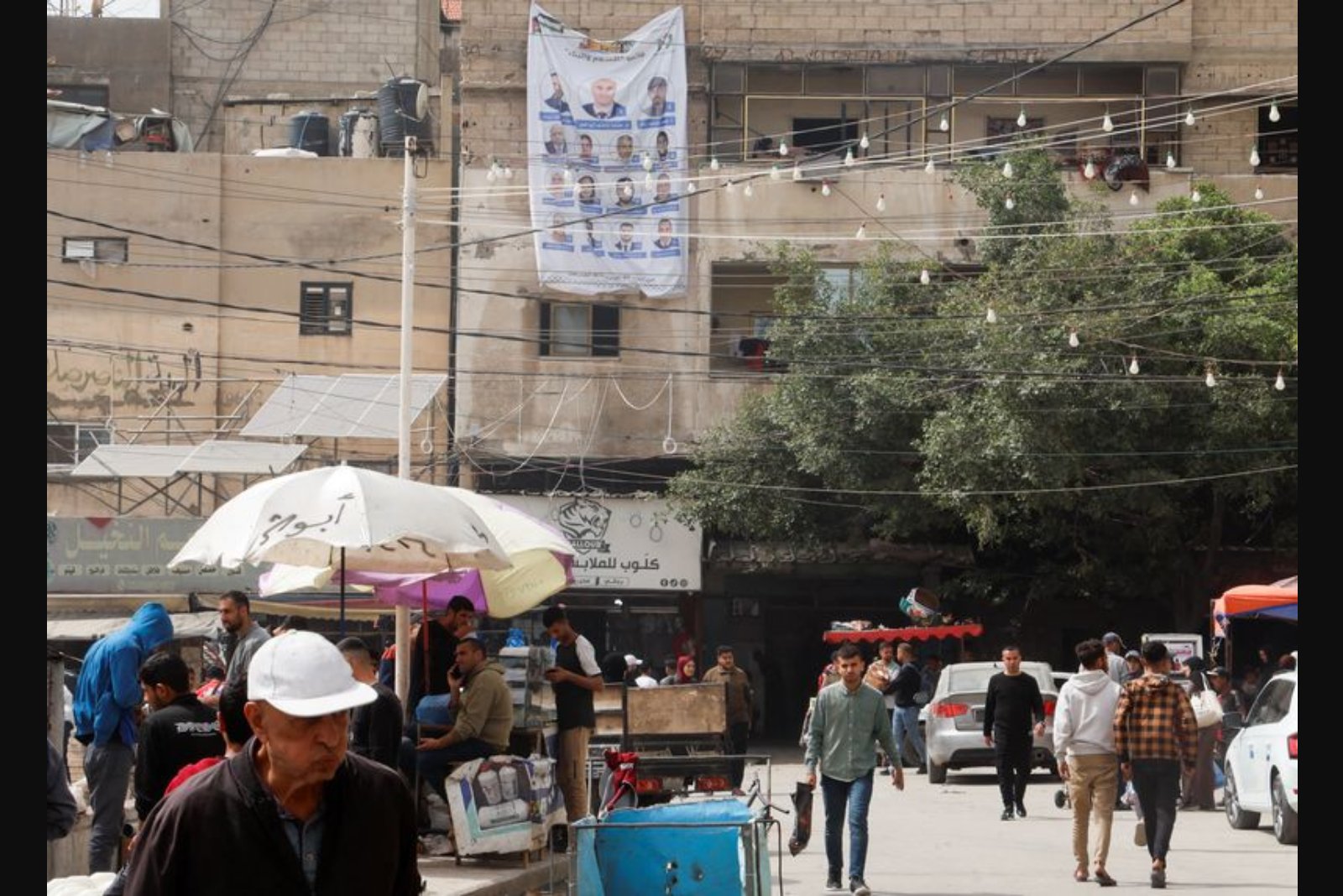
Palestinians in Deir al-Balah are scheduled to vote this weekend in municipal elections that will include lists with candidates seen by residents and analysts as pro-Hamas, offering one of the few direct measures of the militant group’s current popularity inside Gaza.
The vote is part of a Palestinian Authority (PA) round of municipal elections and is being cast by Palestinians as a collective answer to a U.S. initiative for Gaza that many here view as designed to formalize a separation from the occupied West Bank. It is Gaza’s first polling of any kind since 2006, when Hamas won the PA’s legislative ballot and later seized control of Gaza following a brief civil conflict with the Fatah movement that dominates the West Bank.
Authorities are holding the voting in Deir al-Balah in part because the city suffered less destruction than much of the rest of the territory, officials said. The Central Elections Commission said the contest will be run across 12 polling centres, some located in open fields and others in tents. Roughly 70,000 Palestinians in the city are eligible to vote.
Four lists are competing in the municipal contest. One slate includes several figures whom both local residents and political analysts consider to be aligned with Hamas. The militant group has not formally presented a list nor issued an endorsement, citing differences with PA President Mahmoud Abbas over a presidential decree that requires candidates to accept conditions including recognition of Israel.
Other Palestinian factions have opted to boycott the elections. That absence is expected to shape results across the West Bank, where Fatah is widely anticipated to win a significant share of larger municipal councils. Nonetheless, some analysts argue that Hamas could still be using Deir al-Balah as an opportunity to test its electoral strength through sympathetic candidates despite its stated non-participation.
Hani Al-Masri, a West Bank political analyst, said Hamas "may be betting on winning in this election" and could use the performance of pro-Hamas lists as a yardstick of popular support. A Hamas spokesperson has said the group will respect the results, and internal sources have indicated that Hamas plans to deploy police and other security personnel to protect polling locations.
For many residents, the ballot represents a long-awaited chance to take part in civic life after more than two years of war and upheaval. Adham Al-Bardini, 34, said the vote will give him a feeling he has not had in two decades, noting that although he grew up hearing about elections, circumstances had prevented them from occurring. "We are eager to take part so we can change the reality imposed on us," he said.
Deir al-Balah’s streets are lined with large banners displaying rival candidate list logos in the lead-up to the vote. Young men and older residents alike have described the elections as a step toward rebuilding daily life after the Hamas-led attacks of October 7, 2023 and the extended Israeli military campaign that followed.
For 25-year-old Abdul-Rahman Al-Shaaf, even a local ballot is an opening to start restoring normalcy. "Everyone wants to improve the country, especially after two years of war, what we witnessed, and the destruction," he said.
The municipal vote comes amid international debate over Gaza’s future. A U.S.-backed initiative known as the Board of Peace envisions reconstructing Gaza under the stewardship of an apolitical committee of Palestinian technocrats. That plan calls for Hamas to surrender governance of the Strip to the committee, lay down its weapons, and allow Israeli forces to withdraw.
Hamas has rejected demands for disarmament to date, accusing Israel of failing to adhere to the terms of an October 2025 ceasefire. In that ceasefire process, Israeli forces withdrew from stretches of Gaza’s coast, where Hamas reasserted control of Deir al-Balah and other coastal localities; Israel continues to exercise control over more than 53% of the Strip.
Some public opinion data suggests that Hamas retains significant support in both Gaza and the West Bank despite the toll of the conflict. An October 2025 survey by the Palestinian Center for Policy and Survey Research found that 41% of Palestinians in Gaza backed Hamas, compared with 29% who supported Fatah.
Palestinian political analyst Reham Owda described the municipal vote as "a symbolic step to send a message to the world, to the Board of Peace, and to Israel that the Gaza Strip is an inseparable part of the Palestinian political system." The PA had announced in January that municipal elections in the West Bank would be extended to Gaza "wherever possible," a move observers interpret as intended to signal that Gaza remains part of a future Palestinian state.
As the polls open, uncertainties remain. Some factions’ boycotts and the presence of candidates with differing allegiances create an unpredictable local political landscape. Observers will watch whether the ballot functions as a genuine barometer of public sentiment in Gaza or primarily as a symbolic assertion of unity against proposals that many here view as marginalizing Gaza from the West Bank.
Voters and analysts alike said the immediate hopes attached to the election are practical as well as political: a chance to elect local leadership that can help steer reconstruction, manage municipal services, and represent community interests during a period of intense external negotiating and internal strain.