
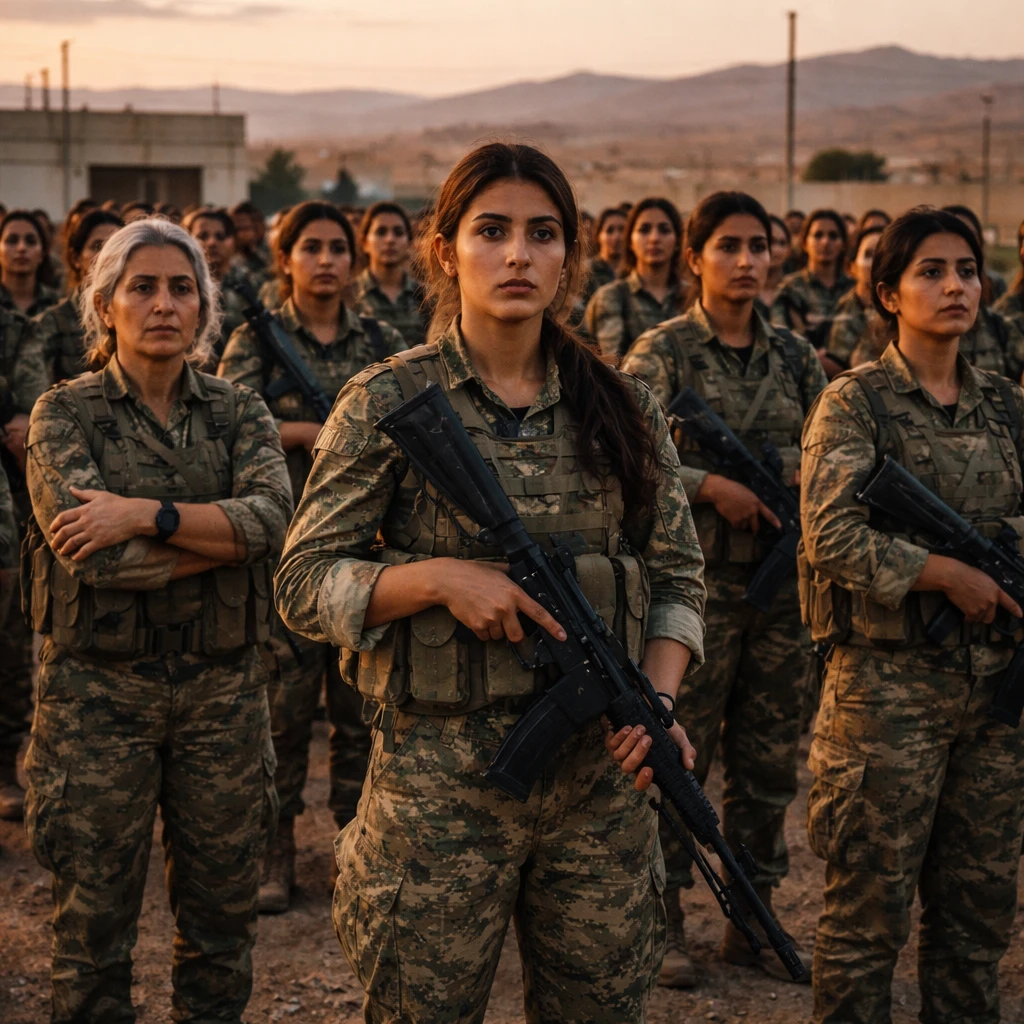
The Women’s Protection Units, widely known by the acronym YPJ, are engaged in talks with Syria’s interior ministry as they try to secure an organised and recognised place within the country’s reworked security architecture. Once an internationally visible all-female fighting force that operated alongside the U.S.-backed Syrian Democratic Forces (SDF) in the campaign against Islamic State, the YPJ now faces uncertainty after sweeping political and institutional changes in Damascus.
The YPJ fought with the SDF during Syria’s civil war and played a role in driving Islamic State from large parts of the country’s north and east. Their all-female ranks made the group one of the conflict’s most recognisable units and a focal point for international attention. That prominence has not insulated them from the consequences of a recent transfer of power in the capital.
Since the downfall of former president Bashar al-Assad in late 2024 and the emergence of a new government led by Islamist rebels, Damascus has taken steps to bring formerly autonomous armed organisations under state control. In that process the SDF was formally dissolved last week. Its commander, Mazloum Abdi, was appointed as an adviser to President Ahmed al-Sharaa, while other SDF members were absorbed into the defence ministry.
Despite the absorption of former SDF personnel into official institutions, there are currently no women represented in Syria’s new defence ministry. Nowruz Ahmed, the YPJ’s commander, said that in meetings with President Ahmed al-Sharaa last week in Damascus she was told her fighters would have no place in the military. "We were aiming to join the army, because our forces have experience and expertise that would enable them to protect themselves in an organised way in the form of an independent brigade or battalion," she said at a military base in the northeastern Syrian city of Qamishli. "Our main condition was that this force must be organised, must not be deployed to any place, and must not be in small groups. They rejected this proposal."
With the army route closed, YPJ leadership has sought an alternative within the interior ministry. The interior ministry already employs some female personnel, notably in a tourism police unit. Earlier this year, Syria’s central authorities reportedly suggested that YPJ fighters could be transferred into that tourism police force; the YPJ rejected that option, and a YPJ spokesperson denied such an offer had been made.
Ahmed said the YPJ instead proposed joining the interior ministry’s special operations forces, arguing that the composition and capabilities of those units more closely match the YPJ’s experience and would increase female representation within otherwise male-dominated security organs. "When we discussed with the interior ministry, we told them that our forces comprise more than 1,500 fighters and we asked whether all these forces would be merged or not," she said. Ahmed added she expects a response "in the coming days."
Syria’s defence and interior ministries did not immediately respond to questions about the deliberations. In a statement to Kurdish outlet Rudaw, interior ministry spokesperson Noureddine al-Baba said YPJ fighters would be welcomed into the ministry’s ranks, but provided no details on their prospective roles. Baba indicated that units would be deployed across Syria rather than being confined to a single geographic zone.
These discussions are unfolding against persistent distrust among many Kurds toward Syria’s new rulers. Kurdish communities have expressed wariness in part because of mass violence attributed to government-linked forces against minorities in 2025 and concerns tied to President Ahmed al-Sharaa’s past, including his former leadership of Al Qaeda’s Syria branch before he broke ties with the militant organisation. Those concerns shape Kurdish expectations and reactions to offers of integration into state structures.
For many Kurdish women, the YPJ represents more than a military formation: it is a potent symbol of political and social gains achieved during the conflict. "They always see women as weak. We as women don’t draw our strength from men, nor do we draw our strength from the current state," said 20-year-old YPJ fighter Goksu Ciyager. "Of course, we want to have a special case and we insist on this."
Penaber Baran, a 31-year-old YPJ unit commander, said the constitution should explicitly guarantee a role for the force. "Until today, we have never waited for anyone to defend us," she said. "We as women defended ourselves."
As the interior ministry and YPJ continue discussions, key questions remain unresolved: whether the YPJ’s fighters will be able to maintain their organisational integrity within state institutions, what operational limitations may be placed on them, and how their deployment across Syria will be managed. The outcome will affect not only the fighters themselves but also broader dynamics of female participation in Syria’s security forces and Kurdish relations with the central authorities.
The negotiations represent a critical moment for integrating an experienced all-female unit into formal security structures while responding to political pressures to centralise control over armed groups. The coming days will determine whether the YPJ can secure an arrangement that preserves its cohesion and operational identity within the reconstituted security framework, or whether its fighters will be dispersed or absorbed in ways that dilute their distinct role.