
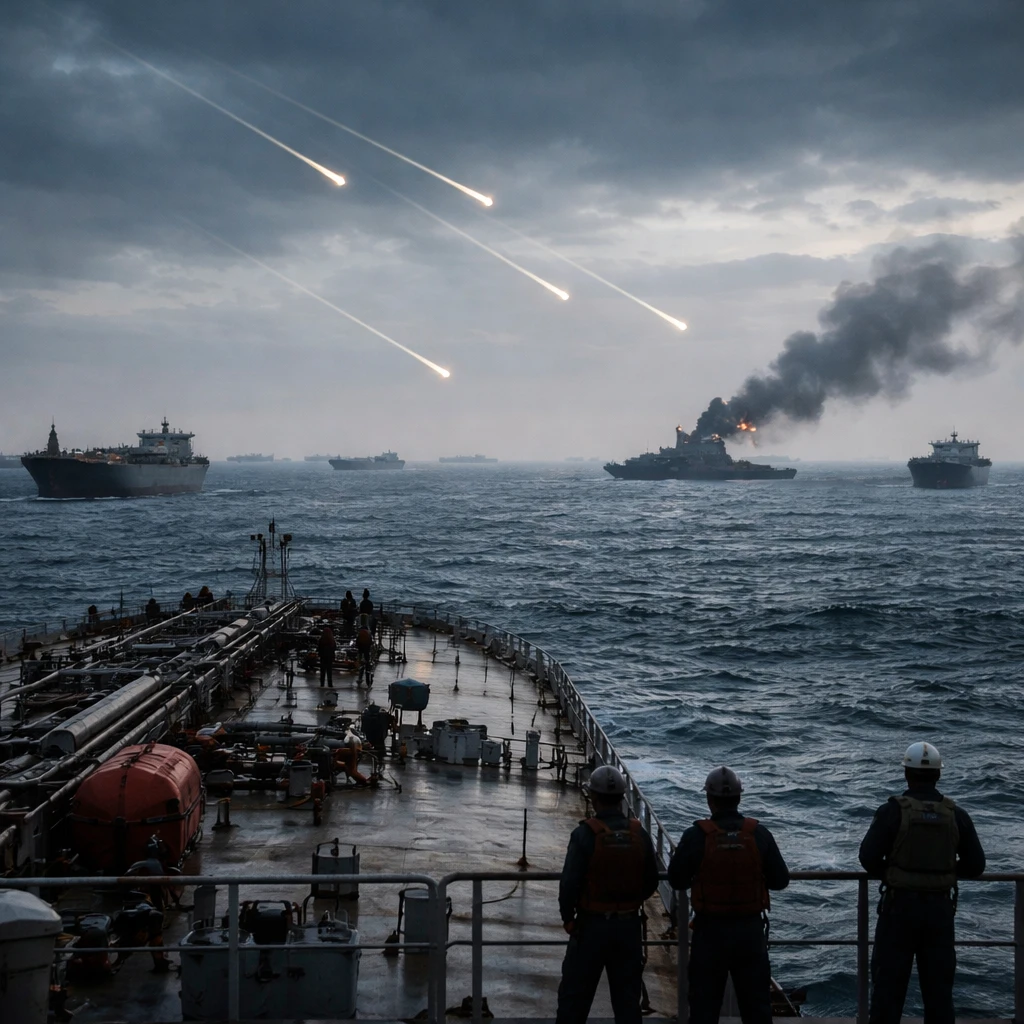
Iran’s Islamic Revolutionary Guard Corps (IRGC) announced on Sept 9 that it fired ballistic missiles at a base in Jordan used by U.S. forces and conducted attacks on 10 ships near the Strait of Hormuz, following U.S. strikes that destroyed five Iranian oil tankers. The exchange represents a significant escalation in a conflict that has lasted approximately six months, with recent actions reversing a period of relative calm.
The U.S. military’s Central Command released video footage showing strikes it said destroyed five Iranian oil tankers on Tuesday. U.S. officials described those strikes as a response to what they said were two incidents over the preceding 48 hours in which Iran’s IRGC targeted a U.S. Navy warship twice with ballistic missiles. U.S. authorities said no American personnel were harmed in the incidents.
In a public comment, U.S. Secretary of State Marco Rubio said, "Iran continues to try to hit U.S. naval ships, and for every time they do that or try to do that, they’re going to lose tankers," when speaking with reporters during a visit to Colombia.
Shortly after the U.S. action, the IRGC said it carried out a ballistic missile attack on a base near Al Azraq in Jordan that is used by U.S. forces. Iran asserted its missiles caused heavy damage. Jordanian authorities reported that their air defences intercepted 18 of 20 Iranian missiles, with the remaining two falling in unpopulated areas, and they said there were no casualties. A U.S. official described Iran’s strikes in Jordan as ineffective and stated that all American troops were accounted for.
In addition to the Jordan attack, the IRGC said it struck 10 ships in the Strait of Hormuz region, identifying two as U.S. vessels and eight as oil tankers attempting to transit a zone it described as "prohibited and unsafe." The Strait of Hormuz is a critical channel for global energy shipments and has been a focal point of maritime confrontations during the conflict.
The broader campaign has seen Iran target U.S. assets and allied interests across the region, including multiple strikes in Jordan over the course of the war. In one earlier incident in July, an attack in Jordan killed at least two U.S. military personnel, according to accounts tied to the ongoing hostilities.
State media in Iran also reported threats against oil tankers in the ports of Kuwait and Bahrain. Separately, a maritime security source said a liquefied natural gas tanker sustained damage in the Emirati port of Khor Fakkan, though that source indicated responsibility for the damage was unclear.
Market reactions were immediate. Oil prices extended gains in early trade on Wednesday, with Brent crude approaching $100 a barrel amid concerns that tanker movements through the Strait of Hormuz could be further disrupted. Analysts and market participants pointed to recent Houthi attacks on major energy producer Saudi Arabia as an additional pressure point for supply worries.
On Tuesday, Houthi forces, aligned with Iran, launched strikes on multiple Saudi cities in what authorities described as a broad operation that used drones and missiles. The Houthis said they had struck a Saudi air base in Khamis Mushait and targeted Saudi state oil company facilities in Abha, Najran and Jazan. Saudi officials reported fires at those sites and said 73 people were wounded, with women and children among the injured. The attacks reportedly set some oil installations ablaze.
The Houthi campaign has expanded the theatre of conflict to the western side of the Arabian Peninsula, where the group has periodically disrupted shipping at the entrance to the Red Sea. That activity has heightened pressure on U.S. allies and added to regional instability.
Saudi Arabia has led an Arab coalition that has been engaged with the Houthis in Yemen for more than a decade after the Houthis ousted the internationally recognised Yemeni government from the capital. While fighting in Yemen had eased in recent years, a ceasefire there has since broken down, contributing to the renewed intensity of hostilities.
The confrontation in the Gulf has taken on the character of a strategic contest between the U.S. and Iran, with each side employing economic and maritime measures to try to constrain the other. Washington has sought to keep oil flowing to global markets by escorting vessels through the Strait of Hormuz, while also attempting to block Iran’s oil exports through a separate interdiction effort.
Central Command stated that the five tankers destroyed by U.S. forces were part of a clandestine network alleged to fund the IRGC and its regional proxies. Tehran has long described its regional strategy as supporting an "Axis of Resistance," which it says includes groups such as Hamas, Lebanon’s Hezbollah, Iraqi Shia militias and the Houthis.
As the confrontation continues to unfold, military, commercial shipping and energy sectors remain directly affected. The recent exchanges have led to renewed concerns about security in key maritime corridors and potential further disruptions to oil shipments, which in turn influence global energy markets and prices.