
Hook / Thesis
Toast has officially entered a different earnings regime. After years of heavy investment in product and go-to-market, the company reported profitability for 2025: $6.2 billion in revenue and $342 million in net income, backed by a record $608 million in free cash flow. That transition materially changes how investors should value Toast - from a long-duration growth story priced for perfection to a profitable, cash-generating platform with optionality.
Market sentiment has been jittery: the stock suffered a meaningful pullback earlier this year amid macro and AI-related software fears. That corrected reaction, combined with active buying from a large institutional investor and validation in the form of improving margins and FCF, creates a practical swing trade setup at current prices near $28.35.
What Toast Does and Why It Matters
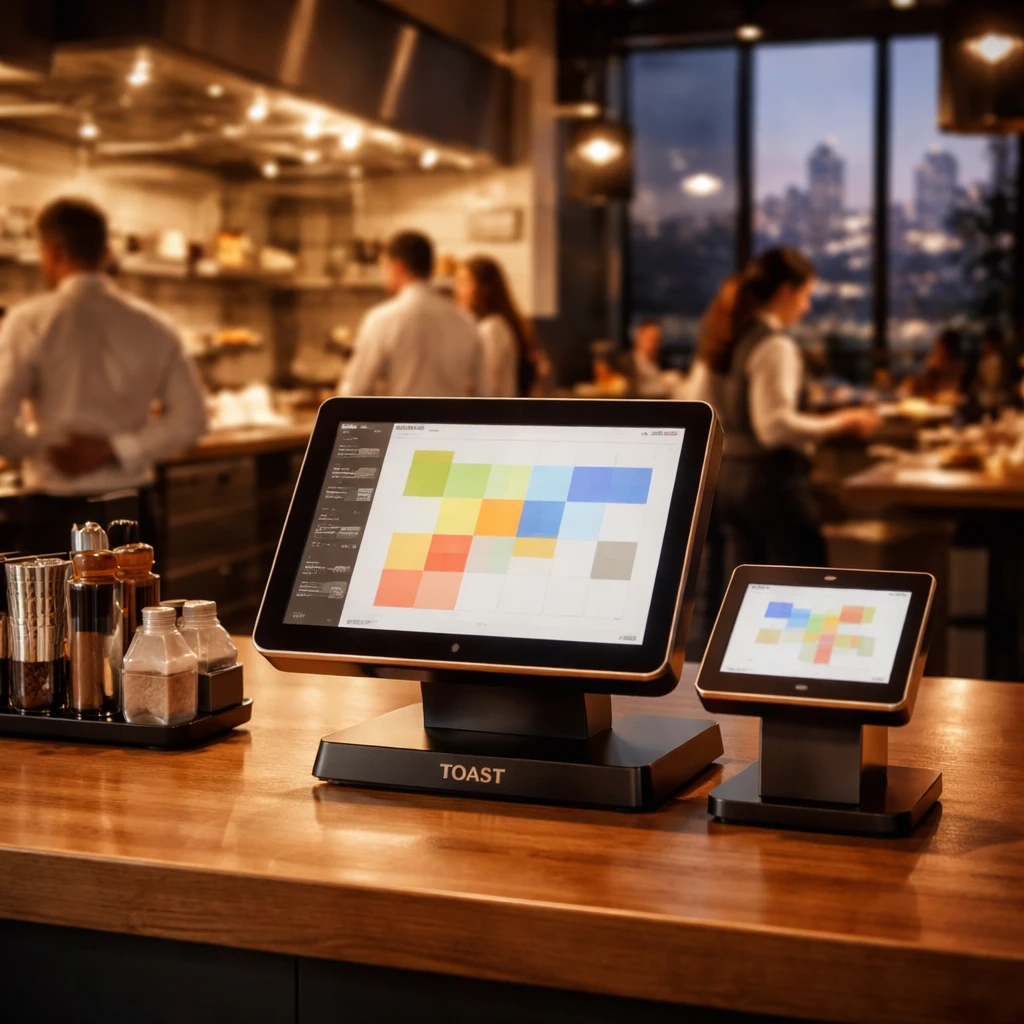
Toast is a vertically focused restaurant technology platform that bundles point-of-sale hardware, payments, online ordering, analytics, and kitchen and guest-facing systems. Its product mix creates high switching costs for small and independent restaurants and an embedded revenue stream from hardware, software subscriptions, and payments.
Two numbers explain why the market should care: approximately 164,000 restaurants on Toast today and a domestic footprint still with meaningful runway - the company estimates large addressable pools where hundreds of thousands of locations remain on legacy systems. The combination of sticky recurring revenue (software and payments) and payments margin capture is what drove Toast to $608M in free cash flow in 2025 and net income of $342M.
Fundamentals and Valuation Frame
Key facts to anchor the valuation discussion:
- Market cap: roughly $16.7 billion.
- Enterprise value: about $15.09 billion.
- Free cash flow (2025): $608 million.
- 2025 revenue: $6.2 billion; net income: $342 million.
- Price / trailing free cash flow: ~27x (consistent with the software cohort reset).
- PE is elevated relative to cyclicals (price_to_earnings ~52x on the snapshot), but that reflects earnings momentum and the fact many investors still priced Toast as a high-growth SaaS name.
Put simply: you're buying a profitable, cash-generating vertical SaaS + payments company with durable unit economics at an enterprise value that implies modest multiple compression relative to the public software index sell-off. At about 27x trailing FCF, the stock is neither dirt-cheap nor frothy; it's a valuation that anticipates continued growth but not unchecked acceleration.
Technical and Market Structure
The near-term technicals are constructive. The stock trades above its 20-day and 50-day SMAs (SMA-20: $27.24; SMA-50: $27.53) and the 9-day EMA sits just below price at ~$28.26. Momentum indicators are neutral to positive - RSI around 53 and a bullish MACD histogram - suggesting there is room for a measured move higher without immediate overbought risk.
Short interest is moderate: recent settlement shows ~28.3M shares short with a days-to-cover metric hovering near 2.8 on the most recent report. Short volume remains elevated on many trading days, implying that positive surprises could induce squeezier action, but the short base is not outsized.
Trade Plan (Actionable)
Thesis: Buy Toast at $28.35 to capture near-term re-rating as profitability and FCF convert skeptics, supported by potential upside from enterprise wins and continued location adds.
| Entry | Target | Stop Loss | Horizon | Risk Level |
|---|---|---|---|---|
| $28.35 | $38.00 | $24.35 | mid term (45 trading days) | medium |
Why these levels?
- Entry $28.35 - this is the current trading level and sits near short-term moving averages, offering a controlled entry with momentum on your side.
- Target $38.00 - a realistic mid-term upside that does not require a full retest of the 52-week high ($49.66) but represents ~34% upside and would reflect a modest multiple re-rating (closer to 35-40x FCF alongside continued ARR growth and margin expansion).
- Stop $24.35 - the 52-week low. A break below this level would signal a failed support and materially increase downside risk, invalidating the thesis that profitability is being fairly discounted.
Trade duration: mid term (45 trading days). Why 45 days? That window covers at least one earnings cycle or catalyst (quarterly release cadence) and is long enough to allow the market to process institutional buying, quarterly results, or large account announcements, while keeping capital at work in a defined risk period.
Position sizing suggestion: given the medium risk level, size the position so that the dollar loss to the stop represents no more than 1-2% of portfolio capital.
Catalysts
- Quarterly financials that confirm recurring profit growth and maintain or improve FCF guidance for 2026 (company has guided to 20-22% growth in recurring profit).
- Evidence of expansion into larger chain accounts or increased average revenue per location, which would validate the move beyond small and independent restaurants.
- Institutional accumulation - additional disclosures from large shareholders (ValueAct has increased its stake) could drive follow-through buys.
- Macro stability - any soft-landing narrative or resilient consumer spending on dining-out would support unit growth and payments volume.
- Product momentum - tangible wins for higher-margin software or AI-assisted features that increase switching costs or monetization.
Risks and Counterarguments
Toast's bull case is credible, but several real risks could derail the trade. I outline four specific risks and then provide a counterargument that skeptics will use.
- Restaurant cyclicality: The business is tied to restaurant health. A recession or sustained pullback in dining out would hit transaction volumes and new location adds.
- Competitive pressure and in-house builds: National chains have the resources to develop proprietary systems, and broader AI tools lower the cost of building specialized software. If chains migrate away, ARPU and growth could suffer.
- Margin compression from wins in payments: Payments contribute materially to cash flow; any regulatory or competitive pressure that squeezes payments economics would hurt FCF.
- Execution risk on larger accounts: Toast’s strength is the small-to-mid market. Scaling reliably into national chains is execution-heavy; failures or slow uptake would disappoint investors.
Counterargument: critics point out that AI and general-purpose tools make custom restaurant software cheaper to replicate, and that SaaS multiples remain vulnerable to sentiment-driven declines. They also highlight the elevated PE (~52x) as a buffer against disappointment.
My rebuttal: while AI lowers certain development costs, mission-critical, deeply integrated systems with hardware, payments, and operational integrations are hard to replicate quickly. Toast’s record FCF of $608M and profitability in 2025 materially raise the bar for competitors; the company is no longer an unprofitable growth-only story. That said, the counterargument is valid: if Toast fails to convert large-chains or payments margins erode materially, the re-rating could reverse.
What Would Change My Mind
I would reduce conviction or flip bearish if any of the following occur:
- Quarterly results miss both ARR/recurring revenue growth and free cash flow expectations simultaneously.
- Guidance turns negative on recurring profit growth (below the company’s 20-22% recurring profit growth guidance) or provides a materially lower outlook for payments revenue.
- Evidence of accelerating churn among mid-market customers or a string of high-profile chain losses that suggest Toast cannot scale upward profitably.
- Regulatory changes that meaningfully compress payments economics.
Conclusion - Clear Stance
Toast is worth owning here as a tactical swing trade. The combination of profitability, record free cash flow, a still-large addressable market, and constructive technicals provides an asymmetric setup: downside is bounded to the $24.35 support level while upside to $38.00 is credible if the company continues executing and institutional support persists. Keep position sizes disciplined and watch for the catalysts listed above - a confirmed beat on recurring profit or an announcement of broader enterprise traction would materially increase the odds of hitting the target.
If near-term results disappoint or a clear trend of customer defections emerges, step aside. But for patient, tactical capital, Toast at $28.35 is a pragmatic long with a defined stop and a compelling risk-reward for the mid term (45 trading days).
Trade Plan Recap: Buy $28.35, Target $38.00, Stop $24.35, Horizon: mid term (45 trading days), Risk level: medium.