
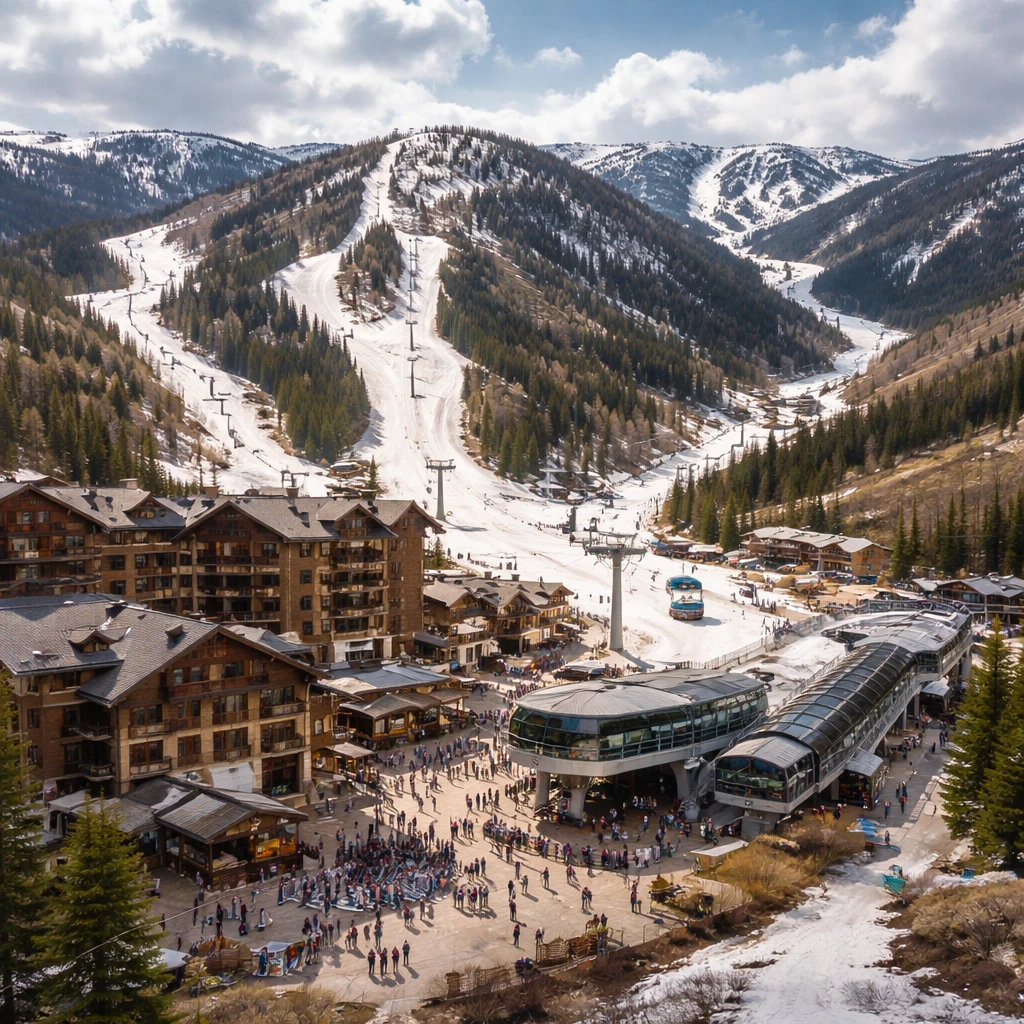
Vail Resorts Inc. has enlisted bankers to conduct a broad review of areas that might be vulnerable to activist shareholders, according to reporting that cites people familiar with the matter. The company is preparing for possible pressure even though no activist campaign has formally started.
Shares of Vail Resorts (NYSE:MTN) rose sharply on the news, trading up 9% at $141.65 on Thursday and recovering from an earlier 52-week low of $118.51 reached earlier this year. That intraday increase pushed the company's market capitalization to about $5.05 billion.
The advisers have been asked to examine a range of potential weaknesses - spanning labor issues, weather-driven swings in demand and a public campaign being advanced by Matthew Prince, who co-founded Cloudflare (NET). In remarks to a local Colorado publication in June 2026, Prince said he is prepared to invest $500 million in Park City Mountain Resort and acknowledged he had been contacted by activist investors probing Vail's position. Prince's stated preference would be to shift Vail toward an asset-light model in which the company serves primarily as a facilitator of partnerships rather than retaining direct ownership of ski areas - an approach that would likely require separating parts of the company's real-estate holdings.
The timing of the review compounds management's challenges. For fiscal third quarter 2026 Vail reported earnings per share of $8.81, missing the consensus estimate of $9.09 by roughly 3.1%. Revenue for the quarter was $1.21 billion, about $10 million below forecasts. In the aftermath, management lowered its fiscal 2026 net income guidance to a range of $128 million to $162 million and narrowed Resort Reported EBITDA guidance to $735 million to $755 million, down from the prior $745 million to $775 million range.
Balance-sheet metrics have also shifted. Net debt rose to $2.65 billion from $2.24 billion a year earlier, and net leverage stood at 3.5x trailing twelve-month EBITDA as of April 30, 2026. Cash on hand was reported at $371.4 million. Those figures frame arguments about financial flexibility at a time when the company is simultaneously addressing operational issues.
Forward indicators add another layer of concern for investors and potential activists. Early sales of Epic Passes through late May showed pass units down roughly 10%, days sold down about 8%, and sales dollars down approximately 5%. Management has said some of this softness reflects timing shifts in when consumers buy, but the declines provide a ready narrative for activists that question structural demand.
Corporate governance moves over the past year also factor into the landscape. In May 2025 the board recalled Rob Katz - the executive who originally built the company into a multi-mountain operator - and removed his chosen successor. Katz has concentrated on operational improvements aimed at easing customer complaints, specifically addressing lift-line congestion and persistent labor shortages. New offerings, such as Epic Friend Tickets and discounted super-advanced lift tickets, have been introduced and are showing early signs of adoption. The board's insistence on operational fixes indicates it views service and guest experience as a primary bulwark against activist arguments that center on mismanagement.
Financial policy is another element management can use defensively. Vail pays a quarterly cash dividend of $2.22 per share, with the next scheduled distribution on July 9, 2026. At current prices that payout equates to an annualized yield of roughly 6.6%. Management can point to regular cash returns while pursuing a turnaround as evidence of shareholder-focused discipline, though the argument is tempered by rising leverage and reduced guidance.
Investors will look to the company's fiscal fourth-quarter 2026 results, tentatively scheduled for September 24, 2026, for clearer evidence of whether recent operational programs and pricing actions are stabilizing demand. Consensus EPS for that quarter currently stands at -$5.05. Analysts have issued eight downward revisions to estimates for that quarter in the past 90 days and no upward revisions, a trend that underscores the downside that an activist - or the market - could seek to exploit.
For now, Vail's engagement of bankers signals an effort to be proactive rather than reactive as it navigates a mix of public pressure, softer forward booking indicators and financial strain. The company's next reporting and the response to the operational initiatives will be material in shaping whether that preparation is sufficient to deter outside challengers.
Key points
- Vail has hired financial advisers to evaluate vulnerabilities that could attract activists, including labor issues, weather-related demand volatility and targeted pressure from Matthew Prince.
- Shares jumped 9% to $141.65 following the report, lifting market capitalization to about $5.05 billion, after hitting a 52-week low of $118.51 earlier this year.
- Operational and financial headwinds include disappointing early Epic Pass sales, lowered fiscal 2026 guidance, rising net debt to $2.65 billion and a consensus -$5.05 EPS estimate for fiscal Q4 2026.
Risks and uncertainties
- Potential activist pressure could push for an asset-light restructuring that may require selling or spinning off real-estate holdings - a governance and strategic risk affecting the leisure and real-estate sectors.
- Rising leverage and reduced guidance weaken the company's financial flexibility and may constrain the defensive value of the dividend - a risk relevant to investors and the broader consumer discretionary sector.
- Early declines in Epic Pass metrics - units down roughly 10%, days sold down about 8% and sales dollars down about 5% - could foreshadow continued softness in demand for ski and resort services.