
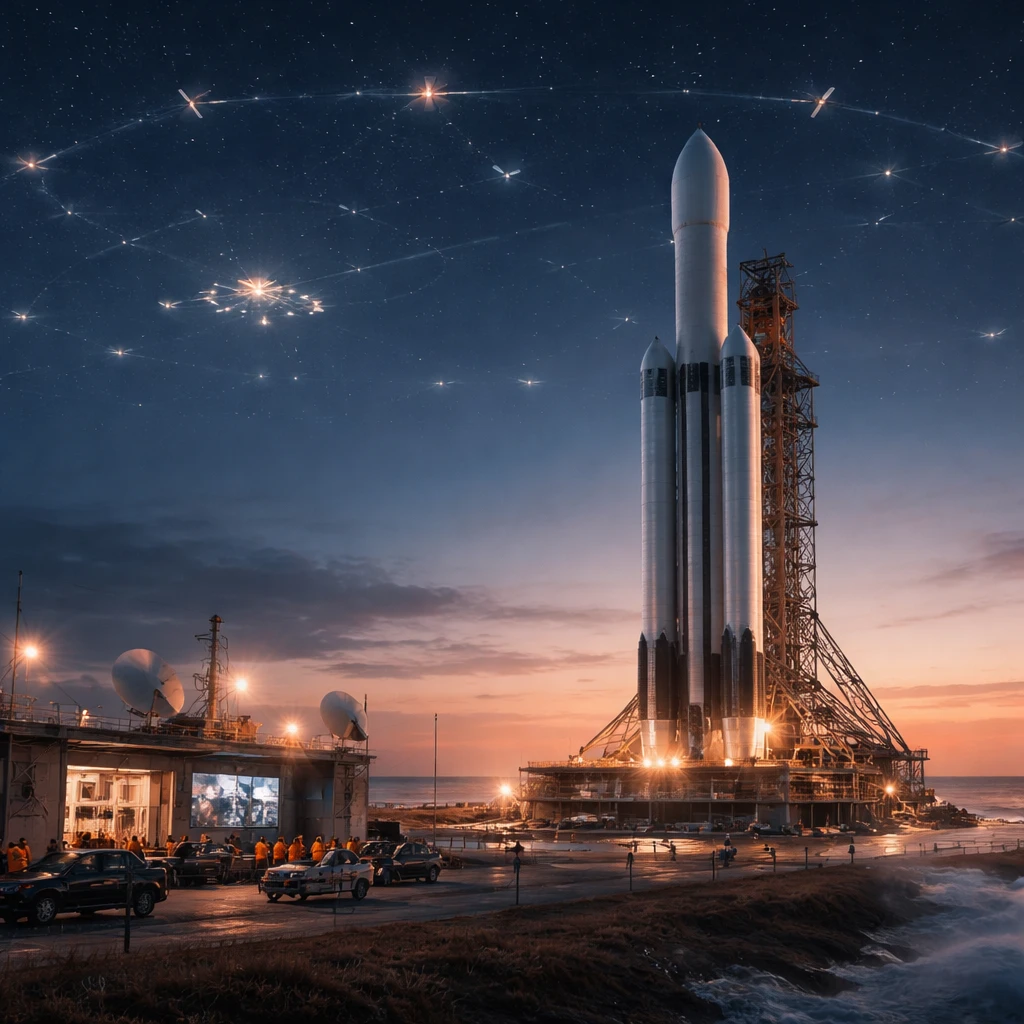
Susquehanna Financial Group has initiated coverage of SpaceX with a Neutral rating and a $170 price target, concluding that the space operator commands robust market positions but is currently priced for extremely strong future growth.
Analyst Charles Minervino outlined a fundamentally favorable view of the company’s business mix. He emphasized SpaceX’s dominant position in the commercial space launch market, the expanding addressable market for its Starlink satellite connectivity unit, and the development of an early-stage artificial intelligence offering following the firm’s acquisition of xAI earlier this year.
Minervino’s forecast anticipates very rapid expansion: revenue is projected to increase at a compound annual growth rate of 56% between 2025 and 2030, reaching $173 billion by 2030. Over the same period, Susquehanna expects EBITDA to climb from $6.6 billion to $74.9 billion.
Despite these bullish growth projections, the analyst stopped short of recommending a Buy. He noted that the stock’s present valuation presumes premium multiples applied to optimistic assumptions about both revenue and EBITDA growth. With several of SpaceX’s potential markets described as still relatively unproven, Minervino warned that a wide range of outcomes remains possible and that this uncertainty injects material risk into forward expectations. For that reason, he recommended investors wait for a more attractive entry point.
The $170 target derives from a sum-of-parts valuation. Susquehanna assigns the Space segment a 40-times 2028 EV/Sales multiple, the Connectivity segment a 45-times 2028 EV/EBITDA multiple, and the AI segment a 9-times 2028 EV/Sales multiple. The analyst notes these multiple assumptions are significant premiums relative to peer groups.
Susquehanna also listed potential catalysts that could drive the stock higher or lower. Central to the long-term investment thesis is successful development of Starship, the next-generation, fully reusable launch vehicle. Starship is viewed as critical because it supports the deployment of Starlink’s next-generation satellites and is tied to SpaceX’s stated ambitions for orbital data centers.
On the risk side, Minervino highlighted several execution and market pressures. Possible Starship delays could undermine the timetable for related initiatives. Competitive pressure on Starlink’s pricing from a planned rival satellite constellation could compress revenue or margin outcomes. Additionally, the AI segment carries concentration risk: compute-leasing contracts with Anthropic and Google together represent roughly $26 billion of annualized revenue in Susquehanna’s model, but these agreements can be terminated by either contracting party after initial trial periods. Susquehanna views these factors as meaningful downside risks to the firm’s forecasted outcomes.
Bottom line - Susquehanna sees SpaceX as a company with strong structural advantages across launches, satellite connectivity, and nascent AI services, but the firm judges the stock’s current valuation to be stretched relative to the range of plausible execution scenarios and therefore recommends patience.