
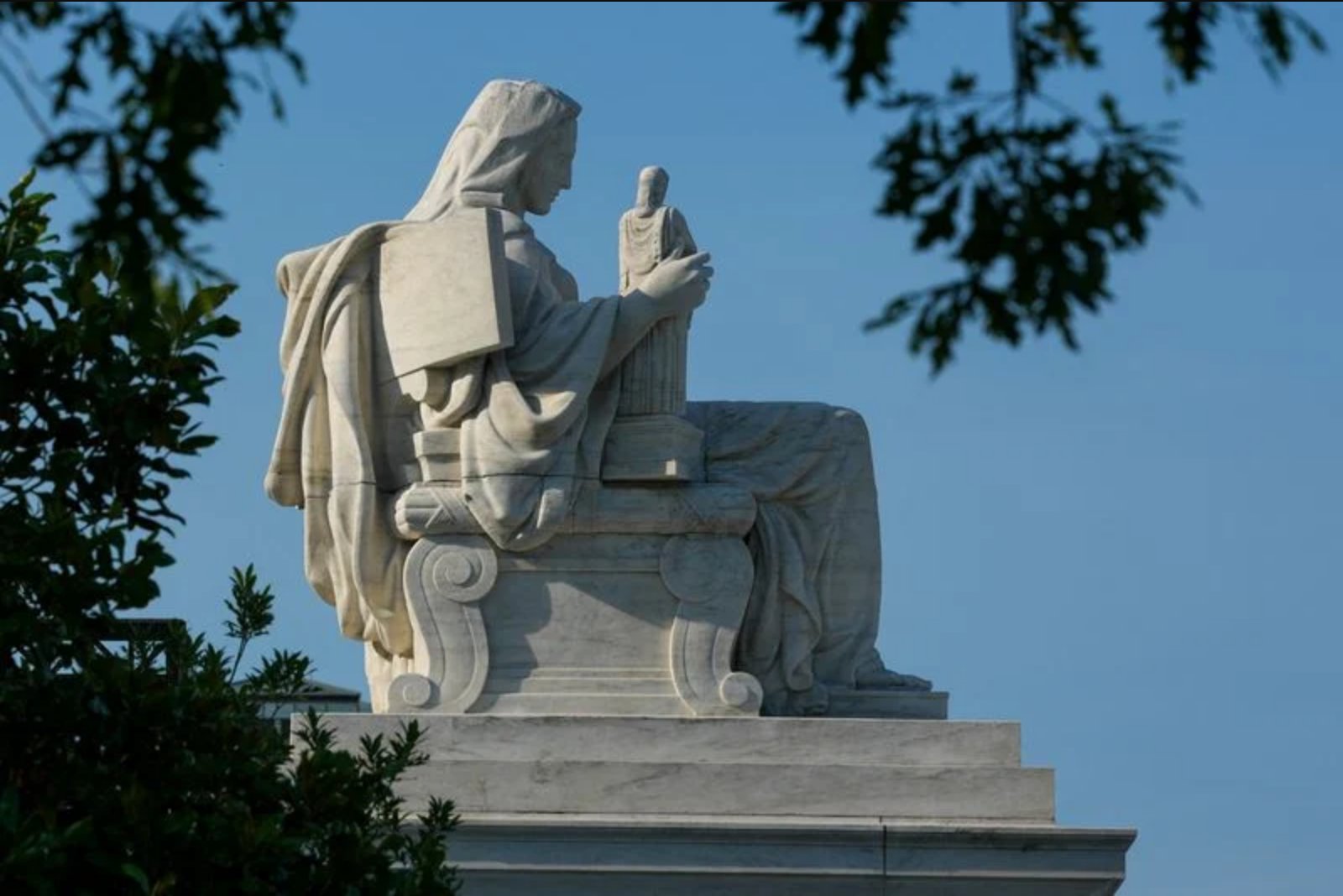
This Supreme Court term - which began in October and runs through roughly the end of June - placed before the justices a wide array of consequential legal questions touching constitutional limits on executive authority, voting and civil rights, immigration policy, gun rights, and the scope of federal regulatory and enforcement powers. The Court considered or decided challenges involving the President's ability to act on trade, personnel decisions at independent agencies, and the reach of federal statutes; it also addressed claims involving the Voting Rights Act, birthright citizenship, asylum and immigration procedures, as well as an assortment of civil and commercial disputes. What follows is a systematic review of the principal cases argued or decided during the term, presented in topic-specific sections.
Voting Rights Act - Section 2
On April 29 the Court issued a decision that significantly narrowed a central provision of the Voting Rights Act, substantially raising the bar for minority communities seeking to challenge electoral maps as racially discriminatory. The ruling blocked an electoral map that would have created a second Black-majority U.S. congressional district in Louisiana and, in doing so, curtailed the effectiveness of Section 2 as a tool to bar electoral maps that dilute minority voting strength.
Section 2, enacted by Congress to prohibit vote dilution rooted in racial discrimination, had become an essential mechanism for minority voters to seek remedies when they alleged that districting plans undermined their electoral influence. The Court's decision - which overturned or set aside the map at issue - was described as a critical weakening of Section 2 and has immediate practical ramifications. By making it more difficult to obtain judicial relief on the grounds that a map diminishes minority voting power, the ruling opened the way for changes to districts in states where Republican leadership controls redistricting, particularly in Southern states where majority-Black and majority-Latino districts have traditionally supported Democratic candidates. The ruling arrives in the run-up to midterm elections and is likely to affect the composition of competitive districts in those jurisdictions.
Birthright Citizenship
The Court devoted substantial scrutiny to a challenge to President Trump’s directive seeking to curtail birthright citizenship. On April 1 the justices expressed skepticism about the legal basis for the administration’s directive, probing both the legal theory and the practical effects of the policy during oral argument.
The White House order directed U.S. agencies not to recognize as citizens children born in the United States when neither parent is a U.S. citizen or a lawful permanent resident. A lower court had blocked the order, concluding that it violated the U.S. Constitution’s 14th Amendment as well as a federal statute that codifies birthright citizenship. The Supreme Court indicated it might be inclined to question the administration’s legal argument and the asserted authority to override the constitutional and statutory framework governing citizenship. At the time of argument the lower court’s injunction remained in place, and the Supreme Court was expected to issue a decision by the end of June.
Trump’s Tariffs and the International Emergency Economic Powers Act (IEEPA)
On February 20 the Court ruled against the Trump administration’s expansive use of tariff authority under a statute enacted decades earlier, handing a major legal setback to the President’s trade policies. In a 6-3 decision the justices affirmed a lower court’s determination that the President overstepped the authority conferred by the International Emergency Economic Powers Act - the IEEPA - when imposing broad tariffs claimed to address national security or other emergencies.
The Court held that the IEEPA did not grant the President the authority to impose the sweeping trade measures at issue. The justices underscored the constitutional design under which Congress, not the President, holds tax and tariff power. The decision undercuts a key legal premise upon which the administration had relied to pursue a broad tariff strategy - a strategy that had global economic reverberations, stirred tensions with trading partners and contributed to market uncertainty.
Firing of a Federal Reserve Governor
The Court addressed an effort by President Trump to remove a Federal Reserve governor, a case that touched on the insulation of the central bank from political interference. During oral argument on January 21 the justices indicated reluctance to permit immediate presidential removal of Governor Lisa Cook while her challenge to the firing is litigated, suggesting skepticism toward the administration’s request to set aside a lower court’s blocking order.
Congress created the Federal Reserve with statutory protections intended to shield the institution from direct political pressure. The Federal Reserve Act includes language that permits governors to be removed by the President "for cause" - a term the statute provides but does not define or describe procedures to enforce. The administration advanced allegations of mortgage fraud as the ground to dismiss the governor, allegations that Governor Cook has denied. Cook has characterized the allegations as a pretext motivated by policy disagreements - specifically, the President’s push for lower interest rates - rather than legitimate misconduct. The Court’s comments at argument signaled it might be unwilling to give the President immediate relief, and a ruling was anticipated by the end of June.
Temporary Protected Status (TPS) for Haitians and Syrians
On June 25 the Court cleared the way for the administration to terminate Temporary Protected Status for hundreds of thousands of immigrants from Haiti and Syria. The justices reversed decisions by federal judges that had barred the administration from ending TPS for more than 350,000 people from Haiti and roughly 6,100 people from Syria.
TPS is a humanitarian designation that allows migrants from countries experiencing war, natural disaster or other extraordinary conditions to live and work in the United States while it remains unsafe for them to return. The State Department continues to advise against travel to both Haiti and Syria because of pervasive violence, crime, terrorism and kidnappings. The Supreme Court’s decision removed earlier judicial obstacles to the administration’s effort to terminate TPS protections for individuals from those two countries.
Federal Trade Commission Firing
The Court confronted a dispute involving presidential authority and the statutory protections accorded to officers of independent regulatory agencies. Arguments heard on December 8 centered on whether the President lawfully exceeded his authority when he sought to remove a sitting member of the Federal Trade Commission before the member's term had expired.
The lower court that initially blocked the President’s action had found the removal unlawful, prompting an appeal. The conservative justices on the Supreme Court signaled receptivity to arguments that longstanding statutory tenure protections for agency officials - protections designed by Congress to limit executive interference - unlawfully encroach on the President’s constitutional authority. The Court at one point permitted the removal to proceed while the litigation continued. The outcome of the case has the potential to diminish a nearly century-old legal regime governing the independence of agencies created by Congress. A decision was expected by the end of June.
Transgender Athletes and State Bans
The justices heard appeals from Idaho and West Virginia on January 13 in cases testing state laws that bar transgender athletes from competing on female sports teams. The justices’ questioning and comments suggested that the conservative majority might be prepared to uphold such state restrictions amid growing national debate over the issues.
Lower courts had sided with transgender students who argued that the bans violated constitutional protections and federal anti-discrimination law. Twenty-five other states have enacted similar measures. During oral argument the conservative justices voiced concern about imposing a uniform national rule in the face of sharp disagreement among states and scientific uncertainty over whether medical interventions - such as puberty blockers or gender-affirming hormones - mitigate physiological advantages that males would otherwise present in athletic competition. The Court’s approach suggested deference to state-level policy choices in this contentious area, and a ruling was expected by the end of June.
LGBT Conversion 'Therapy' and Free Speech
On March 31 the Court struck down a Colorado law that prohibited licensed psychotherapists from practicing so-called conversion therapy aimed at changing the sexual orientation or gender identity of minors. The justices, in an 8-1 decision, sided with a Christian counselor who argued the law impermissibly regulated protected speech.
The counselor, a licensed Christian therapist, had challenged the statute as a violation of the First Amendment. Colorado maintained that the law regulated professional conduct and thus fell outside the scope of protected speech. The Supreme Court disagreed with the state, reversing a lower court decision that had upheld the statute, and held that the prohibition constituted an unconstitutional intrusion on free speech rights. The Court’s ruling invalidated the Colorado restriction and underscored the justices’ posture toward speech-related limits even in the sensitive context of therapeutic practices with minors.
Hawaii Gun Law
In one of several gun-related rulings this term, the Court on June 25 struck down a Hawaii law that limited the carrying of handguns on private property open to the public without the owner’s permission. The justices concluded that the statute violated the Second Amendment right to keep and bear arms, overturning a lower court’s determination that the law was likely consistent with constitutional guarantees.
Under the Hawaii statute, individuals needed a property owner’s express authorization to bring a handgun onto private property that is open to the public - for example, most businesses - a requirement the Court found incompatible with the Second Amendment. The decision continued a pattern of rulings expanding certain gun rights and contracting the latitude of state regulations designed to limit firearm possession in public spaces.
Drug Use, Firearms and the Second Amendment
On June 18 the Court limited the reach of a federal statute that had been interpreted to bar firearms possession by certain drug users. The decision rejected a harder line urged by the administration, which would have imperiled the gun rights of millions of Americans who use marijuana and also own firearms.
The case reached the justices after a lower court dismissed an illegal-possession charge brought against Ali Hemani, an American-Pakistani dual citizen and Texas resident who acknowledged regular marijuana use. The Supreme Court found that the government had not shown that its prosecution of Hemani was consistent with the Second Amendment. By upholding the dismissal, the Court narrowed the circumstances in which a prosecution under the statute can proceed against individuals who use certain substances.
Campaign Finance - Coordinated Party Spending
The Court heard arguments on December 9 in a Republican-led challenge seeking to invalidate federal limits on coordinated expenditures by political parties, a case that involved Vice President JD Vance among the challengers. The dispute tests whether restrictions on party spending made in coordination with candidates violate the First Amendment’s protection of free speech.
Some conservative justices appeared sympathetic to the challenge, while the Court’s liberal bloc seemed inclined to preserve limits on coordinated spending. The immediate legal question concerns whether federal caps on the amount that political parties can spend with candidate input - termed coordinated party expenditures - are a constitutionally permissible restriction on political expression. The case appealed a lower court ruling that had upheld those limits; a decision was expected by the end of June.
Mail-In Ballots and Mississippi’s Five-Day Grace Period
On March 23 conservative justices expressed skepticism about a challenge brought by Republicans to a Mississippi statute that permits a limited grace period for mail-in ballots to be counted after Election Day. Under the Mississippi rule, certain mail-in ballots postmarked on or before Election Day may be counted if they arrive within five business days following the election. A lower court had invalidated the law.
The challenge - supported by the Trump administration - targets the provision that allows late-arriving ballots under narrowly specified circumstances to be included in election results. Absentee voting in Mississippi is restricted to a set of categories, including elderly voters, those with disabilities and individuals living away from home. The Court’s questioning suggested concern about the legal arguments pressing for a uniform rule that could change how mail-in ballots are treated in federal elections; a ruling was anticipated by the end of June.
U.S. Asylum Processing and 'Metering'
The Court issued a ruling on June 25 that endorsed federal authority to refuse processing asylum claims when border crossings are deemed too congested to handle additional claims. The decision reversed a lower court’s finding that the policy - a practice often referred to as "metering" - violated federal law.
The metering approach allowed immigration officials to stop asylum seekers at border entry points and opt not to process their claims, effectively denying them the opportunity to have their cases heard. The Trump administration had used the policy; the Biden administration subsequently abandoned it. The Supreme Court’s ruling, however, left open the prospect that the Trump administration may seek to reinstate metering as part of its immigration enforcement toolkit.
Weedkiller Litigation and Bayer
The Court on June 25 curtailed thousands of lawsuits filed in state courts alleging that Bayer’s Roundup herbicide - and specifically the active ingredient glyphosate - causes cancer and that the company failed to warn users appropriately. The justices overturned a Missouri jury verdict awarding $1.25 million to a plaintiff who said he developed non-Hodgkin lymphoma after long-term exposure to glyphosate, concluding that a federal statute governing pesticides precluded the plaintiff’s state-law failure-to-warn claim.
By siding with Bayer, the Court concluded that the federal regulatory framework for pesticides can preempt certain state-law claims, restricting plaintiffs’ ability to pursue damages in state courts for alleged pesticide-related harms in some circumstances. The decision removed an avenue for many such suits to proceed.
Human Rights Claims Against Corporations - Alien Tort Statute
On June 23 the Court further restricted the scope of a federal law that has been used to pursue corporate liability for alleged human rights abuses abroad. The justices reversed a lower court ruling that had allowed a lawsuit by members of the Falun Gong movement to proceed against Cisco Systems, which alleged the company aided the Chinese government’s surveillance and persecution of the group.
The case originated under the Alien Tort Statute of 1789, which permits non-U.S. citizens to seek remedies in U.S. courts for violations of certain norms of international law. The Supreme Court’s decision significantly narrowed the statute’s applicability in private suits alleging corporate complicity in abuses committed outside the United States.
SEC Disgorgement Power
The Court on June 4 rejected a challenge to the Securities and Exchange Commission’s authority to obtain disgorgement - a financial remedy aimed at recovering ill-gotten gains in enforcement actions. The justices upheld a lower court’s expansive reading of the SEC’s disgorgement power, backing the agency’s use of the remedy to reclaim profits produced by fraud.
The appeal had been brought by a defendant ordered by a California court to repay more than $3 million in gains and interest in connection with a fraud case. The Trump administration supported the SEC’s position in the litigation, and the Supreme Court’s affirmance preserves one of the agency’s principal enforcement tools.
FCC Forfeiture System and Wireless Carriers
In a June 4 ruling the Court rejected challenges mounted by wireless carriers to the Federal Communications Commission’s approach for assessing fines and forfeitures. The justices sided with the FCC and the Trump administration on the legality of the agency’s system for imposing monetary penalties, ruling against AT&T and Verizon in their constitutional challenge.
The carriers had argued that the FCC’s internal procedures deprived them of their constitutional right to a jury trial. The Court’s decision upheld the regulatory agency’s procedure for levying penalties and denied the relief sought by the telecommunications companies.
Compensation Claims From Cuba
The justices on June 23 issued a ruling favorable to U.S. companies seeking compensation from the Cuban government for property seizures dating to the Castro era, siding with ExxonMobil in litigation against a Cuban state-owned firm, Corporación CIMEX. The Court held that a legal defense known as foreign sovereign immunity - which ordinarily shields foreign governments and their agents from U.S. lawsuits - was not available in cases brought under the Helms-Burton Act, a 1996 statute that creates a private right of action in certain contexts.
The decision makes it easier for American corporations to pursue claims for compensation related to property taken by Cuba long ago. In a separate dispute, however, the Court dealt a setback on May 21 to four U.S. cruise-line operators who challenged combined judgments totaling $440 million in litigation by a U.S. company asserting unlawful use of ports and docks in Cuba that it had built and that were later seized.
Geofence Warrants and Cellphone Location Data
On April 27 the Court heard argument over whether law enforcement's use of so-called geofence warrants - orders compelling technology companies to search customer location data for devices that were near a crime scene at a given time - violates the Fourth Amendment's prohibition on unreasonable searches.
The case involved a geofence order served on a third-party company that compelled the search of location data to identify potential suspects who had cellphones near a robbery of a credit union. A defendant who conditionally pleaded guilty reserved the right to challenge the admissibility of evidence derived from the geofence search on constitutional grounds. The Court’s upcoming ruling was expected to address whether the practice of sweeping location data from third parties for investigative leads is consistent with protections against unreasonable searches.
Crisis Pregnancy Centers and Subpoena Dispute
The Court on April 29 revived a federal lawsuit brought by a network of Christian-operated crisis pregnancy centers in New Jersey that is challenging a state attorney general subpoena seeking information about donors and medical providers. First Choice Women’s Resource Centers, which seeks to counsel women against abortion, had seen its federal challenge dismissed by a lower court; the Supreme Court’s action reinstated the lawsuit.
The facilities contend that the subpoena advances an unlawful investigatory intrusion and seek to block the state inquiry. The Court’s decision restored the centers’ ability to pursue federal claims challenging the state’s investigative actions.
Rastafarian Inmate and Religious Rights in Prison
The justices on June 23 declined to permit a Rastafarian inmate to sue individual prison officials after they forcibly removed his hair in violation of his religious practice. The Court affirmed a lower court decision dismissing the claim on the basis that the federal statute invoked did not allow the kind of individual monetary damages action the inmate sought.
The prisoner, Damon Landor, claimed that being held down and shaved bald by guards contravened his religious obligation to grow his hair. The Court rejected his suit under the statute relied upon, concluding that the law did not permit his requested remedy against individual officials.
Death-Row Inmate and Intellectual Disability Determination
On May 21 the Court refused to disturb a judicial finding that a man convicted of a 1997 Alabama murder is intellectually disabled and therefore ineligible for execution. The justices dismissed Alabama officials’ appeal of a lower court’s method for assessing intellectual capacity, which weighed multiple IQ test scores and expert testimony.
The Supreme Court’s action kept in place the lower court’s approach, aligning with a 2002 precedent that executing an intellectually disabled person violates the Eighth Amendment's ban on cruel and unusual punishment.
Jury Selection and Batson Claims
The Court on May 28 sided with a Black death-row inmate in Mississippi who alleged prosecutors used race-based strikes to exclude Black prospective jurors. The justices determined that state courts did not properly evaluate his claim that four Black potential jurors were unlawfully dismissed in violation of the Court’s 1986 Batson v. Kentucky precedent, which bars racial discrimination in jury selection.
The ruling required state courts to revisit the evaluation of the claim, reinforcing the protections against racially motivated juror exclusions in criminal trials.
Sentence Reductions and the First Step Act
The Court on May 28 ruled that judges cannot order the retroactive shortening of sentences under the First Step Act for prisoners who argued they would have received lesser sentences if sentenced under more recent statutory reforms. The justices upheld lower-court rulings denying compassionate release claims by two Pennsylvania men convicted of armed robbery, finding that the law does not permit judges to apply the reduced sentences retroactively in the way the defendants sought.
The ruling affirmed the limitations on courts’ ability to grant relief based on changes in sentencing policy enacted after a prisoner’s sentence was imposed.
Securities Litigation - Investment Company Act
On June 11 the Court sided with a consortium of investment funds affiliated with BlackRock and other managers, reversing a ruling that had allowed a hedge fund to bring suit under the Investment Company Act of 1940. The appellate decision at issue involved a challenge by Saba Capital Master Fund against fund bylaws that limited the voting power of activist shareholders.
The Supreme Court’s reversal protects the funds named in the dispute - including BlackRock-affiliated vehicles, FS Credit Opportunities and other funds such as Adams Diversified Equity Fund, Adams Natural Resources Fund, Royce Global Trust - from the particular private plaintiff claims Saba had attempted to assert under the statutory framework. The Trump administration supported the funds in the appeal.
Cox Communications and Music Copyright Liability
On March 25 the Court unanimously held that Cox Communications could not be held liable in the way the record labels had alleged for the piracy of songs by the ISP’s subscribers. The 9-0 decision overturned a lower court order for a new trial on contributory copyright infringement and brought an end to the billion-dollar-plus lawsuit brought by Sony Music, Warner Music Group, Universal Music Group and other labels.
The labels had argued that Cox was responsible for subscribers’ infringing activity and that a retrial could produce substantial damages - figures cited by the company included potential liability as high as $1.5 billion - but the Supreme Court’s ruling foreclosed the labels’ path to recover under the theory presented in that litigation.
Pharmaceutical Patent Dispute - "Skinny Labels"
In another June 4 decision the Court held that Hikma’s generic version of Amarin Pharma’s cardiovascular drug Vascepa did not infringe Amarin’s patents. The outcome may reduce patent exposure for generic drugmakers that use so-called "skinny labels," a practice by which generic versions are marketed for uses not covered by the brand-name patent.
The justices reversed a lower-court ruling that had favored Amarin. Generic manufacturers argued that a contrary outcome could chill competition by deterring generics from introducing lower-cost alternatives and potentially increasing drug prices in the United States.
Conclusion
This Supreme Court term produced a series of rulings and oral-argument signals that together recalibrate the balance among federal power, presidential authority and individual rights across a broad spectrum of policy areas. The Court narrowed the reach of established federal protections in voting and in certain civil-justice contexts, constrained some state regulatory measures in areas such as firearm restrictions and mental-health regulation, and clarified boundaries in administrative law and international litigation. Several cases left open doctrinal questions or signaled future shifts in the law as litigants and institutions adjust to the Court's interpretations.
As these decisions are implemented by judges, agencies and elected officials, their practical effects will be felt in electoral maps, immigration enforcement, agency governance, commercial litigation, public-safety regulations and beyond. The Court’s rulings during this term will prompt litigation strategies and policy responses across the public and private sectors as stakeholders evaluate legal avenues and regulatory compliance in light of the high court’s guidance.