
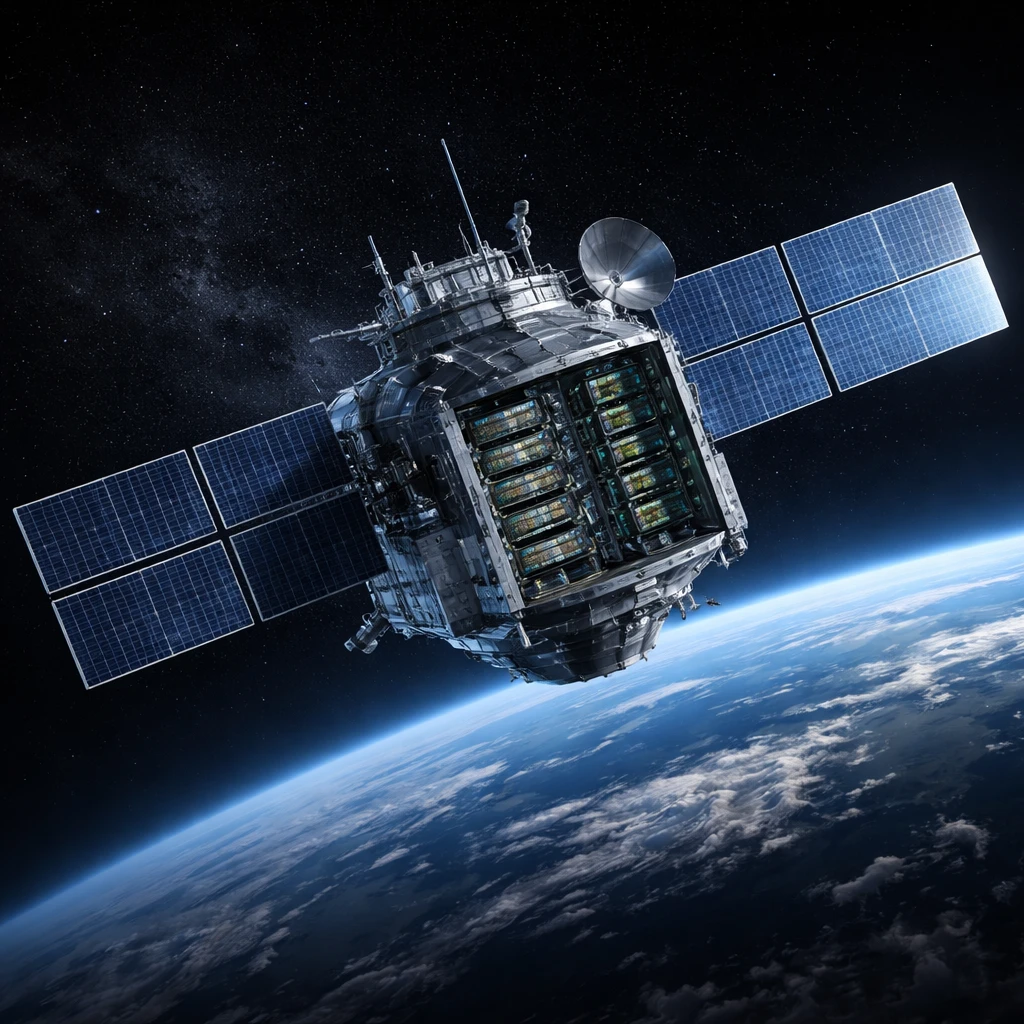
SpaceX has told investors it plans to conduct early demonstrations of orbital AI computing by late 2027, according to people who attended pre-IPO investor briefings. That schedule would advance the timetable implied in the company's IPO filing, which said orbital data-center deployments could begin "as early as 2028."
The demonstrations, described inside meetings led by President Gwynne Shotwell and Chief Financial Officer Bret Johnsen, are framed as demonstrator systems meant to validate the concept and hardware before any broader commercial rollout, the attendees said. Two people with direct knowledge of the briefings recounted the timeline and the presentation details; both were at a Goldman Sachs meeting and one of them attended an additional meeting where the roadmap was discussed.
In regulatory filings, SpaceX asserts it is "the only company with a commercially viable path to building orbital AI compute at scale" and has sought permission to launch up to 1 million satellites intended to serve as space-based data-center nodes. Company executives emphasized the orbital-compute effort as a central element of the long-term growth case presented to potential investors.
Investor outreach and fundraising plans
The presentations by Shotwell and Johnsen were part of the outreach accompanying SpaceX's initial public offering, in which the company has been courting major investment banks to support a proposed $75 billion capital raise as part of an IPO that targets a valuation of $1.75 trillion. SpaceX stock is slated to begin trading on the Nasdaq under the ticker SPCX, with an IPO price targeted at $135 per share.
Presenters delineated a pathway that would begin with demonstrator missions in 2027, with commercial deployments indicated in the IPO filing as possibly starting in 2028. The filing did not explicitly separate demonstration missions from commercial rollouts, and one attendee said management appears to have left room in the filing for potential delays tied to Starship development or satellite manufacturing.
Technical backbone and timeline sensitivities
The orbital AI plan depends on SpaceX's Starship vehicle, a fully reusable rocket intended to enable frequent launches and economies of scale for deploying many satellites. Starship, however, remains behind initial schedules and has not yet shown the rapid reusability that SpaceX says would be necessary to make a large-scale orbital data-center business economically viable.
Commenting on the engineering challenge, one portfolio manager not present at the meetings noted that although Starship and related programs have experienced delays, the orbital data-center problem has definable bounds that could make the task tractable. The portfolio manager observed that other projects have faced open-ended technical hurdles, while orbital data centers may offer clearer engineering targets.
SpaceX's CEO has addressed the engineering aspects publicly, saying that the company already possesses much of the necessary technology within its existing Starlink satellite network. In a video released on Monday, the CEO said the first iteration of an AI satellite would likely use Nvidia chips and that the spacecraft's computing capacity would be comparable to an Nvidia GB300 rack.
Market debut and comment status
SpaceX did not immediately respond to requests for comment about the investor events. The IPO timetable remains on track for a Nasdaq listing this week under the SPCX ticker symbol.
Implications for sectors and investors
The company's push for orbital AI compute positions SpaceX at the intersection of aerospace launch economics, satellite manufacturing, and AI infrastructure. Investors evaluating the IPO will need to weigh the demonstrator timeline, Starship's development progress, and the practicalities of manufacturing and operating large numbers of data-center satellites.