
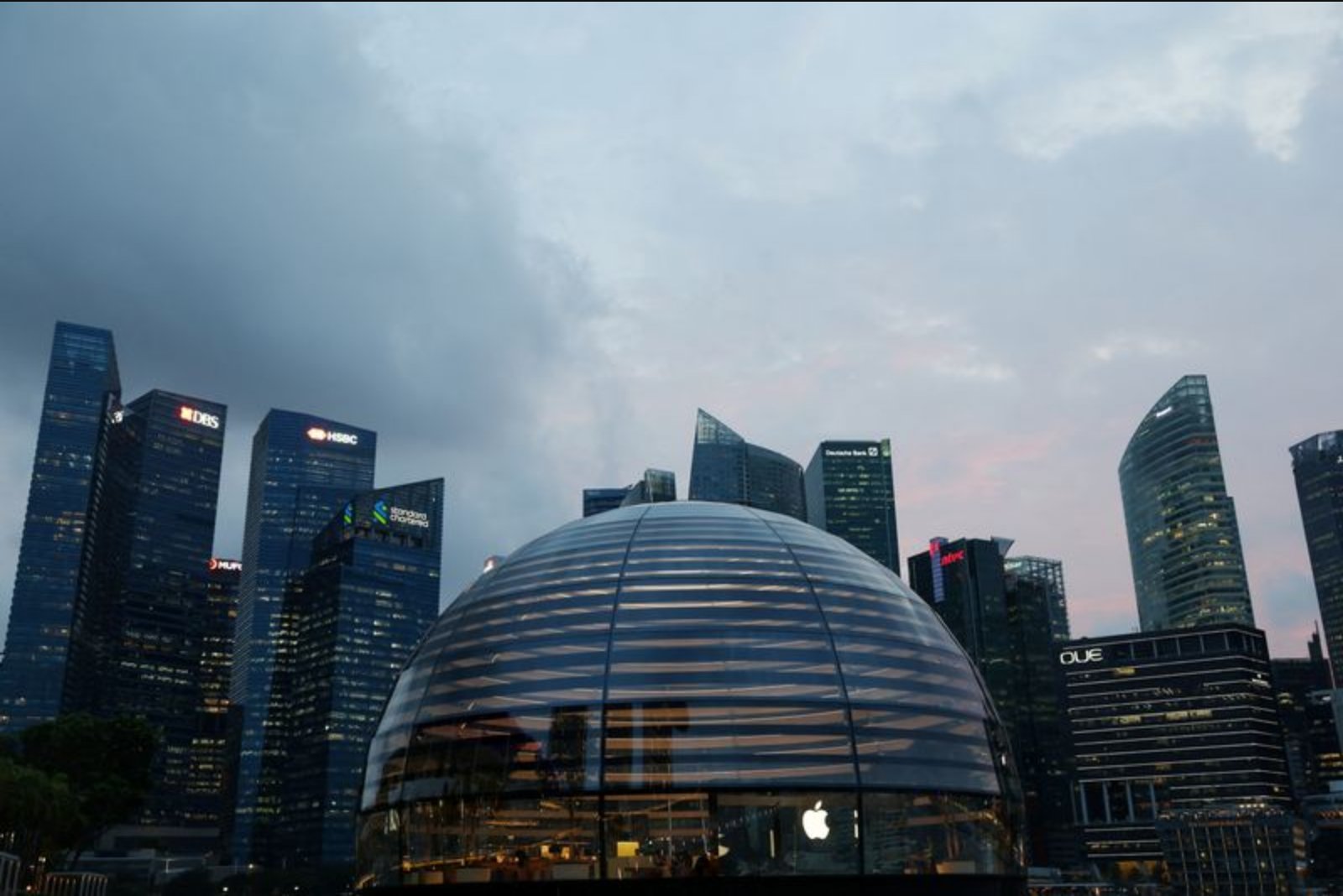
Singapore is increasingly being viewed by artificial intelligence firms as a neutral place to base operations - a location where companies can limit exposure to either U.S. or Chinese government controls while tapping international customers and talent.
Long prized for its pro-business environment and bilingual workforce, the city-state is drawing attention not merely as a bridge between the superpowers but as a zone where firms hope to keep both the U.S. and China at arm's length amid escalating contestation over AI technology, export controls and talent mobility.
"Setting up in Singapore gives a lot of comfort" to overseas clients that a startup's intellectual property resides on the island and thus may be beyond immediate control from either China or the U.S., said Kerry Goh, CEO of Kamet Capital. Goh advised two former Alibaba executives who went on to found AI video company Topview to establish the business in Singapore in part to allay international customers' concerns about Chinese government oversight.
Topview, which Kamet has invested in for more than $8 million since 2024, markets products principally to non-Chinese customers and does not make its product available in China. Goh said operating from Singapore enhances Topview's prospects of selling to buyers in the U.S.
The shifting geopolitical environment has been amplified by high-level U.S. rhetoric and policy. U.S. President Donald Trump brought Sino-U.S. tech rivalry to the forefront during his first term with talk of security risks, leaving technology firms navigating tit-for-tat measures that intensified in his second term alongside the rise of AI. Those measures include tighter export restrictions and other controls that affect how firms develop and deploy advanced technologies.
Compounding those pressures for firms that rely on global talent flows is an overhaul of H-1B visa rules for highly skilled workers in the U.S., which has made bringing or sending engineers to the United States less predictable for many companies.
These dynamics have strengthened Singapore's ambitions to be among the most AI-enabled economies. Initiatives cited by the country's Economic Development Board include a visa designed for AI talent and tax incentives for registering intellectual property locally. The board said its "ecosystem enablers" have drawn investment from companies of various sizes and geographies.
Industry executives and analysts say Singapore is attracting companies from China that want to distance themselves from political perceptions by presenting a more Singaporean footprint, and U.S. firms seeking access to engineers without the complications of U.S. visa processing.
"Singapore is increasingly becoming a neutral hub for AI companies from both the U.S. and China," said Brad Gastwirth, global head of research at Circular Technology.
Local operations or offices in Singapore now include a range of AI-linked companies with connections to either China or the United States: automation platform Workato, wealth management tool developer Addepar, and note-taking device maker Plaud AI, with legal platform Harvey AI also beginning operations in June. Major U.S. AI developer Anthropic - whose $30 billion fundraising round was led by Singapore's sovereign wealth fund GIC - plans to open a Singapore office, according to three people familiar with the matter, joining established names such as OpenAI, Superintelligence Labs from Meta, and DeepMind from Alphabet's Google. Anthropic declined to comment.
At the same time, the superpowers' efforts to secure or limit technology have continued. The U.S. has blocked sales of leading AI chips to China and restricted access to certain chipmaking equipment. Those measures form part of a broader effort to manage the spread of advanced computing capabilities.
China, for its part, has taken steps to limit cross-border movement by some AI personnel. Reports say China imposed a travel ban on the founders of AI startup Manus after the company relocated from China to Singapore and was later acquired by U.S. technology firm Meta. The Washington Post has reported that China told the startup MiroMind not to send talent abroad after it opened offices in Singapore, Japan and the U.S. When contacted about MiroMind, parent company Shanda said only that it develops AI projects across countries. Shanda CEO Chen Tianqiao wrote on LinkedIn that going global presented challenges for AI firms as regulation, geopolitics and public scrutiny change rapidly.
Those actions underscore an emerging tension: policymakers in both the U.S. and China are increasingly focused on keeping technology stacks separate. That has led observers to warn there is a risk Singapore could be viewed as a "grey space" for technology transfers - including the movement of people to new firms - that one or both governments may seek to curb, said political scientist Chong Ja Ian of the National University of Singapore. Such perceptions could prompt restrictions on the city-state.
For Chinese founders, the practicalities of basing a company in Singapore can be exacting. Tan Yinglan, founding managing partner of Insignia Ventures Partners, said the move only works if founders relinquish Chinese passports, avoid employing engineers in China, and ensure their revenue, data and headquarters are kept out of China.
At the operational level, Singapore's visa process has been cited as a competitive advantage. Circular Technology's Gastwirth said the U.S. visa process has grown more unpredictable with lengthier processing, tighter screening and higher fees - all of which complicate workforce planning for startups and mid-sized AI firms that rely on global talent. By contrast, Huang Lin, founder of corporate services provider Link-da, said Singapore's approach to employment passes is "very friendly," with approvals sometimes issued in as little as three days. Link-da has assisted about 50 Chinese AI-related businesses in setting up in Singapore since 2024.
Personal accounts reflect these differences. Indonesian AI engineer Vincent Tatan described Singapore as "very welcoming" after moving there from the U.S., where an application for permanent residency initiated by his employer was later cancelled. "I can fight for it, but is it worth the fight and the wait?" he said.
Singapore's positioning as a neutral operational hub for AI companies points to an evolving strategic calculus for firms weighing issues of intellectual property location, workforce mobility and market access. The city-state's policy levers - including visas tailored to AI talent and incentives for IP registration - are helping it attract a mix of startups and established developers seeking to reduce friction created by tightening U.S. export rules and China's own measures to control talent and technology flows.
Yet observers caution that the same dynamics that make Singapore attractive could, if perceived as facilitating disallowed technology transfers, draw scrutiny or restrictions from either superpower. The balance firms strike between proximity to markets, regulatory certainty and access to engineers will continue to shape decisions about where to locate operations in the coming months and years.