
Summary
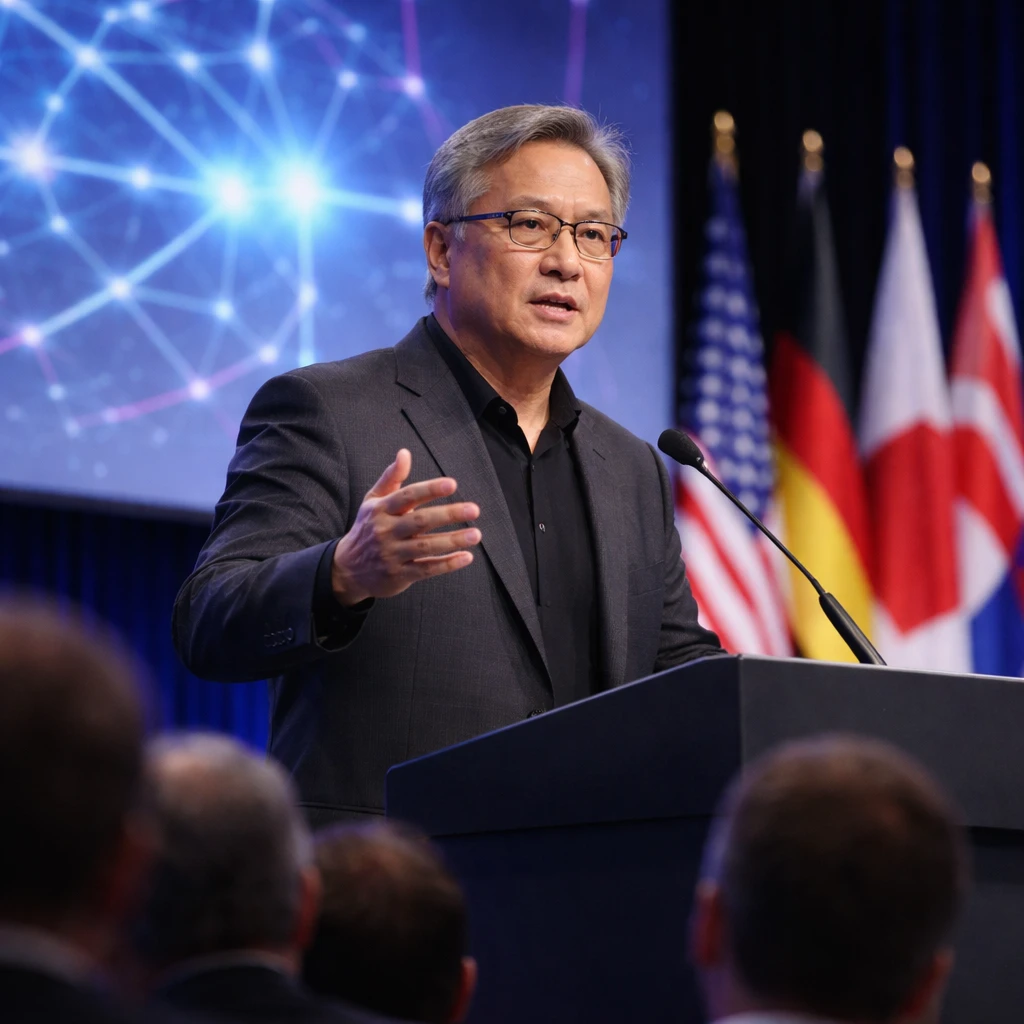
Nvidia's chief executive, Jensen Huang, told attendees at a tech-focused G20 meeting in Chapel Hill, North Carolina, that governments should not craft AI rules that emphasize "theoretical harms." Instead, he said, policymakers should pursue regulations that respond to demonstrable, real-world problems connected to the technology. Huang delivered the remarks alongside U.S. Commerce Secretary Howard Lutnick as other high-profile industry figures, including Anthropic's Tom Brown and OpenAI's Sam Altman, were scheduled to speak later the same day.
Event and key remarks
At the Chapel Hill gathering on Wednesday, Huang argued that regulation should be proportional to the actual risks presented by AI applications rather than hypothetical risks. He specifically criticized focusing on threats that remain theoretical and urged a regulatory emphasis on tangible outcomes tied to the technology.
Huang's intervention came during a sequence of industry testimony that echoed messaging from the Trump administration and other U.S. technology executives who took part in the earlier portion of Tuesday's sessions. Those executives pushed for less regulation globally for fast-growing AI businesses, or for the opportunity to influence rule-writing so regulation would be shaped in ways more favorable to their operations.
Government stance and industry concerns
U.S. officials are seeking to persuade G20 member countries to avoid creating entirely new regulatory regimes for AI. Instead, they advocate for narrowly targeted rules that address novel circumstances involving the technology, according to Michael Kratsios, President Trump's tech adviser, who spoke on Tuesday. The administration's approach aligns with industry leaders who worry that broad federal mandates could impede product development and revenue.
The industry has argued that government requirements could damage profitability if they delay the release of new AI models or force companies to alter how their products function to meet security or compliance requirements. Those objections underpinned the plea by Huang and other executives for regulatory restraint or for rules tailored only to clear, demonstrable threats.
Market snapshot
Market data displayed alongside coverage showed NVIDIA Corporation (NVDA) at 217.44 ▼ -3.34 (-1.51%) Closed and 217.91 ▲ +0.47 (+0.22%) Pre Market · 09:21:04.
Context and appearances
In addition to Huang and U.S. Commerce Secretary Howard Lutnick, the day's agenda listed appearances by Tom Brown of Anthropic and Sam Altman of OpenAI. Those scheduled presentations indicate the meeting's focus on engaging top industry figures as governments discuss regulatory approaches.
What was not stated
The public remarks outlined above did not specify particular regulatory texts, nor did they enumerate precise legal or technical standards to be adopted. The emphasis was on a high-level preference for targeted rules addressing "novel" situations rather than broad new regulatory frameworks. Participants cited concerns about potential impacts on product timelines and company profits if expansive rules were imposed.
Conclusion
Jensen Huang's plea at the G20 tech meeting underscores a coordinated push from parts of the U.S. government and major technology firms for a restrained, situation-specific regulatory approach to AI. Officials and executives alike framed their positions around minimizing disruptions to model development and commercial performance while addressing clear, demonstrable harms from the technology.