
Stock Markets June 3, 2026 11:25 AM

Northrop Grumman Delivers Final Booster Segments for Artemis III Ahead of Summer Stacking

Last eight twin solid rocket motor segments arrive at Kennedy Space Center to join earlier shipments as NASA prepares for Artemis III

By Maya Rios
Share
Twitter Reddit Facebook LinkedIn
NOC

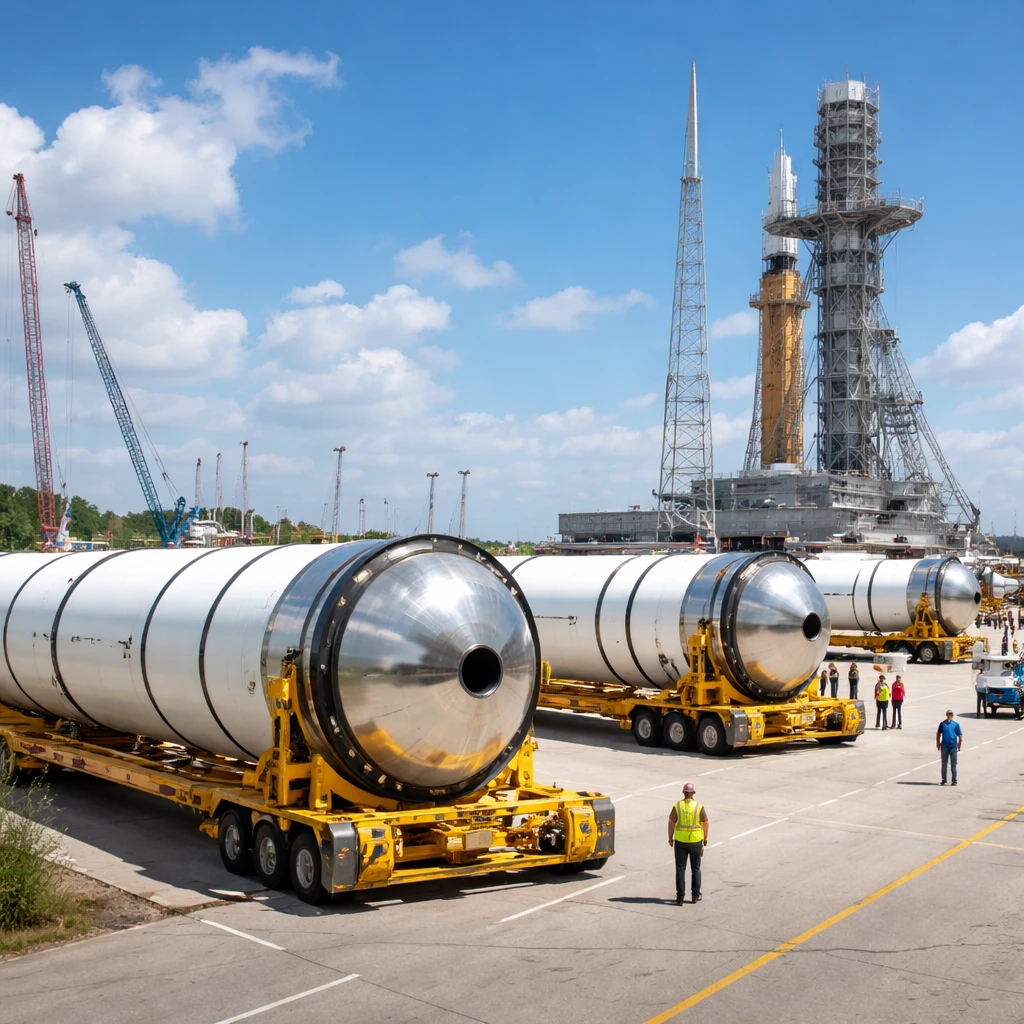
Northrop Grumman has transported the final eight twin solid rocket booster motor segments destined for NASA's Artemis III mission to Kennedy Space Center, where they will be stacked this summer. These segments join parts previously sent in April and complete the booster deliveries for the mission. The company highlights its production capacity as it works to support NASA's planned launch cadence alongside national security and space exploration objectives.

Northrop Grumman Delivers Final Booster Segments for Artemis III Ahead of Summer Stacking
NOC
Summarize with
ChatGPT Perplexity Claude Grok Gemini

Key Points

  • Northrop Grumman shipped the final eight twin solid rocket booster motor segments for Artemis III to Kennedy Space Center; they will be stacked this summer.
  • These segments join parts sent in April and will be the first hardware assembled on the mobile launch platform for the mission.
  • The company's solid rocket boosters produce 7.2 million pounds of thrust at lift-off and are responsible for much of the Space Launch System's lift during Artemis III.
  • Northrop Grumman aims to accelerate solid rocket motor production to meet NASA's increased Artemis launch cadence while supporting national security and space exploration objectives.

Northrop Grumman has shipped the final eight twin solid rocket booster motor segments for NASA's Artemis III mission to Kennedy Space Center in Florida, completing the set of booster hardware destined for that flight. The segments will be stacked on the vehicle at the launch site during the summer months.

These latest deliveries complement booster segments that Northrop Grumman shipped in April. Together, the full complement of segments will form the first hardware to be assembled on the mission's mobile launch platform. The company notes that its solid rocket boosters produce 7.2 million pounds of thrust at lift-off.

The solid rocket boosters are a principal source of thrust for NASA's Space Launch System on Artemis III. That mission will transport astronauts and critical cargo aboard the Orion spacecraft to conduct rendezvous operations in low-Earth orbit with human landing systems, as part of preparations for sustained lunar exploration and eventual missions to Mars.

Northrop Grumman emphasizes it has facilities and a workforce structured to accelerate production of solid rocket motors. The company states its objective is to meet NASA's increased Artemis mission launch cadence while also supporting national security and broader space exploration goals. With this shipment, Northrop Grumman characterizes the booster segments as the final delivery for Artemis III mission hardware.


Operational context

The delivered segments complete the booster hardware package for Artemis III and will be integrated at Kennedy Space Center this summer. The booster segments are intended to provide much of the lift capability required for the Space Launch System during the mission's ascent phase.

Program and production notes

Northrop Grumman has framed the deliveries as part of a broader effort to align production capacity with NASA's increased mission tempo. The company points to its ability to scale solid rocket motor production through its existing facilities and personnel to support both exploration and national security objectives.

Risks

  • Meeting NASA's increased Artemis mission launch cadence is an stated company objective but remains a future target that depends on production and scheduling.
  • Accelerating solid rocket motor production relies on the company's facilities and workforce capacity, which the company says it operates and maintains.
  • The Artemis III mission will test rendezvous operations in low-Earth orbit with human landing systems; those in-orbit operations are scheduled to occur during the mission and their outcomes will be determined during flight.

More from Stock Markets

World Cup’s Corporate Lift Likely Brief; Media Engagement May Outlast In-Person Gains Jun 7, 2026 LATAM CEO Warns of Further Capacity Cuts if High Fuel Costs Continue into 2027 Jun 7, 2026 Citi’s Bear Market Checklist Hits Levels Not Seen Since 2008; 10 of 18 Signals Now Alerting Jun 7, 2026 Embraer Sees Opportunity to Introduce E2 Regional Jets in China Over Time Jun 7, 2026 United CEO Sees Major Merger as Unlikely After American’s Rebuff, Keeps Door Open to Asset Purchases Jun 7, 2026