
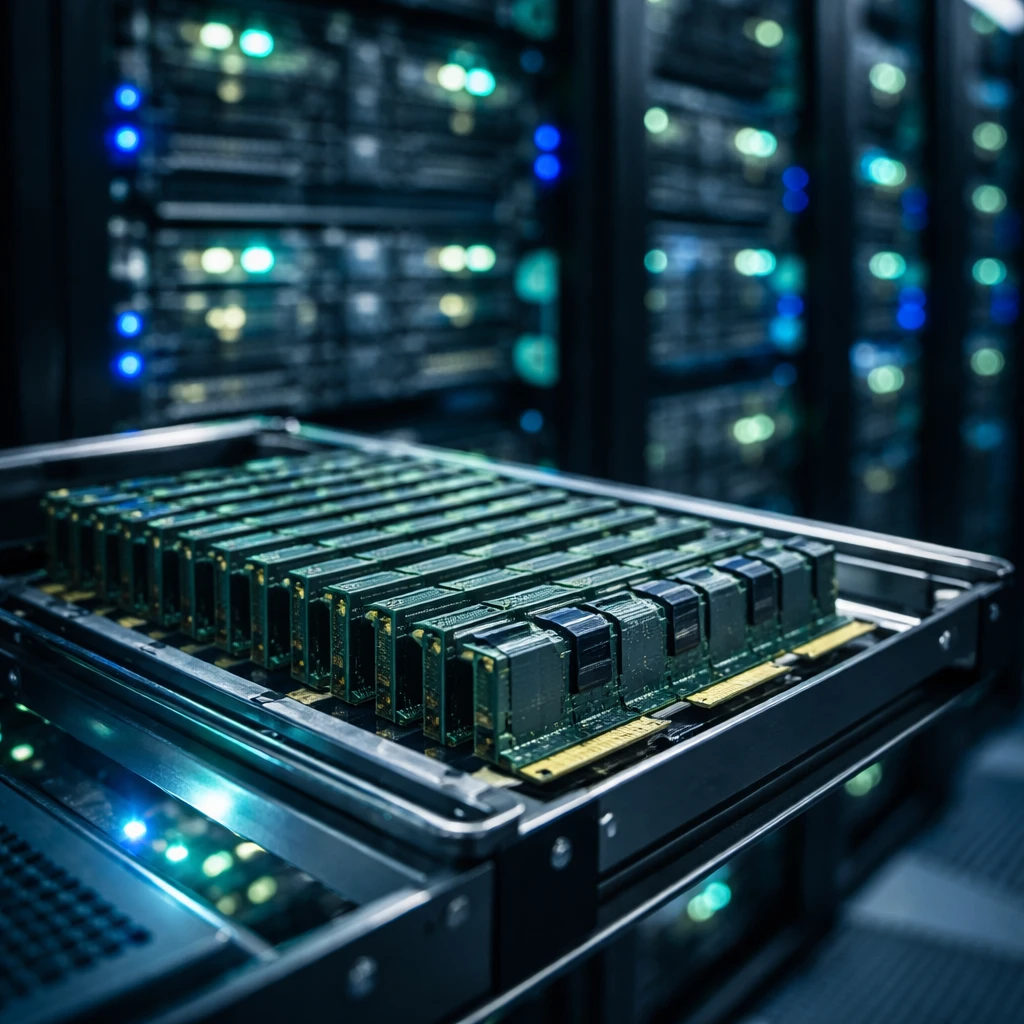
Memory chip pricing has reversed decades of steady decline, increasing more than sixfold over the past year and creating what Morgan Stanley equity analysts describe as a structural supply crisis rather than a cyclical blip.
TrendForce forecasts cited in the Morgan Stanley note put the memory market at roughly $220 billion in 2025 and project it to swell to about $890 billion in 2026. That roughly $670 billion year-over-year increase, the analysts observe, exceeds the standalone addressable market for whole industries such as smartphones, personal computers and servers.
For much of the modern computing era, the cost of a gigabyte of DRAM declined predictably. According to Morgan Stanley analysts Shawn Kim and Joseph Moore, that long-term period of roughly tenfold price declines every five years from 1957 to 2020 has ended.
The note attributes the reversal to demand rather than supply-side oversupply. Artificial intelligence workloads have produced a sudden, price-inelastic jump in demand for memory. The report highlights that supply is slow to react because adding capacity involves a multi-step process - installing new tools, qualifying production processes and ramping yields - that can take around two years.
Market concentration is an important factor. Three DRAM manufacturers control about 90% of DRAM supply and virtually all high-bandwidth memory, known as HBM. Those producers are prioritizing scarce leading-edge wafers toward higher-margin products such as HBM and server DRAM, reducing the share available for consumer markets.
Bit supply is expanding at roughly 30% annually but is constrained by limited extreme ultraviolet lithography tools and wafer capacity. At the same time, revenue in the memory market is rising by approximately fourfold. "Almost the entire spend surge is therefore price, not volume," the analysts said.
Global DRAM wafer capacity is expected to grow by about 30% by 2027, yet the industry focus on AI applications means consumer segments may remain undersupplied. Morgan Stanley’s projections suggest PC DRAM could be about 15% short of demand by 2027, equal to around 58 million units, while smartphone DRAM may face a 12% deficit, roughly 134 million units.
HBM, which is central to AI server performance, consumes substantially more wafer capacity per usable bit than conventional DRAM. The note states HBM uses three to four times the wafer capacity per usable bit and that its share of leading-edge memory wafer capacity could rise from about 6% in 2023 to 34% by 2028.
The analysts quantify the pricing pressure required to maintain gross margins if cost increases were passed through directly. Average selling prices would need to climb roughly 34% for smartphones, 67% for PCs, 83% for servers and 14% for storage products to offset higher memory costs alone. They add that a 67% rise in PC average selling prices would be the largest such increase on record, surpassing pandemic-era price moves by a factor of eight to nine.
But the broker notes that manufacturers, retailers and OEMs do not typically pass the full cost through to end consumers. "Nobody passes all of this through, which is why it surfaces instead as margin pressure, spec cuts and delayed launches," the note said.
Memory cost increases are not fully captured in headline consumer price indexes because memory is an intermediate input embedded in capital goods and services. The report points out electronic components have increased about 30% year-on-year in producer prices, according to the analysts.
Finally, the analysts describe the emergence of a two-tier market. Large cloud providers and hyperscalers are securing capacity through long-term agreements and prepayments, locking in supply, while other purchasers compete for a smaller and more volatile residual pool of memory.
Implications for markets: The note highlights how allocation decisions and capacity constraints tied to AI demand are altering the dynamics between enterprise and consumer segments, with consequences for product availability, corporate margins and the structure of supplier agreements.