
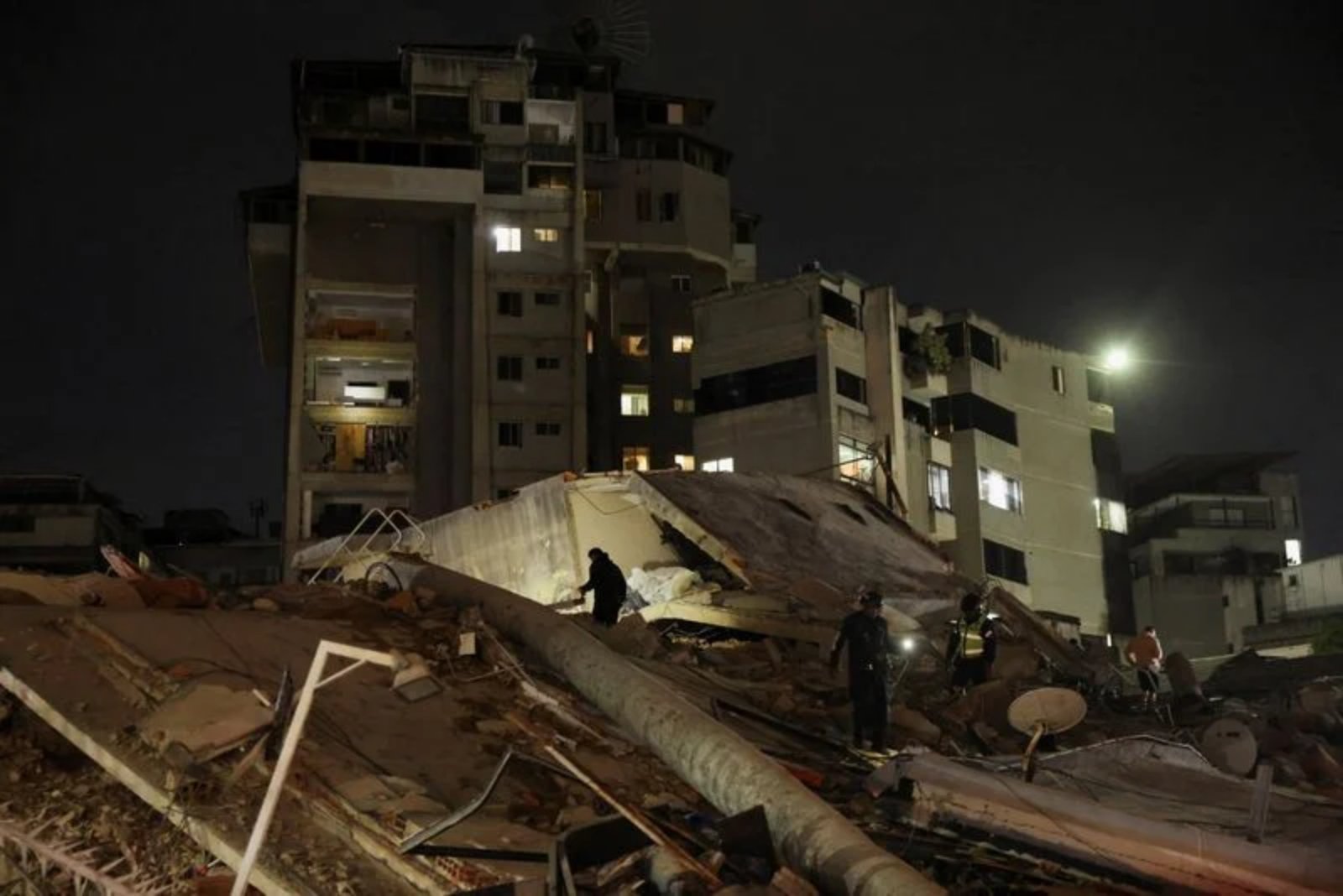
Two major earthquakes struck near Venezuela's capital in the afternoon of a public holiday, collapsing buildings and sending residents running into the streets as rescue teams worked into the night to find survivors.
The U.S. Geological Survey reported an initial magnitude 7.2 quake roughly 160 km (100 miles) west of Caracas, followed less than a minute later by a magnitude 7.5 tremor. Venezuelan authorities confirmed at least 32 fatalities and about 700 injuries, while emergency crews and distraught relatives searched through rubble for those believed trapped beneath collapsed structures.
Interim President Delcy Rodriguez said the early casualty figures did not yet include victims from La Guaira state - one of the worst-hit areas that is also home to Caracas' main airport, which was closed. "Dozens of buildings have collapsed, and we are currently carrying out very intense rescue efforts to save as many lives as God allows us to save," she said on state television just before 1 a.m. local time (0500 GMT) on Thursday.
Scenes from Caracas showed rescuers climbing over debris as night fell and taking several survivors away, some on stretchers. One nearby resident, Maria Alejandra, described the scene as "like a horror movie," saying she had to climb over rubble with others and that only one family emerged from a neighbor building.
Aftershocks continued to rattle the region into the early hours, complicating rescue operations. Authorities and outside observers warned that the danger had not yet passed.
Casualty estimates and missing-persons reports
Beyond the confirmed deaths and injuries, the U.S. Geological Survey used predictive modelling to estimate that the eventual death toll would most likely reach into the thousands, with a substantial probability of exceeding 10,000. Shortly after 2 a.m. local time (0600 GMT), a website created to track missing people and shared on X by opposition leaders listed more than 6,600 people as unaccounted for.
Many Venezuelans were at home when the quakes struck, increasing the likelihood that residences suffered significant damage. "There was a very loud crash. Things fell in the house, jugs inside the refrigerator. I’ve never experienced anything like it," said Coro Martinez, 56, who lives in eastern Caracas.
Government and international responses
Interim President Rodriguez said the country was focused on rescue efforts and expected to receive international rescue crews in the coming hours. She publicly thanked foreign leaders who had offered support, including U.S. President Donald Trump. In a social media post, Trump said the U.S. was "ready, willing and able to help" and described the quakes as "both massive in scale" and causing a "devastating number of deaths." The article notes Mr. Trump had previously ordered the capture of President Nicolas Maduro in a raid in January.
The United Nations' human rights mission in Venezuela urged the government to lift local restrictions on social media, calling it "a matter of life and death." The appeal reflected concerns that limits on online communications could impede search-and-rescue coordination. In some areas access to social platforms had already become available.
Eyewitness accounts and immediate fallout
Video and accounts captured the impact at Maiquetia Airport in La Guaira, where masonry and clouds of dust were seen falling. Former lawmaker Wilmer Azuaje recorded footage as the quake hit the airport and said the situation was "serious." A tsunami warning was issued and later canceled once the danger had passed.
Residents across Caracas described chaotic evacuations as buildings shook. "As soon as it started, we began hearing people screaming," said Astrid Ramirez, a 41-year-old publicist in western Caracas. Maria Romero, an 80-year-old pensioner in southern Caracas, said police assisted her evacuation and described the quake as "horrible, even worse than the one in 1967." Another resident, a 41-year-old office worker who declined to be named, reported receiving an earthquake alert on her phone seconds before the shaking intensified.
Leaders from countries including El Salvador, the Dominican Republic, Brazil and Spain offered support and sympathy. The U.S. State Department said it was in contact with Venezuelan authorities and mobilizing assistance.
Hospitals, infrastructure and relief efforts
At Caracas' Hospital de Clínicas, staff were asked to double up on the night shift to treat the injured. Classes were canceled for the remainder of the week while authorities assessed damage. The Venezuelan Red Cross reported its headquarters had been critically damaged but said it had already dispatched rescue teams to hardest-hit areas, while warning of the risks from strong aftershocks.
France said its embassy in Caracas had sustained heavy damage.
Despite widespread structural impacts, Venezuela's oil infrastructure did not appear to be immediately affected. Civil protection authorities in Maracaibo - near the oil hub of Lake Maracaibo - reported no injuries. A worker at the El Palito refinery near Morón, close to the earthquakes' epicenter, said there had been no damage there. UK oil firm Shell said all its employees were accounted for with no injuries.
The article notes one source warned that an extended power loss could affect crude output levels, though it does not provide further detail. Venezuela’s oil ministry, state-run oil company PDVSA and its main foreign partner, Chevron, did not immediately reply to requests for comment.
Historical context and ongoing dangers
Venezuela sits in a seismically active zone where the Caribbean Plate meets the South American Plate. The U.S. Geological Survey estimates that an earlier powerful quake in 1812 killed around 30,000 people in Mérida and Caracas, an event referenced in the reporting.
With aftershocks continuing and rescue operations ongoing, authorities and aid groups face urgent challenges in locating survivors, treating the injured and restoring critical services. The constraint on social media access raised by U.N. observers underscores the challenge of coordinating a large-scale response under disrupted communications.
What officials have said
Interim President Rodriguez: "Dozens of buildings have collapsed, and we are currently carrying out very intense rescue efforts to save as many lives as God allows us to save."
U.S. President Donald Trump (via social media): The U.S. is "ready, willing and able to help" and described the loss of life as "devastating."
The situation remains fluid. Rescue teams and emergency services continue to prioritize search-and-rescue operations amid ongoing aftershocks, damaged infrastructure and intermittent communications in some areas. Authorities are working to assess the full scale of human and material loss while accepting international aid offers.