
Overview
Several right-leaning contenders in Brazil’s upcoming general election have prominently embraced the template used by El Salvador’s government to combat gang violence, signaling a campaign push to make public safety a central electoral issue. Those pledges center on expanding prison capacity and adopting stringent anti-crime measures similar to actions taken under Salvadoran President Nayib Bukele.
Visits to El Salvador and the CECOT model
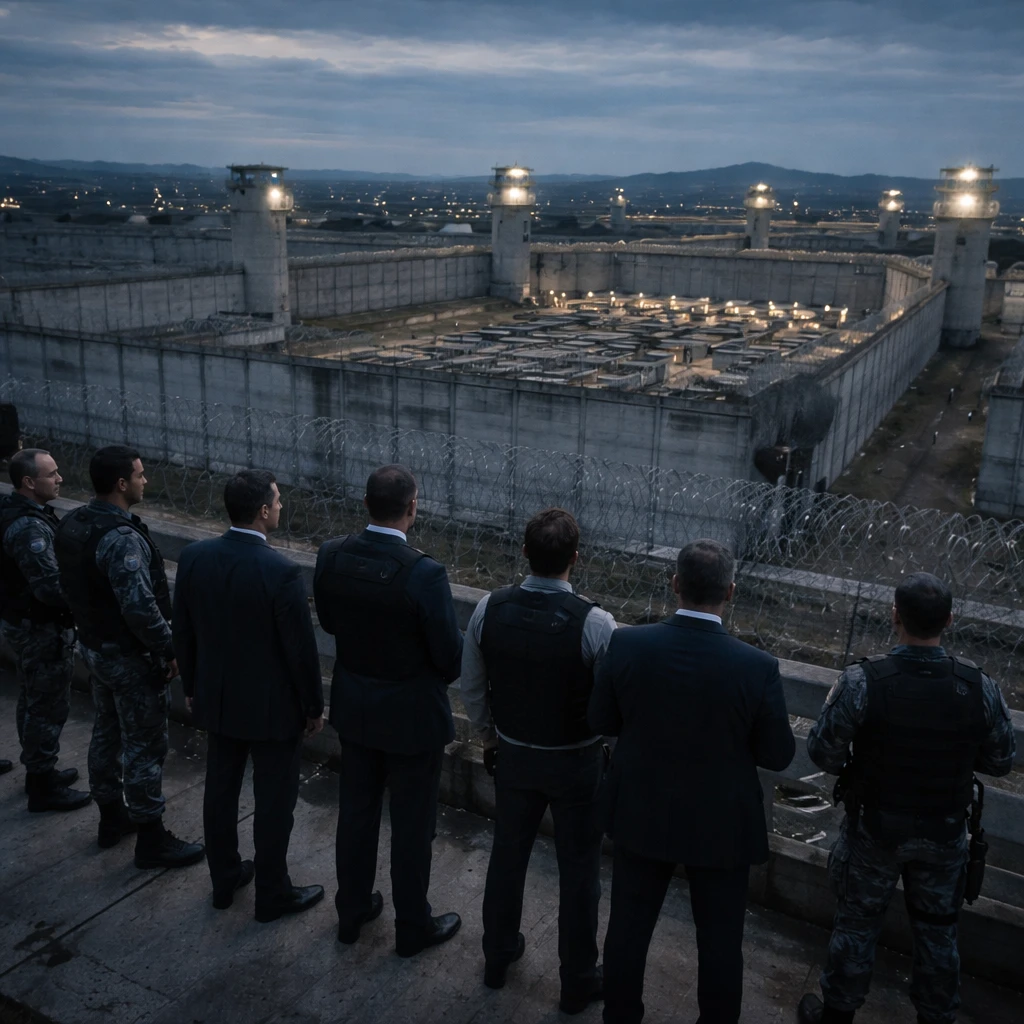
Senator Flavio Bolsonaro, Congressman Nikolas Ferreira and former Governor Romeu Zema have visited El Salvador, where some of them toured the CECOT prison complex, which holds 40,000 inmates. The visits have been used to bolster support for proposals that emulate that prison-centered, security-focused approach.
Flavio Bolsonaro, who leads in polls among conservative presidential hopefuls, unveiled a public safety plan that includes the construction of "five new maximum-security prisons along the lines of El Salvador’s model." At a public event he said: "More prisons, fewer criminals on the loose," echoing a tough-on-crime message that has featured prominently in his family’s political brand.
Last year Flavio Bolsonaro and his brother Eduardo met with El Salvador’s security minister, and Ferreira has also held meetings in El Salvador. These engagements illustrate growing admiration among Brazil’s conservative leadership for Bukele’s strategy.
Support and endorsements within Brazil
Romeu Zema described El Salvador’s tactic as "pragmatic," telling reporters: "In El Salvador ... criminals stay locked up. Here in Brazil, criminals walk free." São Paulo Governor Tarcisio de Freitas has likewise pointed to Bukele’s record as offering potential lessons for Brazil, arguing at a public event that the country must begin confronting crime "with the harshness it deserves." These comments reflect a convergence among key conservative figures in favor of hardline security policies.
What Bukele’s approach entails
Bukele’s anti-crime campaign has relied on an extended state of emergency, widespread arrests, security operations backed by the military and the use of the CECOT mega-prison. Salvadoran authorities credit the package of measures with a historic decline in homicides and with reducing gang control. Critics and human rights organizations, however, say the crackdown has come at the cost of curtailed civil liberties, including limits on constitutional rights, press freedom and judicial independence. Human rights groups have accused Salvadoran officials of arbitrary detentions and torture; the Salvadoran government denies those allegations and says extraordinary measures were required to dismantle gangs.
Regional ripple effects
The Bukele model has attracted attention across Latin America. Costa Rica hosted Bukele in January for the inauguration of a prison built with Salvadoran support and patterned on the CECOT design. The new Costa Rican president, Laura Fernandez, took office last month and pledged a "heavy-handed war against organized crime." In Colombia, President-elect Abelardo de la Espriella campaigned on a plan for 10 new mega-prisons, a platform that drew media comparisons to Bukele that he rejected. In Peru, the presumptive President-elect Keiko Fujimori ran on a platform calling for a "frontal war" on crime, including tougher anti-terrorism laws and expanded military roles in security operations.
Analysts’ views and cautions
Observers say the electoral appeal of decisive security measures is understandable in countries where voters face persistent insecurity and declining trust in institutions. Robert Muggah, co-founder of the Igarape Institute, wrote this month in a defense policy journal that voters confronting chronic insecurity are rewarding leaders who promise firm control, while cautioning that "heavy-handed strategies carry well-known risks when they are poorly designed and politically rewarded."
Experts warn the risks may be acute in Brazil. The country’s experience shows mass incarceration has not necessarily contained organized crime; two of Brazil’s largest criminal groups, the First Capital Command and Red Command, evolved from prison gangs into national and transnational drug-trafficking organizations. Brazil also has one of the world’s largest prison populations, which the University of London’s World Prison Brief reports nearly quadrupled between 2000 and 2024 to about 909,000 inmates, straining facilities that operate far beyond capacity.
"Brazil is far more complex than El Salvador, and it would be very difficult to implement something like that here," said Rafael Alcadipani, a public security expert and professor at Getulio Vargas Foundation. That assessment underscores the questions about whether a direct replication of Bukele’s methods would deliver the same outcomes in Brazil’s larger and more decentralized security environment.
Implications for the election
As crime becomes a central campaign issue, candidates advocating for the Bukele model are seeking to channel voter frustration into political support by promising visible, immediate measures: new prisons, sharpened policing and more assertive security postures. Whether those promises reshape the electorate remains to be seen, but the strategy aligns Brazil with a regional trend in which security-centric platforms have helped propel candidates to office.
Conclusion
Brazil’s conservative contenders are advancing a public safety narrative modeled on El Salvador’s hardline approach, combining prison expansion and tighter enforcement proposals with high-profile visits to Salvadoran facilities. While the approach has clear political resonance across several Latin American countries, analysts highlight both human rights concerns and structural obstacles in Brazil that complicate attempts to replicate Bukele’s model at scale.