
Stock Markets June 3, 2026 08:29 AM

Lockheed Demonstrates Container-Launched Missile Intercepting Attack Drone

Successful test highlights portable, lower-cost counter-drone option built from commercial components

By Marcus Reed
Share
Twitter Reddit Facebook LinkedIn
LMT LDOS

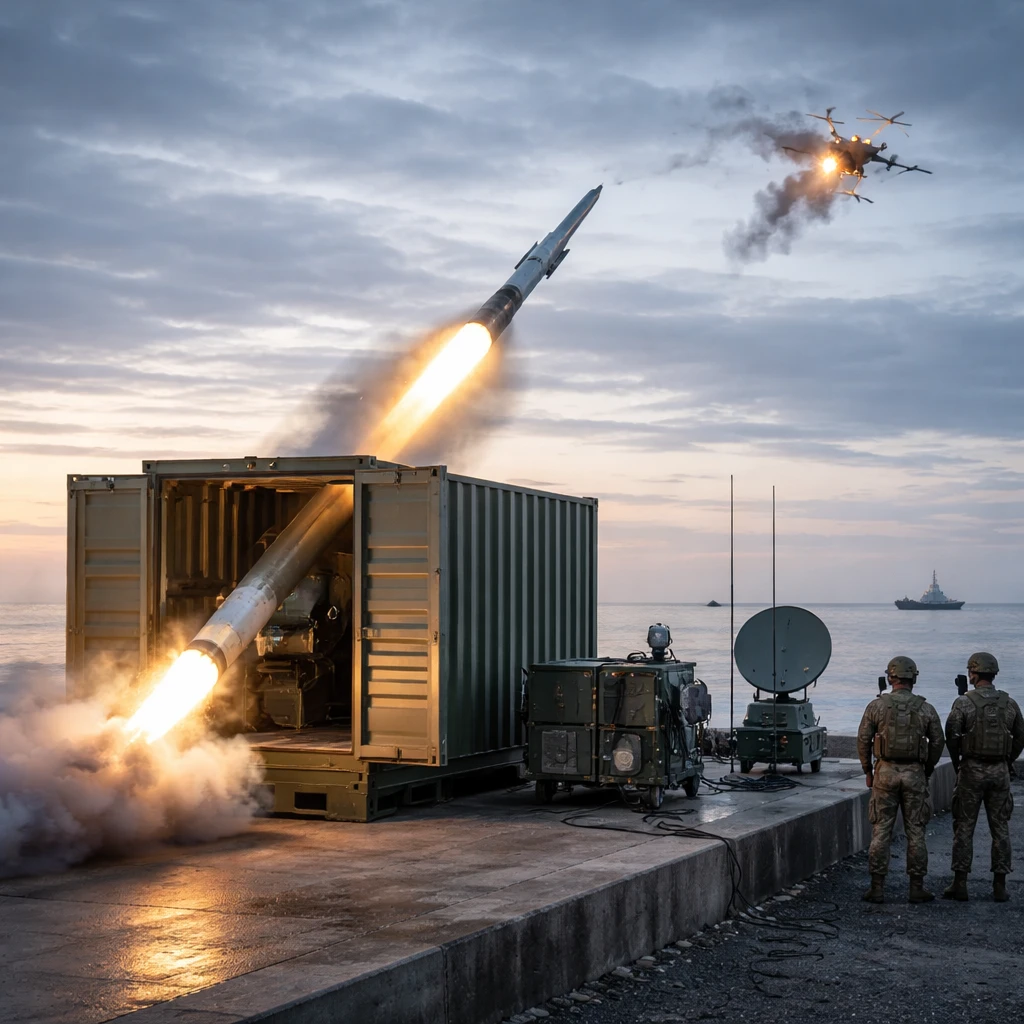
On June 3, Lockheed Martin reported a successful test in which a missile fired from a standard shipping container intercepted a one-way attack drone. The demonstration used a 10-foot GRIZZLY containerized launcher built from commercial off-the-shelf materials, integrated sensors and radar from partner firms, and showcased a mobile, lower-cost approach to counter-unmanned aerial system defenses. The Pentagon has supported containerized weapons concepts as a flexible, cost-conscious defense capability, and a related procurement framework aims to buy 10,000 missiles beginning in 2027.

Lockheed Demonstrates Container-Launched Missile Intercepting Attack Drone
LMT LDOS
Summarize with
ChatGPT Perplexity Claude Grok Gemini

Key Points

  • Lockheed Martin successfully launched a missile from a 10-foot GRIZZLY containerized launcher and intercepted a one-way attack drone.
  • The launcher uses commercial off-the-shelf materials, is mountable on ground or maritime platforms, and can carry up to eight munitions, reducing logistics footprint and acquisition cost.
  • The Pentagon has signed a framework agreement with four other firms including Leidos to field the Low-Cost Containerized Missiles program, which targets procurement of 10,000 missiles over three years beginning in 2027.

June 3 - Lockheed Martin said on Wednesday that it successfully launched a missile from a shipping container and intercepted a one-way attack drone, illustrating a lower-cost approach to countering small unmanned aerial threats.

The test employed a compact system identified as the GRIZZLY containerized launcher. The launcher is built into a 10-foot shipping container and is designed to use commercial off-the-shelf materials, an approach Lockheed says shrinks the logistics footprint and reduces acquisition expense.

How the system works

  • The joint-air-to-ground missile was fired from the GRIZZLY launcher, which occupies a standard 10-foot container space.
  • The target in the test was a one-way attack drone, an unmanned aircraft intended to strike by impacting a target.
  • The containerized launcher can be installed on land sites or on maritime platforms, and it has the capacity to hold up to eight munitions, enabling a relatively high rate of fire from a compact package.
  • Lockheed highlighted use of commercial off-the-shelf components in the launcher, a design choice intended to cut both the logistical burden and procurement cost.

Sensors, software and tracking

During the missile test, the system employed sensors and software from the Sanctum Counter-Unmanned Aerial System, which Lockheed noted was developed jointly with Microsoft. Tracking and engagement also involved R-40 radars produced by Utah-based Fortem Technologies.

Procurement context

The Pentagon has historically supported containerized weapons systems deployed from standard shipping containers as a mobile and cost-efficient defense option. In May, the Defense Department signed a framework agreement with four additional defense contractors, including Leidos, to move forward with the Low-Cost Containerized Missiles program. That initiative aims to procure 10,000 missiles over a three-year span, with purchases scheduled to begin in 2027.


Implications for logistics and defense procurement

The demonstration underscores a device-level emphasis on mobility and reduced logistics demands through use of off-the-shelf parts and a standard container form factor. The ability to mount the launcher on either ground sites or maritime platforms signals flexibility in deployment options without requiring bespoke transport or launch infrastructure.

Risks

  • The procurement timetable and delivery schedule remain subject to implementation risk, with formal purchases slated to start in 2027, creating uncertainty for program execution and supplier planning.
  • Meeting the program's numerical target of 10,000 missiles across three years could present production and supply-chain challenges for contractors and suppliers involved.
  • The program relies on specific sensor and radar suppliers, including the Sanctum system jointly developed with Microsoft and Fortem Technologies' R-40 radars, which introduces supplier dependency risk for tracking and engagement capabilities.

More from Stock Markets

Moscow trading ends with mixed moves; MOEX index holds steady at six-month low Jun 7, 2026 World Cup’s Corporate Lift Likely Brief; Media Engagement May Outlast In-Person Gains Jun 7, 2026 LATAM CEO Warns of Further Capacity Cuts if High Fuel Costs Continue into 2027 Jun 7, 2026 Citi’s Bear Market Checklist Hits Levels Not Seen Since 2008; 10 of 18 Signals Now Alerting Jun 7, 2026 Embraer Sees Opportunity to Introduce E2 Regional Jets in China Over Time Jun 7, 2026