
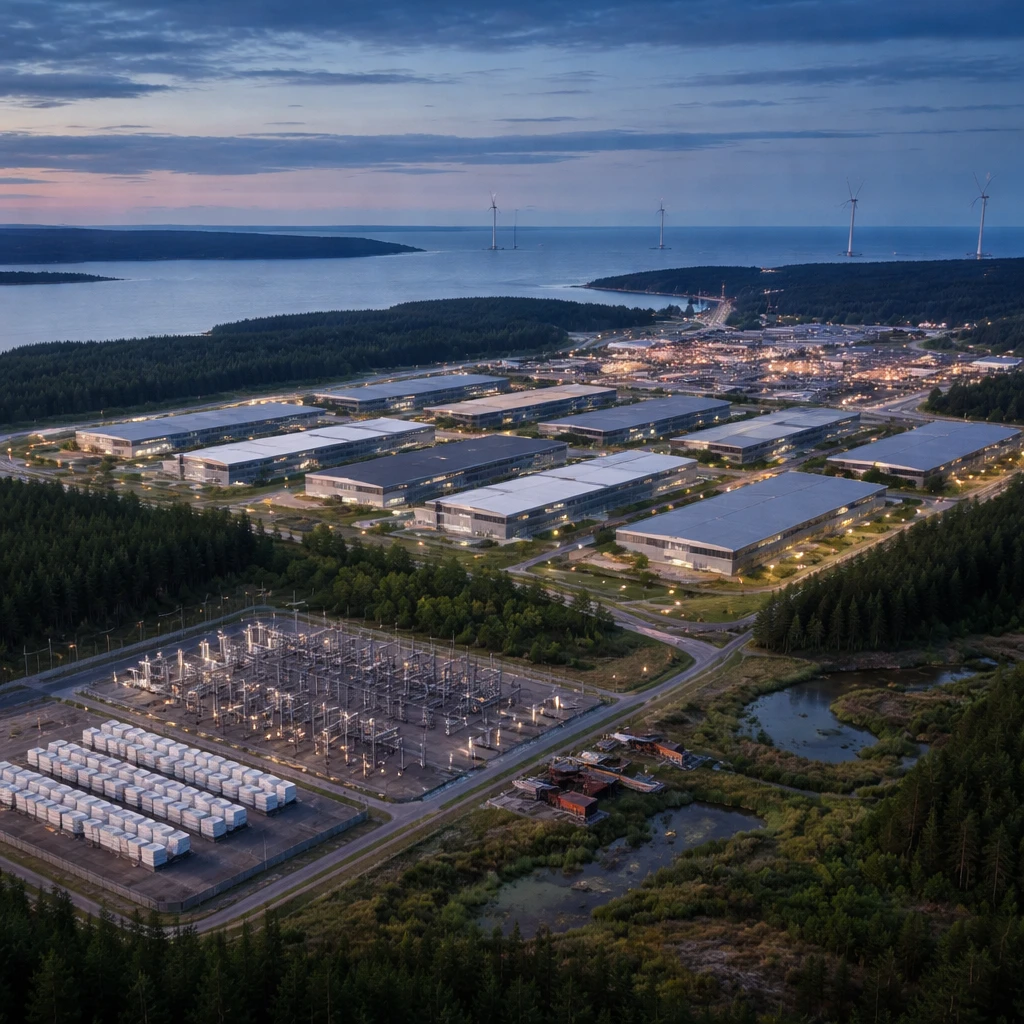
Google announced plans to deploy at least €13 billion in digital infrastructure in Finland over the two-year period of 2027-2028, its largest single investment in Europe to date. The program covers data center expansion and associated infrastructure at sites in Hamina, Kajaani, Muhos and Vaala.
The company said the investment builds on an existing Finnish presence that began with the 2009 acquisition and conversion of a former paper mill in Hamina into a data center. Google noted that between 2023 and 2025 Hamina operations engaged more than 600 Finnish suppliers across construction, operations and network infrastructure, naming DNA, Elisa and Nokia among those participants.
Google provided estimates for the near-term economic impact tied to construction activity. During the initial construction window in 2027-2028, the project is expected to add an annual average of €3.6 billion to Finland's gross domestic product and to support more than 37,000 jobs across the country. Of those jobs, roughly 16,000 are projected to be in construction, generating an average annual labor income of €911 million across that sector. After commissioning, Google expects the facilities to sustain about 7,000 jobs each year, with average wages approximately 24% higher than Finland's median wage.
The new infrastructure will supply capacity for Google services including Gemini, Search, Maps and YouTube. Google highlighted that its Hamina site forms part of a global network of 43 cloud regions, which it said enables Finnish organizations such as Nokia, Elisa and the City of Hamina to run services and develop AI-enabled applications.
To secure the necessary power and grid flexibility for the expansion, Google disclosed several energy partnerships. The company signed a 22-year life extension power purchase agreement with Fortum intended to support the Loviisa nuclear power plant. Google said Loviisa currently supplies 10% of Finland's electricity and employs about 580 people, and that without the lifetime extension investment program the plant could not continue operating beyond 2030.
Google also reported a memorandum of understanding with Fortum to explore collaboration on new flexibility capacity and additional power generation. Separately, the company executed onshore wind power purchase agreements with Valorem and Suomen Hyötytuuli, which together bring the total new-to-the-grid onshore wind capacity supported by Google to 629 megawatts.
Complementing renewable generation, Google said a 94 megawatt battery system will be connected to Finland's grid near its Kajaani site and is expected to be operational in late 2027. The company additionally named partnerships with Fingrid and Business Finland to identify sites for infrastructure and grid-friendly interconnections.
Google outlined community and workforce commitments tied to the buildout. It will invest €31 million over four years across Hamina, Kajaani, Muhos and Vaala to back local initiatives aimed at education and economic growth, and earmarked €10 million of that amount for research and innovation. The initiative will also support municipal energy projects that provide solar and heat-pump installations to low-income households and carry out energy-efficiency renovations in public buildings.
On skills development, Google said more than 4,400 workers will receive AI training through Google.org's AI Opportunity Fund. The company will also launch a workforce development program in partnership with EKAMI to train up to 100 local Finnish students over a one-year period for careers in data center work.
Environmental measures included in the announcement focus on ecological restoration of former forestry lands adjacent to the data center sites. Google indicated the work will prioritize regeneration of native forests and include peatland and wetland conservation activities.
The company framed the plan as a comprehensive package that combines capital investment, energy procurement and grid planning, workforce development and local community and environmental programs. Google did not provide additional detail on project phasing beyond the 2027-2028 construction window or on further financial structuring of the commitments.
Key details at a glance
- Planned investment: at least €13 billion in Finland over 2027-2028.
- Sites: Hamina, Kajaani, Muhos and Vaala.
- Estimated near-term GDP impact: average €3.6 billion annually during construction phase.
- Employment: more than 37,000 jobs supported during construction phase; about 7,000 jobs when operational.
- Energy arrangements: 22-year PPA with Fortum supporting Loviisa nuclear plant; onshore wind PPAs totaling 629 MW new-to-grid; 94 MW battery near Kajaani expected late 2027.