
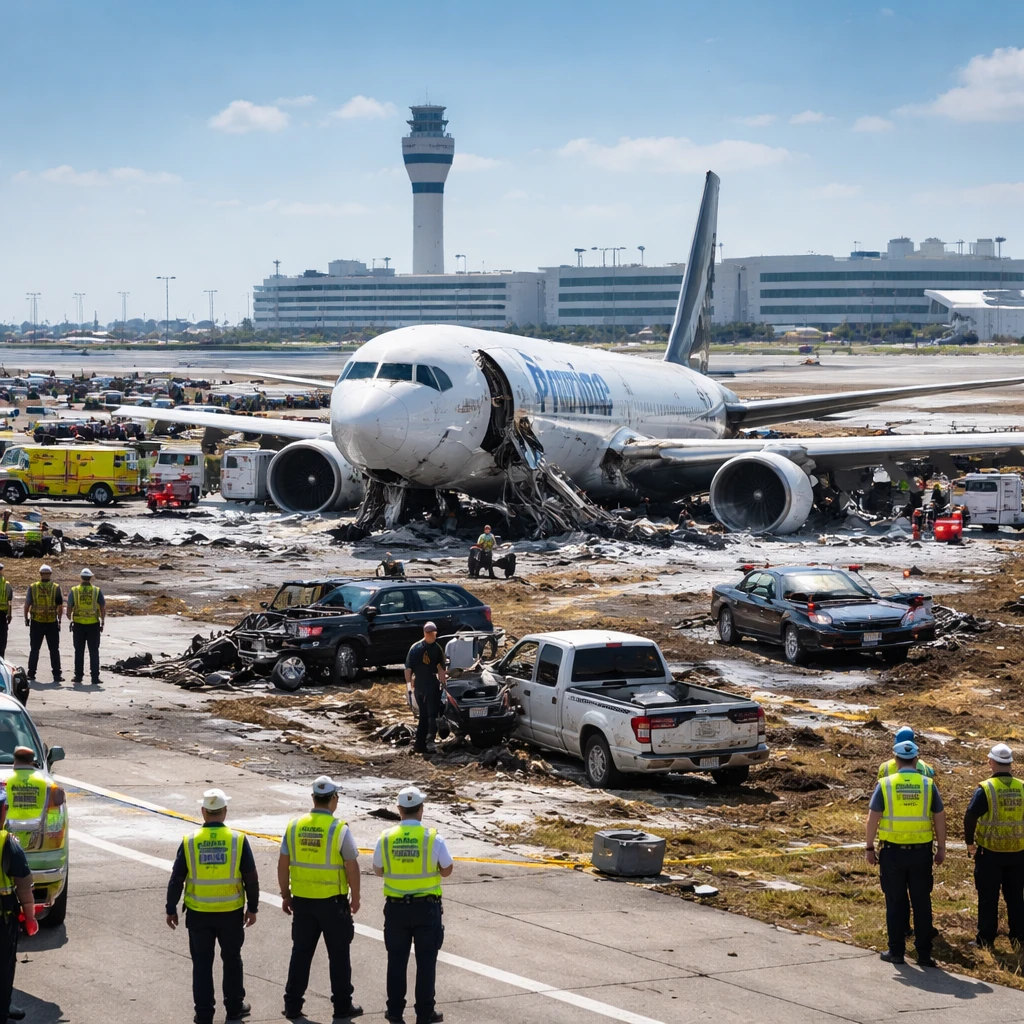
Investigators with the National Transportation Safety Board (NTSB) said Tuesday that data from the flight data recorder shows the pilots of an Amazon Prime Air cargo aircraft moved to abort the landing after the plane had already touched down, a late maneuver that preceded a deadly runway overrun.
The aircraft, a 32-year-old Boeing 767 operated for Amazon by Miami-based 21 Air, left the runway by an estimated 1,300 feet and collided with two vehicles on Sunday. The impact killed five people and injured five others, authorities said.
NTSB Chair Jennifer Homendy said the agency plans to interview both crewmembers on Wednesday and will then publish information recovered from the cockpit voice recorder. Homendy is leading a team of 32 investigators who are working at Miami International Airport.
According to the NTSB account, the flight data recorder captured touchdown events and subsequent control inputs. The nose landing gear and the right main landing gear contacted the runway with the airplane moving at 158 knots, 30 seconds before the recording ended. The left main landing gear touched down later, at 134 knots, 19 seconds before the end of the recording.
Shortly after touchdown, the data show the brakes were released and the throttles were advanced to power settings consistent with a go-around. The NTSB described this as a late attempt to abort the landing and climb back into the air.
That effort did not persist. Eleven seconds before the recording ended the throttles were reduced to idle and the brakes were reapplied. The final recorded ground speed was 65 knots at the end of the file.
The recorded parameters did not indicate deployment of speed brakes or thrust reversers, systems commonly used to decelerate an aircraft after touchdown, the NTSB said.
Homendy also said the NTSB had reopened one of two runways that had been closed after the accident, allowing departures on an easterly heading late Tuesday as investigators continued work at the scene.
The Amazon-operated freighter had been on its third flight of the day when it crashed. It arrived from San Juan, Puerto Rico, having earlier flown from Cincinnati to Miami and then from Miami to San Juan on Sunday. The crash occurred at 1:53 p.m. EDT.
Details on the flight crew included their ages and recent training milestones. The captain, 55 years old, earned his Boeing 767 type rating in May and logged 7,145 flight hours. The first officer, 37, received his 767 type rating in April 2025 and had 2,655 hours of flight time.
Context and next steps
The NTSB continues to analyze recorded flight parameters and impressions from the cockpit voice recorder, with the latter to be released after interviews with the two pilots. Investigators are focused on the sequence of touchdown, braking and throttle movements that led to the runway excursion and subsequent collision with the two vehicles.
Authorities have not released additional information on the injured or deceased beyond the casualty counts, and the NTSB did not indicate any deployment of systems that would normally assist in slowing the aircraft after landing.