
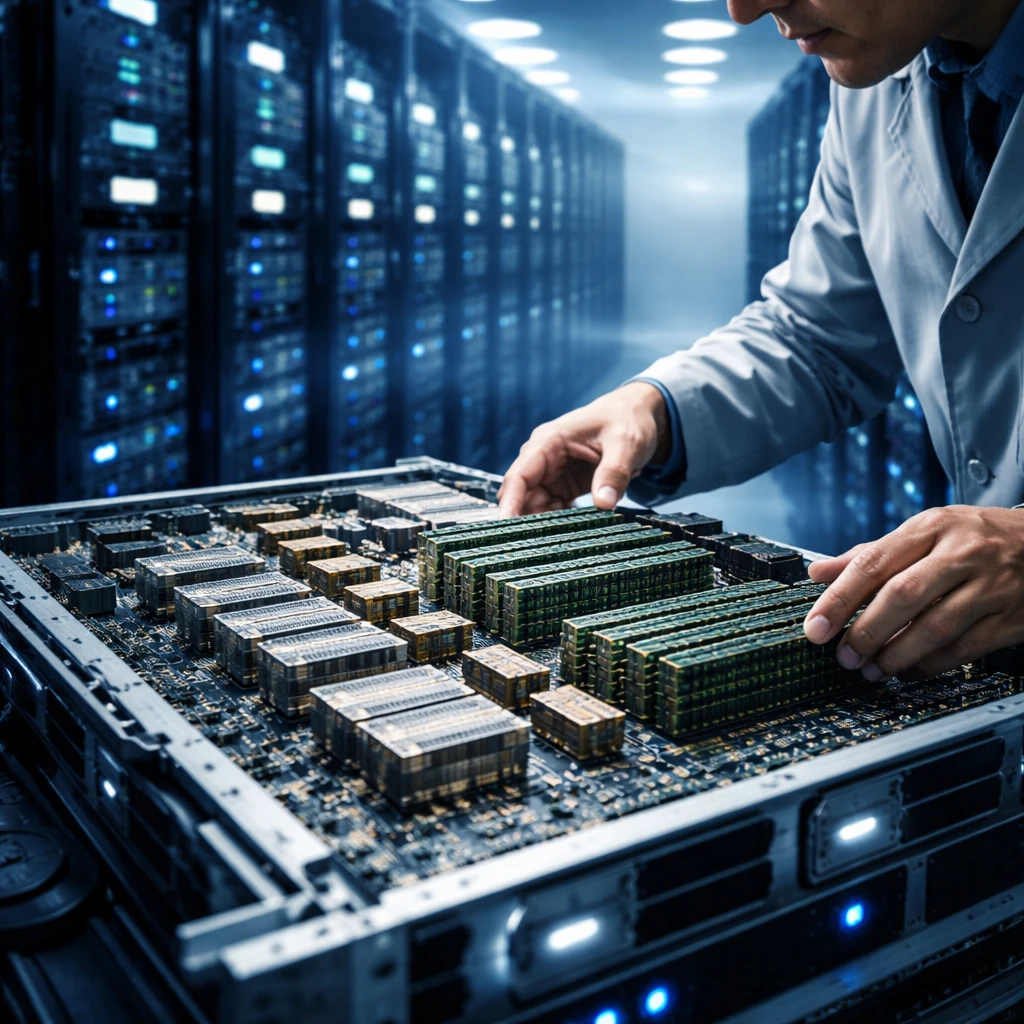
Investment flows into artificial intelligence workloads are changing how market participants view the semiconductors that support data-intensive compute, according to a Mizuho technology, media and telecom analyst. The analyst argues that memory - and DRAM in particular - is set to benefit materially from the shift, creating buying opportunities among several memory-focused companies.
"I could not be more bullish on DRAM and Memory overall off this Ai CPU acceleration narrative/chase," the analyst said, reflecting a view that rising AI-related CPU deployments will drive sustained memory consumption.
Industry indicators cited by the analyst point to tightening supply conditions for memory products. Supply is running short relative to demand, and the analyst expects no material new supply until the second half of 2027. That imbalance is a key reason he anticipates upward pressure on prices for DRAM and related memory types.
High bandwidth memory - HBM - which is a specialized DRAM used in AI accelerators, is singled out for its role in the AI stack. The analyst notes a 3-1 trade ratio for HBM, underscoring the multiplier effect between processors and the memory that supports them.
"You cannot operate a cpu without ram memory. Do not forget that fact. They go hand in hand. So a lot more server (or even client CPUs) means a lot more DRAM over time," the analyst added.
On valuations in the NAND and broader memory space, the analyst contrasts a group of memory names with several CPU and platform companies. He describes Micron Technology (MU), Samsung (005930), SK Hynix (000660) and SanDisk Corp (SNDK) as noticeably cheaper when compared with Advanced Micro Devices (AMD), Arm Holdings (ARM) and Intel Corp (INTC).
Micron is characterized as particularly inexpensive, trading at roughly 3-4 times buyside earnings per share, a valuation the analyst labels "crazy cheap." SanDisk is noted as "still feels good" heading into its earnings report, with rising solid-state drive demand creating the possibility that management could guide to $25-30 per quarter in EPS with gross margins above 80 percent, the analyst said. He also suggested SanDisk could remain an acquisition target even after a strong year-to-date rally, though he qualified that by saying many hedge funds and active managers may not be overweight or long the stock because of its trading volume risk.
Investor focus on CPU and GPU dynamics was reinforced by commentary from Intel's conference call, according to the analyst. Intel management emphasized that agentic AI applications - systems that autonomously plan and execute tasks - require a much higher CPU attach rate to GPU than other AI workloads. The analyst said attach ratios could move from roughly 1:8 to between 1:2 and even 1:1 for these workloads, increasing the role of CPUs to manage and orchestrate tasks where security and planning are important.
Within this competitive backdrop, the analyst sees AMD as well positioned because of its mix of CPU, FPGA and GPU offerings and because it is less capacity constrained than Intel, owing in part to its use of TSM. He also projects that Nvidia (NVDA) will sell a meaningful number of ARM-based CPUs for certain new AI workloads.
Taken together, the analyst's view ties a macro demand trend - expanded CPU use in select AI applications - to company-level opportunities among memory suppliers, with specific valuation and supply considerations driving his recommendations.