
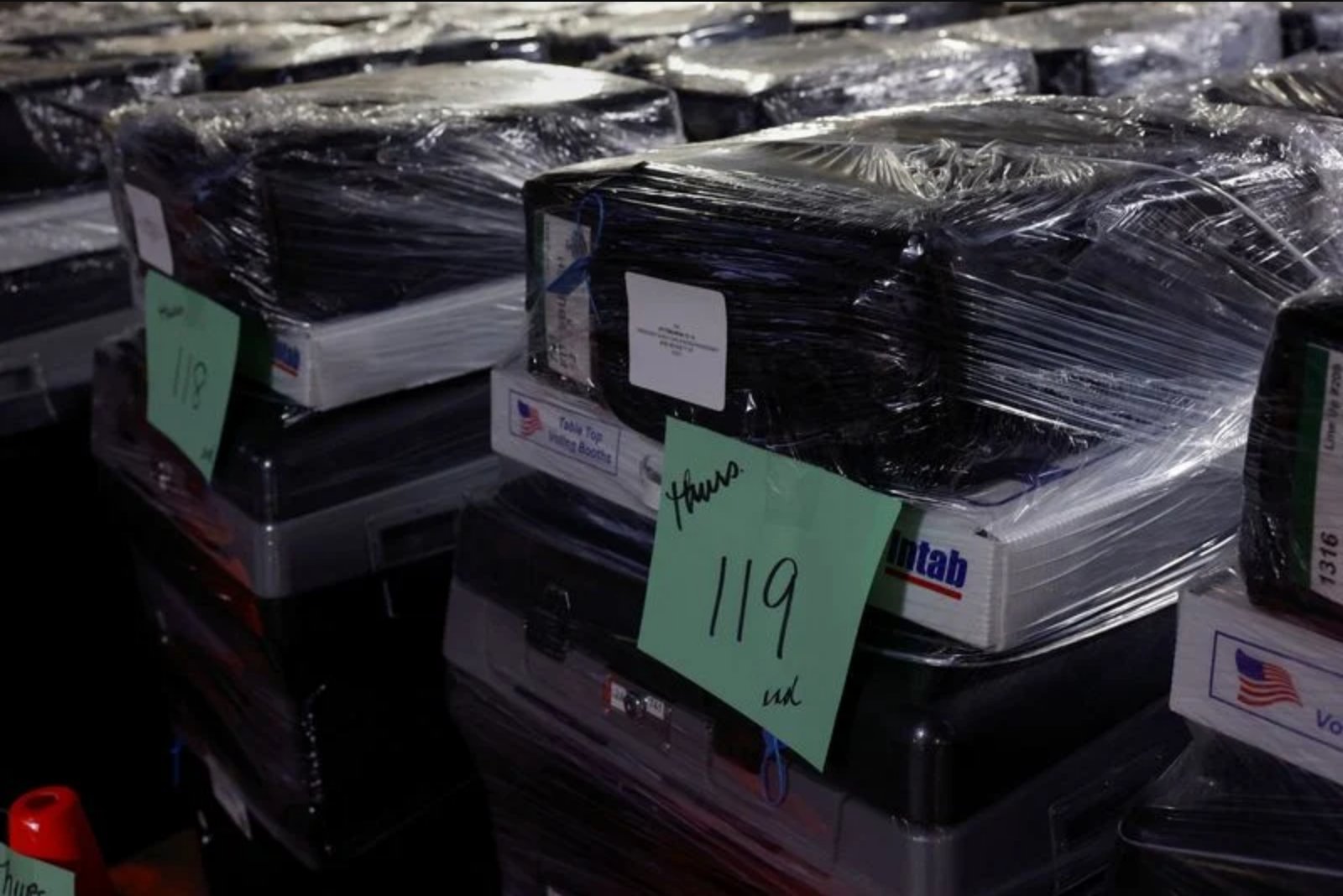
White House officials have delayed the public release of a U.S. government intelligence assessment that documents what it describes as significant vulnerabilities in the nation’s voting machines, according to three sources familiar with the matter. The document, prepared by the Office of the Director of National Intelligence (ODNI), outlines ways the machines could be made more secure, including by updating software, but has not been authorized for publication.
The ODNI assessment does not assert that vulnerabilities have led to votes being altered, the sources said. Instead, it examines security gaps tied to how voting machines are used in U.S. elections and identifies technical weaknesses that could be exploited in theory, such as outdated operating software and the capacity of some machines to connect to the internet.
Internal debate inside the White House has shaped the decision not to publish the report, according to the three sources. Some officials contend that releasing the findings now could harm voter confidence, particularly among Republican voters. Others within the administration argue the report does not substantiate claims that the 2020 presidential election was stolen and therefore does not go far enough to support those assertions.
Several Democrats, speaking privately, expressed concern that investigations into voting machine security could be leveraged by the administration to press states to adopt paper ballots. The mismatch between federal interest in machine vulnerabilities and states’ constitutional authority over election administration has been a recurring theme in internal discussions about how to proceed.
The sources, who were granted anonymity to describe internal deliberations, said ODNI Director Tulsi Gabbard launched the probe into voting machines in part while searching for evidence to support claims of fraud in the 2020 election. Gabbard is stepping down on Friday, and federal housing regulator Bill Pulte will assume the role of interim director. It is not clear what Pulte intends to do with the unreleased ODNI report. Two sources said he has been briefed on the agency’s investigatory work, including the withheld assessment.
President Donald Trump has publicly expressed his desire for Pulte to investigate what he has described as "rigged elections" during his tenure at ODNI. Democrats and some analysts have warned that the administration’s actions could amount to interference in the November midterms, a set of races that analysts expect could result in losses for Republican candidates.
Officials within ODNI and outside experts who advised the agency told White House officials in meetings late last year that remediation of the identified vulnerabilities would require a substantial, coordinated effort with state authorities, and that work should begin promptly to be completed ahead of the midterm elections. Those efforts would involve extensive cooperation with state and local election officials, according to the sources.
When asked about the delay in publishing the report, White House spokesperson Davis Ingle said the administration continues to offer assistance to state and local election officials through agencies such as the FBI and the Cybersecurity and Infrastructure Security Agency, or CISA, to protect the security and integrity of voting machines used in American elections.
ODNI spokesperson Olivia Coleman said that Director Gabbard "has taken actions within her authorities" to support the President’s directive to secure elections, including identifying vulnerabilities in critical infrastructure. Pulte did not respond to a request for comment.
Some of the specific vulnerabilities cited in the ODNI report were already known to previous administrations, one former senior Biden administration official and two of the other sources said. Those include machines operating on out-of-date software and hardware setups that permit network connectivity.
All of the sources interviewed for this story said they were unaware of any evidence demonstrating that votes in U.S. elections have been manipulated. The report compiles findings from both open-source and classified intelligence and, if published, would be the first public document detailing the current administration’s investigative work on voting machines.
The withheld ODNI assessment is one of two reports the agency commissioned on voting machine weaknesses. The other report was produced last year by government contractor Mojave Research and examined machines that had been seized from Puerto Rico. That contractor report also remains unpublished. Two other sources said the Mojave Research report found no evidence the machines had been hacked.
Both the ODNI report and the Mojave Research study have been discussed in White House meetings where officials weighed whether the evidence was sufficient to support claims that the 2020 election had been stolen. The Mojave Research contract was terminated in October, sources said.
According to the sources, the Mojave Research report identified software and coding vulnerabilities and recommended an emergency remediation plan that would have required states to update software immediately. Two sources said that recommendation has not been implemented.
ODNI has briefed the White House on its findings over the past six months but has not received authorization to make the ODNI assessment public, two of the sources said. The report notes that many states continue to use outdated voting systems. It also drew on prior analysis from CISA, which had cited demonstrations at hacking conferences showing that some machines could be compromised via insecure hardware.
CISA has publicly stated it found no evidence that a foreign adversary interfered in the 2020 election and joined other federal, state and local officials in declaring that election the most secure in American history. Senior officials at the FBI and the Department of Justice have also publicly discussed probes into potential voter fraud in various parts of the country.
Beyond the reports themselves, the broader initiative to examine potential vulnerabilities in U.S. elections intensified after President Trump signed an executive order in February 2025 that aims to increase federal involvement in election security. Under the U.S. Constitution, however, the responsibility for how elections are conducted rests with the states, a legal and operational reality that affects the feasibility of any centrally directed remediation effort.
Summary
A classified ODNI assessment identifying vulnerabilities in voting machines, and recommending actions such as software updates, has been withheld by the White House. Officials are divided over whether releasing it could damage voter confidence or whether it fails to substantiate claims of 2020 election fraud. The report and a separate contractor study remain unpublished as leadership changes at ODNI take place and as questions persist about implementing recommended fixes with state collaboration.
Key points
- The ODNI assessment identifies vulnerabilities including outdated software and network connectivity on some voting machines; it recommends remediation such as software updates.
- Release of the report has been delayed amid White House concerns about its political impact and internal disagreement about whether it supports claims of 2020 election fraud.
- Sectors likely affected by these issues include cybersecurity firms, voting equipment manufacturers, and government technology contractors, given potential demand for upgrades and remediation work.
Risks and uncertainties
- Uncertainty over whether the ODNI findings will be published or acted on before the November midterms could leave some jurisdictions using outdated systems - a risk for election technology and state election administrations.
- The potential for political dispute or perceptions of federal overreach into state-controlled election processes could complicate coordinated remediation efforts, affecting government contracting and vendor deployment timelines.
- Leadership changes at ODNI and lack of authorization to publish leave the administrative direction uncertain, which could delay procurement and cybersecurity upgrades for affected jurisdictions.
Tags: elections, cybersecurity, government, technology, oversight