
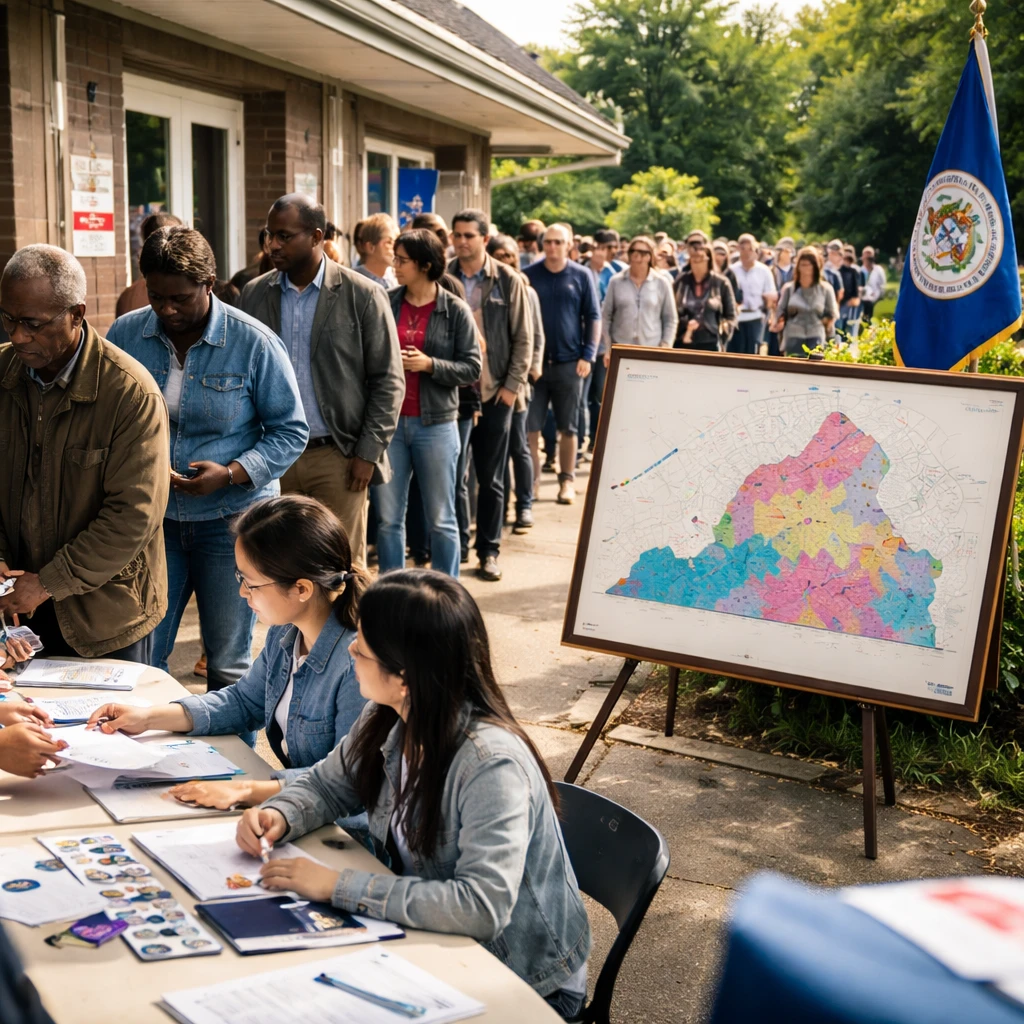
Voters in Virginia are heading to the polls to decide whether to approve a congressional map redrawn by Democrats that could flip as many as four Republican-held seats in the U.S. House of Representatives this November. The referendum has become the focal point of a high-stakes, high-spend contest between the parties, with both sides deploying tens of millions of dollars to influence the outcome.
The state’s referendum is one episode in a wider, unprecedented nationwide redistricting struggle that began last summer when President Donald Trump urged Texas Republicans to adopt a new congressional map aimed at unseating five Democratic incumbents. That move set off a cascade of mapmaking efforts in states controlled by both parties, producing an intensely competitive environment in which a small number of seats could determine which party controls the 435-member House.
For Democrats, the arithmetic is straightforward: flipping three Republican seats nationally would be enough to gain a majority. A Democratic House majority would enable oversight investigations into the Trump administration and could stymie the president’s legislative agenda. In Virginia, Democrats currently hold six of the state’s 11 House seats. Under the new plan, Democrats would have the advantage in all but one district, increasing the party’s odds of contributing the three-seat swing needed at the national level.
Redistricting normally follows the decennial U.S. Census, a process that state legislatures have long used to redraw lines in ways that can favor the party in power - a tactic often described as partisan gerrymandering. The Virginia referendum, by contrast, centers on a map put forward by Democrats to counter similar maneuvers by Republicans elsewhere.
Reflecting the stakes, outside spending has surged. The principal pro-measure operation, Virginians for Fair Elections, had raised $64.1 million through April 13, campaign reports show. More than $38 million of that total came from House Majority Forward, the main nonprofit political arm aligned with House Democrats. On the other side, Virginians for Fair Maps, the leading Republican-backed group opposed to the referendum, had raised nearly $20 million as of April 13. Much of the money has flowed through so-called dark money groups that are not required to disclose donors.
Republicans have also challenged the legality of putting the map to a public vote. The state Supreme Court permitted the referendum to proceed while it considers those legal challenges, leaving the judicial process unresolved as Election Day arrives. Public polling leading into the vote has generally shown the Democrats’ "yes" campaign with a narrow lead.
Political observers note that Virginia’s recent voting patterns have trended Democratic in federal races, with the party’s presidential nominees prevailing in every election since 2008 and the state electing a Democratic governor five months ago by a substantial margin. Yet in the current contest, the national implications have sharpened messaging from both sides. Democrats argue their map is needed to respond to Republican-directed redistricting in states such as Texas, while Republicans point to what they describe as Democratic inconsistency on gerrymandering issues.
In an unusual turn, both parties have used remarks by former Democratic President Barack Obama to bolster their arguments. Republican advertisements highlighting Obama’s prior anti-gerrymandering comments run alongside video messages from Obama urging approval of the referendum to prevent what he characterizes as a potential Republican "steal" of congressional seats.
Even if Virginia approves the Democratic map, the national redistricting battle will continue. Republican Florida Governor Ron DeSantis has called a special legislative session to consider a new map in that state, and the U.S. Supreme Court is expected to issue a ruling in the coming months that could affect whether Republicans in Southern states can pursue additional maps targeting Democratic-held districts.
The Virginia referendum thus sits at the intersection of legal contests, massive campaign spending, and strategic calculations about control of Congress. For investors and market observers, the vote adds another element of political risk to monitor - particularly given that control of the House could shape the scope and intensity of oversight and the prospects for legislative changes that matter to regulated industries.
Context for readers
- The referendum would adjust Virginia’s congressional map previously drawn by Democrats and could flip four Republican-held seats.
- The outcome matters nationally because Democrats need to flip three Republican seats to win a House majority that would enable investigations into the administration and obstruct its legislative priorities.
- Campaign spending on the Virginia referendum has been substantial, with the pro-map group reporting $64.1 million raised and the leading opposition group nearly $20 million as of April 13; much of this funding is from groups that do not disclose donors.
Implications for markets and finance
While the referendum is a state-level vote, the potential change in congressional control gives it broader market relevance. A shift in House majority could influence the regulatory and oversight environment facing industries sensitive to federal enforcement and legislative change. Investors tend to monitor such political shifts as part of political risk assessment for sectors where federal policy, funding, or regulation play a major role.