
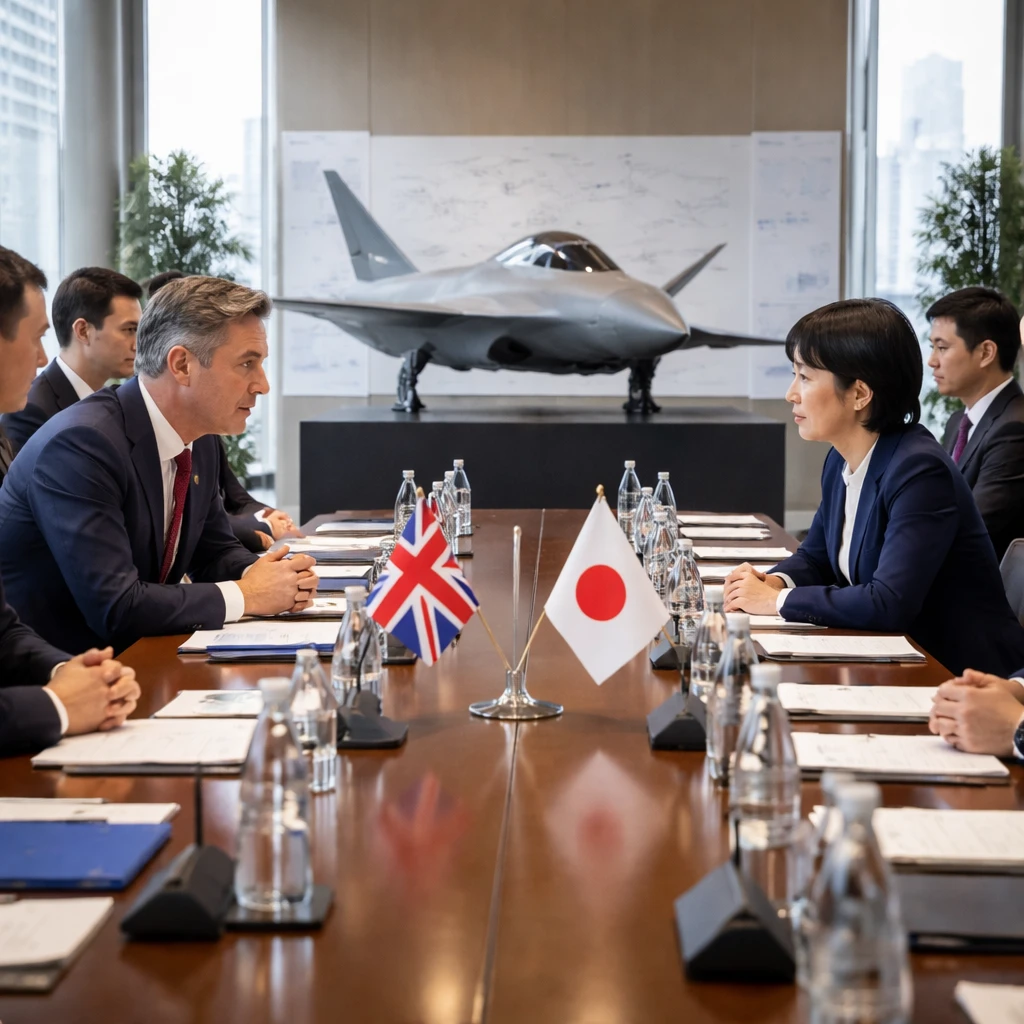
British Prime Minister Keir Starmer will hold talks with Japanese Prime Minister Sanae Takaichi on Sunday, with the future financing of their shared fighter jet programme with Italy still unresolved.
The leaders are scheduled to review progress on the Global Combat Air Programme (GCAP), a joint effort among the UK, Japan and Italy to develop a next-generation combat aircraft targeted for introduction by 2035. While technical and strategic cooperation continues, the programme has been affected by uncertainty over the UK’s planned financial commitments.
Questions about the UK contribution have grown after the government delayed publication of its long-term defence investment plan. Officials had been expected to set out billions of pounds in spending for the fighter project as part of that wider defence strategy, but the announcement was postponed amid internal disagreements over spending priorities. The delay was extended further following the departure of Defence Secretary John Healey.
On Saturday the UK government reiterated its commitment to the fighter project but did not provide new information about funding levels or timing.
By contrast, Japan and Italy have already allocated significant resources to GCAP. Japan spent more than A5500 billion on the initiative over the five years through March, and it has earmarked an additional A5170 billion for the current fiscal year. Italy’s parliament approved a funding package of roughly $10.7 billion earlier this year.
The programme is a strategic priority for Japan, which plans to begin replacing its F-2 fighter fleet starting in 2035. That timetable aligns with GCAP’s objective of fielding a next-generation aircraft in the mid-2030s.
Beyond the fighter programme, Starmer and Takaichi are expected to discuss an expanded economic and technology partnership between the UK and Japan. The pair will review plans for a proposed council intended to deepen industrial cooperation across a range of advanced sectors.
Planned areas of focus for the industrial council include artificial intelligence, drone technology, semiconductors, quantum technology, supply chain resilience and offshore wind. Japanese media reports indicate the two countries may also announce a new fund to support startups developing dual-use technologies that have both commercial and defence applications.
The meeting precedes the Group of Seven summit in France, where leaders are expected to prioritise geopolitical developments, economic security and technology cooperation on the agenda.
Context and implications
The talks will test whether political and budgetary disagreements in the UK can be resolved in time to match the financing already committed by Japan and Italy. While the UK has publicly affirmed its support for GCAP, the absence of concrete funding details leaves the scale and timing of any UK contribution unclear.