
Economy June 11, 2026 08:27 AM

Nationalbanken Poised to Raise Current Account Rate to 1.85% to Support Krone

All economists polled expect a 25 basis-point increase, mirroring the ECB and aimed at preserving Denmark's euro peg

By Maya Rios
Share
Twitter Reddit Facebook LinkedIn

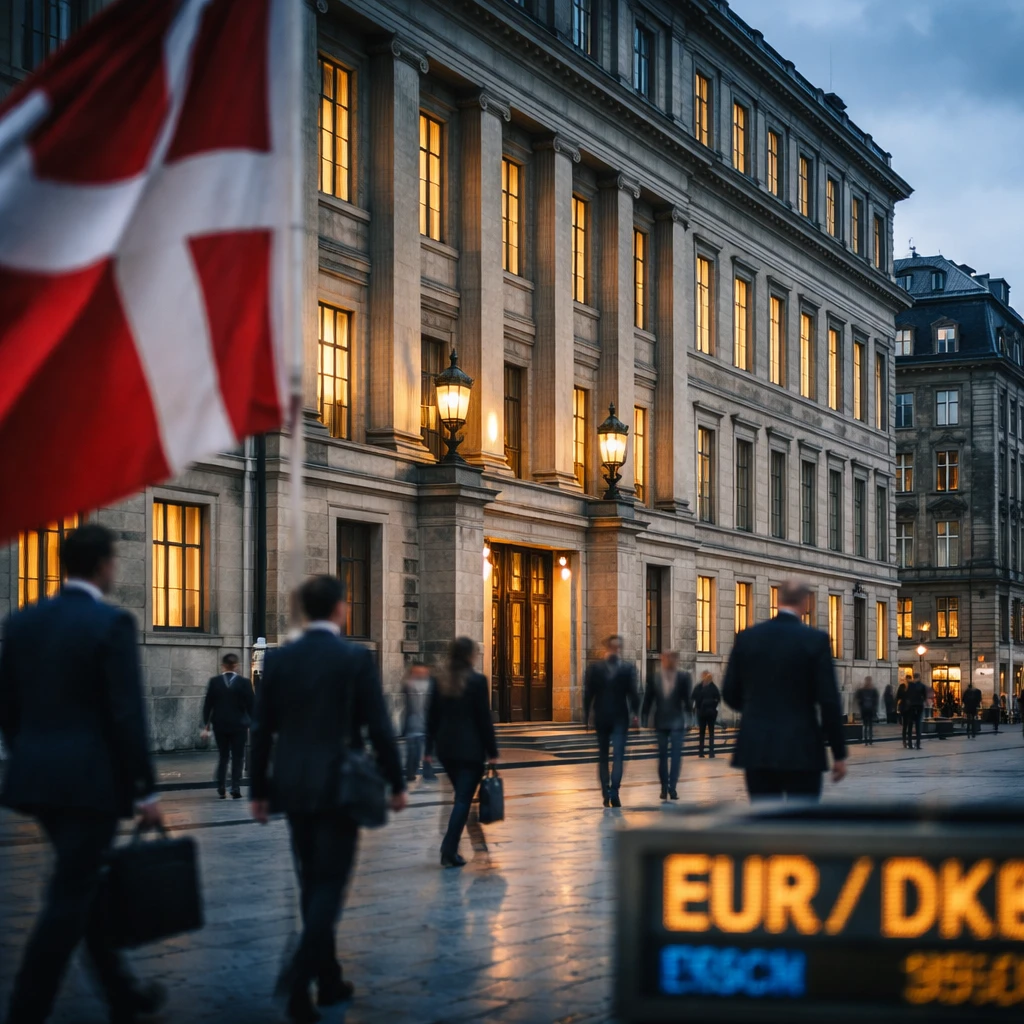
Economists surveyed anticipate that Denmark's central bank will lift its current account rate by 25 basis points to 1.85% from 1.60% at 5 p.m. in Copenhagen, a move aligned with a similar increase by the European Central Bank and intended to uphold the krone's fixed exchange-rate arrangement with the euro.

Nationalbanken Poised to Raise Current Account Rate to 1.85% to Support Krone
Summarize with
ChatGPT Perplexity Claude Grok Gemini

Key Points

  • Nationalbanken is expected to raise its current account rate by 25 basis points to 1.85% from 1.60% at 5 p.m. in Copenhagen.
  • The move is anticipated to mirror a similar increase by the European Central Bank and is intended to preserve the krone's peg to the euro, affecting FX markets and financial institutions.
  • The krone fell to a six-year low this week while Nationalbanken has not recently intervened by purchasing kroner; the central bank operates under a formal 2.25% band around 7.46038 per euro but targets a tighter range in practice.

Economists surveyed by Bloomberg News expect Denmark's central bank to raise its key current account rate by 25 basis points on Thursday, moving the rate from 1.60% to 1.85% at 5 p.m. in Copenhagen. The anticipated action is widely seen as following a comparable rate increase by the European Central Bank.

The survey found unanimous expectation among six economists that Nationalbanken will implement the increase. The decision is being framed within the context of maintaining the krone's fixed relationship to the euro.

This week the Danish currency weakened to its lowest level in six years. Economists noted that Nationalbanken has not recently intervened in foreign exchange markets by buying kroner. Such currency purchases are typically the first response used before an independent policy rate adjustment is chosen.

"I interpret that as a signal that the Danish central bank does not currently consider it necessary to defend the krone," said Oscar Norgaard, economist at Jyske Bank A/S.

Nationalbanken operates under a mandate to maintain a fixed exchange rate to the euro and officially manages the krone within a 2.25% band around 7.46038 per euro. In practice, the central bank aims for a noticeably tighter trading range than the formal band allows. The bank does not hold regularly scheduled policy meetings; instead, it typically sets rates a few hours after the European Central Bank announces its decisions.

The Bloomberg survey named the economists who participated: Soren Kristensen of AL Sydbank A/S, Jens Naervig Pedersen of Danske Bank A/S, Oscar Norgaard of Jyske Bank A/S, Jan Storup Nielsen of Nordea Bank Abp, Jes Asmussen of SJF Bank A/S and Sune Malthe-Thagaard of Totalkredit A/S.


Background and context provided by survey responses

All six polled economists expect the 25 basis-point increase to 1.85% to be announced at the specified Copenhagen time, consistent with the timing pattern Nationalbanken follows relative to ECB decisions. The krone's recent slide to a six-year low and the absence of recent kroner purchases by the central bank were highlighted by respondents as notable developments in the current policy backdrop.

The central bank's dual practices - adherence to the formal 2.25% band and informal targeting of a narrower range - were reiterated in the survey as the operational framework guiding its interventions and rate decisions.

Risks

  • Continued weakness in the krone could require future policy responses; the central bank has not had to buy kroner in recent months, reducing the visibility of its intervention stance - this affects foreign exchange and export/import dynamics.
  • Reliance on aligning policy moves with the ECB introduces timing uncertainty, since Nationalbanken typically sets policy a few hours after ECB rate decisions - this could influence short-term market volatility in interest-rate sensitive sectors.
  • The krone trading near a six-year low creates uncertainty for financial markets and institutions that are sensitive to currency fluctuations, including banks and hedged corporate exposures.

More from Economy

World Bank trims 2026 global growth forecast to 2.5% amid Middle East conflict Jun 11, 2026 Kenya pares back 2026 growth outlook, cites Middle East conflict Jun 11, 2026 Romania's National Bank Seeks Clarification from Competition Authority Over Antitrust Findings Jun 11, 2026 Emaar Unveils Plan for 4.5 Million Sq m Dubai District Valued at 200 Billion Dirhams Jun 11, 2026 Elevated U.S. Mortgage Rates Set to Keep Housing Activity Muted Through 2028, Poll Shows Jun 11, 2026