
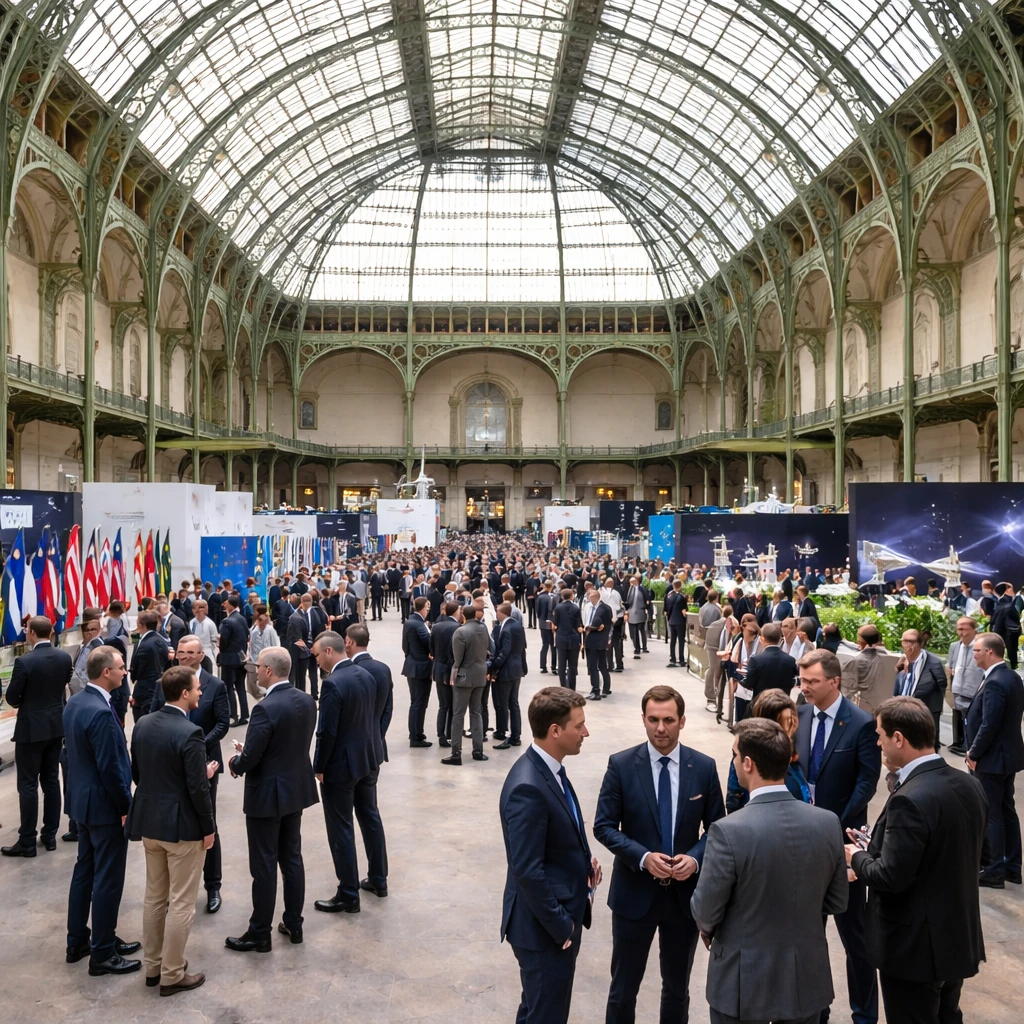
France has decided to press ahead with an International Space Summit scheduled in Paris for Sept 9 and 10, even as the event has been marked by the withdrawal of several prominent U.S. space companies and a lower-than-expected presence from some European leaders. The summit, convened as a forum for policy-makers, corporations and scientists from about 120 countries, was positioned by organisers as an opportunity to explore cooperation among rival space powers and to consider improvements to regulation.
White House concerns that the summit might tilt toward a pro-European agenda led several U.S. firms - including SpaceX and Blue Origin - to pull out, according to sources. The departures resulted in the cancellation of a handful of planned announcements, organisers said last week. At the same time, Germany, which is formally co-chairing the summit, said that Chancellor Friedrich Merz will not attend due to other commitments. Italy's prime minister, Giorgia Meloni, will also be absent, her office confirmed.
These absences underline a wider political divide over how Europe should position itself in a fiercely competitive global space market. France has been arguing for greater European autonomy in space capabilities. Germany, by contrast, appears more open to continued engagement with dominant commercial launch providers such as SpaceX. The difference in tone between Paris and Berlin extends to secure satellite networks: President Emmanuel Macron supports the European Union's IRIS2 secure constellation, whereas Germany is pursuing a separate national secure network.
Organisers have sought to play down the significance of the gaps in attendance, noting that U.S. companies will still be represented and that around 2,000 delegates are expected to gather beneath the glass dome of the Grand Palais - a venue selected in part as a symbol of industrial ambition. The summit is an informal political meeting and is not expected to produce binding decisions. Nevertheless, France hopes to secure broad declarations on a number of topics, including space traffic, access to space and allocation of limited radio frequencies used to operate satellite services - an area that divides some companies across the Atlantic.
European Commission President Ursula von der Leyen is due to deliver a keynote policy address on Thursday. Chinese participation has also been confirmed by officials, though they did not provide further detail.
Beyond political discussion, the meeting is anticipated to be a platform for commercial announcements timed to elevate the summit's profile, in a manner reminiscent of major deal-making revealed at a recent French summit on artificial intelligence. France's history as a leading European space power dates to mid-20th century defence and ballistics programmes, but contributions to the European Space Agency have shifted - Germany has become the top contributor to ESA.
European spending on space remains substantially lower than that of the United States. Josef Aschbacher, director general of the European Space Agency, has said Europe invests about five times less than the U.S. in space. He also told reporters ahead of the summit that ESA is developing emblematic proposals aimed at reducing European dependence on U.S. rockets for human launches.
Other agenda items will include a roll-call of European concerns around security in space, according to Philippe Baptiste, France's minister for higher education. The combination of high-level political signaling, industry withdrawals, and differing national plans for secure satellite networks frames the summit as a test of Europe's ability to coordinate on strategic space priorities while still accommodating commercial ties with major non-European providers.
Event details and context
- Event: International Space Summit, Paris
- Dates: Sept 9-10
- Expected participants: Delegates from roughly 120 nations; organisers project about 2,000 attendees
- Venue: Grand Palais, Paris
- Key policy speaker: European Commission President Ursula von der Leyen