
Economy May 22, 2026 02:51 PM

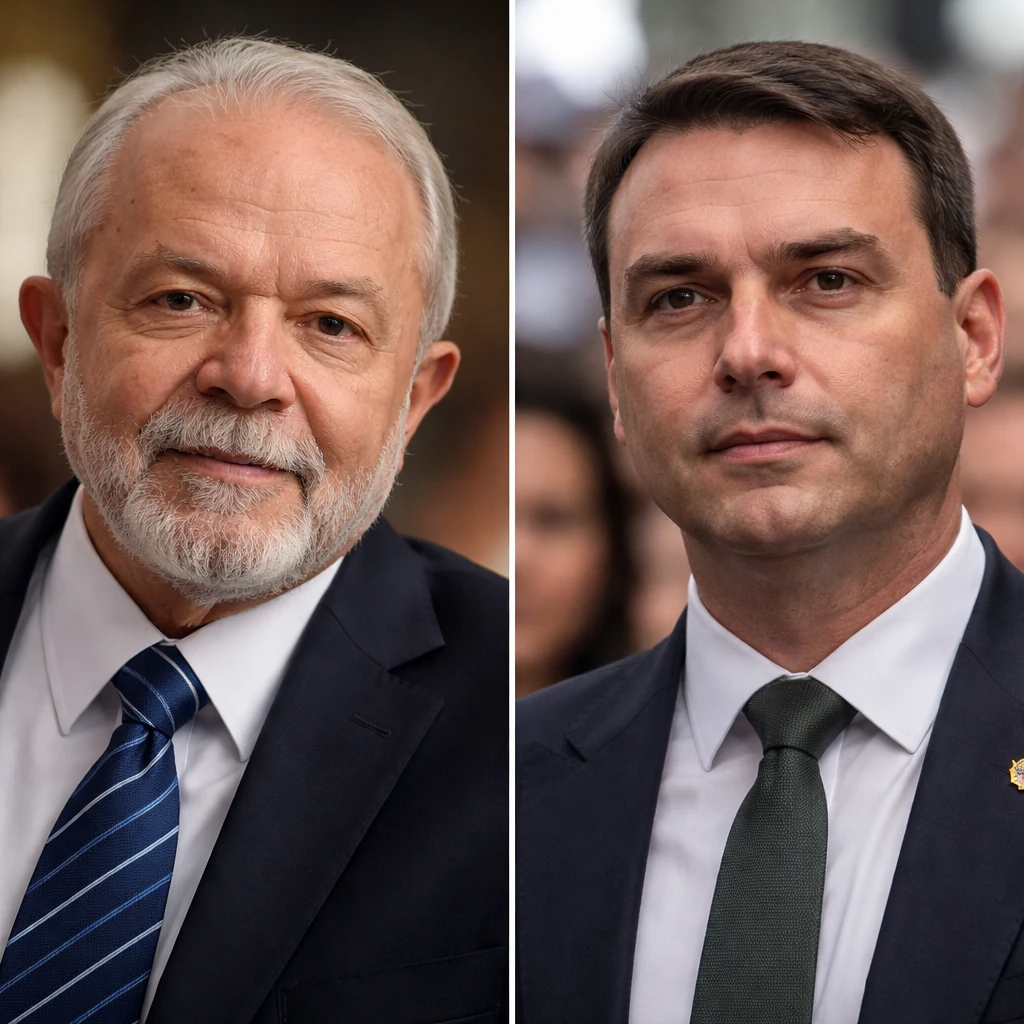
Lula Edges Ahead of Flavio Bolsonaro in Latest Datafolha Survey

New poll shows the incumbent leading in potential second-round matchups and ahead in first-round voting intentions

By Caleb Monroe
Share
Twitter Reddit Facebook LinkedIn

A Datafolha survey released Friday indicates President Luiz Inacio Lula da Silva has pulled ahead of opposition Senator Flavio Bolsonaro in head-to-head polling for this year's presidential contest, reversing a tie recorded in mid-May. The poll also shows Lula leading a separate runoff against Michelle Bolsonaro and maintaining a lead in first-round voting intentions.

Lula Edges Ahead of Flavio Bolsonaro in Latest Datafolha Survey
Summarize with
ChatGPT Perplexity Claude Grok Gemini

Key Points

  • Datafolha's Friday survey shows President Luiz Inacio Lula da Silva leading Senator Flavio Bolsonaro 47% to 43% in a hypothetical second-round runoff.
  • The same poll indicates Lula would beat Michelle Bolsonaro in a separate runoff matchup, 48% to 43%.
  • First-round voting intentions in the Datafolha survey place Lula at 40%, Flavio Bolsonaro at 31%, Caiado at 4%, Zema at 3%, and Santos at 3%.
  • The poll reflects a shift from a May 16 Datafolha survey that had Lula and Flavio Bolsonaro tied.

A survey published Friday by pollster Datafolha finds President Luiz Inacio Lula da Silva leading Senator Flavio Bolsonaro in hypothetical second-round matchups for this year’s presidential election.

In the Datafolha results, the leftist incumbent would receive 47% of the vote in a possible runoff against the right-wing challenger, with Flavio Bolsonaro at 43%.

This outcome represents a change from an earlier Datafolha snapshot dated May 16, which showed the two candidates tied in a second-round pairing.

Datafolha also reported results for an alternate runoff scenario: Lula would secure 48% of the vote against Michelle Bolsonaro, who would obtain 43% in that matchup, according to the poll.

On first-round voting intentions, the poll lists support levels as follows: Lula at 40%, Flavio Bolsonaro at 31%, Caiado at 4%, Zema at 3%, and Santos at 3%.

Datafolha’s noted shift in voting preferences follows media reports that linked Flavio Bolsonaro to a disgraced banker. The pollster’s findings suggest those reports appear to have affected Bolsonaro’s standing with voters.


Context and limitations

The Datafolha numbers provide a snapshot of voter preferences at the time the survey was conducted. The poll demonstrates movement in voter sentiment compared with the May 16 polling results, but it does not, by itself, indicate whether the change is durable or how underlying voter motivations may evolve ahead of the election.

The survey lists specific percentages for the two-candidate runoff scenarios and for multi-candidate first-round intentions, but it does not offer additional detail in this release about the methodology, margin of error, sample composition, or how respondents explained their choices. Those limitations mean the poll should be interpreted as a current measure of preferences rather than a definitive forecast.

Risks

  • Poll volatility - The survey shows a change from the May 16 results, highlighting that voter preferences can shift between polling snapshots; the article does not specify whether this movement will persist.
  • Reputational effects - Reports linking Flavio Bolsonaro to a disgraced banker appear to have influenced his standing with voters, indicating that media revelations can affect candidate support.
  • Information gaps - The published results do not include methodology details or margins of error, limiting the ability to assess the statistical precision of the figures.

More from Economy

UBS: Concentration in Korea’s market behind record 2026 foreign equity outflows Jun 7, 2026 BCA Research Disputes Kevin Warsh: AI May Be Inflationary, Not Disinflationary Jun 7, 2026 Deutsche Bank Identifies Sectors and Stocks Poised to Gain from 2026 World Cup Jun 7, 2026 SpaceX IPO Poised to Pressure a Tech-Led U.S. Rally as Inflation Data and Earnings Loom Jun 7, 2026 Deutsche Bank Sees Euro Area Growth Slowing Sharply in 2026 After Energy Shock Jun 7, 2026