
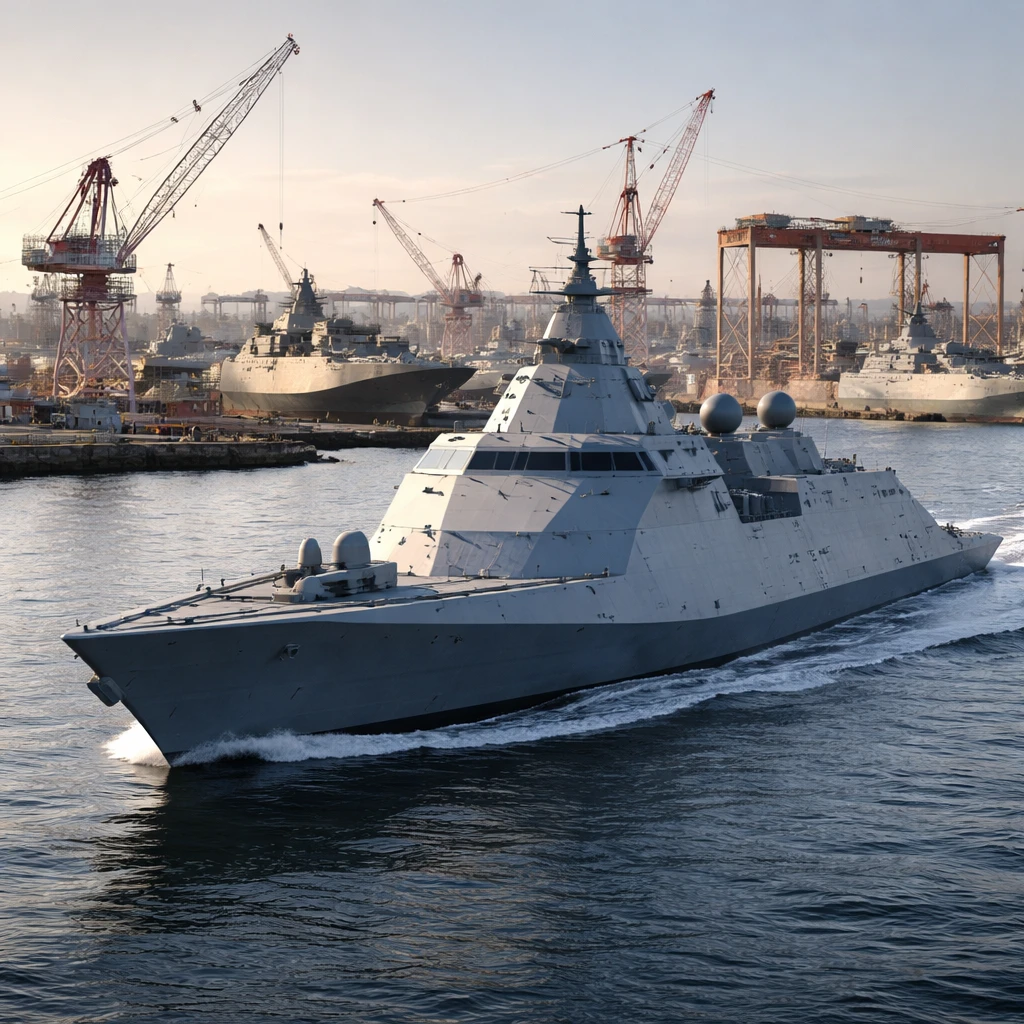
Australia and Japan have finalized a major defense procurement agreement to add 11 advanced Mogami-class stealth frigates to the Royal Australian Navy, with the first three vessels to be acquired directly from Japanese yards and the remainder to be built in Australia.
The contract was formalized at a signing ceremony in Melbourne on Saturday attended by Australian Defense Minister Richard Marles and Japanese Defense Minister Shinjiro Koizumi. The overall value of the deal is reported as falling between A$15 billion and A$20 billion - roughly $10.8 billion at the cited conversion - and centers on upgraded Mogami-class frigates optimized for both air defense and undersea warfare.
"Our surface fleet is more important than at any time in decades," Marles said during the event. "These general-purpose frigates will help secure our maritime trade routes and northern approaches as part of a larger and more lethal surface combatant fleet."
Under the terms disclosed at the ceremony, the first three frigates will be constructed in Japan, with the initial delivery expected by 2029. Australia will then take responsibility for completing the program domestically: the remaining eight vessels are planned to be built in Western Australia. The arrangement signals a substantial transfer of production work to Australian shipbuilding facilities over the life of the program and a commitment to expanding local industrial capacity alongside the bilateral partnership.
Mitsubishi Heavy Industries, Ltd. (TYO:7011) has been named lead contractor for the build. The vessels are intended to replace the Royal Australian Navy's aging Anzac-class warships and are described as specifically optimized for air defense and undersea warfare missions.
For Japan, the contract marks a notable development in its defense industry: it is cited as only the second major defense export agreement secured by the country since World War II. Mitsubishi Heavy Industries' selection followed a competitive process in which the Japanese firm prevailed over rival proposals, including a bid from Germany's Thyssenkrupp Marine Systems last year.
The deal is presented by both governments as more than an acquisition of hardware. Australian and Japanese officials describe it as an expansion of military and industrial ties in response to continuing geopolitical pressures in the Indo-Pacific region. The partnership is framed around bolstering maritime security and enhancing interoperability between the two countries' defense sectors.
Japanese political leadership is also referenced in relation to the agreement. The choice of Mitsubishi Heavy Industries is aligned with Prime Minister Sanae Takaichi's stated approach to increase Japan's presence in the global defense market.
Operationally, the program will transition Australia from reliance on older Anzac-class platforms toward a fleet of modern, multi-mission frigates designed to perform air defense and anti-submarine roles. The combination of foreign-built initial hulls and subsequent domestic construction will involve engineering transfer, industrial coordination, and workforce scaling in Western Australia as the program progresses.
The contract represents both a substantial procurement outlay and a strategic industrial collaboration between Canberra and Tokyo aimed at reinforcing maritime capabilities in a region described by both nations as increasingly volatile. Details provided at the signing outline the timeline and production split but do not elaborate further on follow-on support arrangements or lifecycle sustainment in the public remarks provided at the ceremony.
Summary
Australia has signed a contract to acquire the first three of 11 upgraded Mogami-class stealth frigates from Japan in a deal worth between A$15 billion and A$20 billion, with Mitsubishi Heavy Industries named as lead contractor. The first three ships will be built in Japan, initial delivery is expected by 2029, and the remaining eight are slated for construction in Western Australia to replace Anzac-class vessels.