
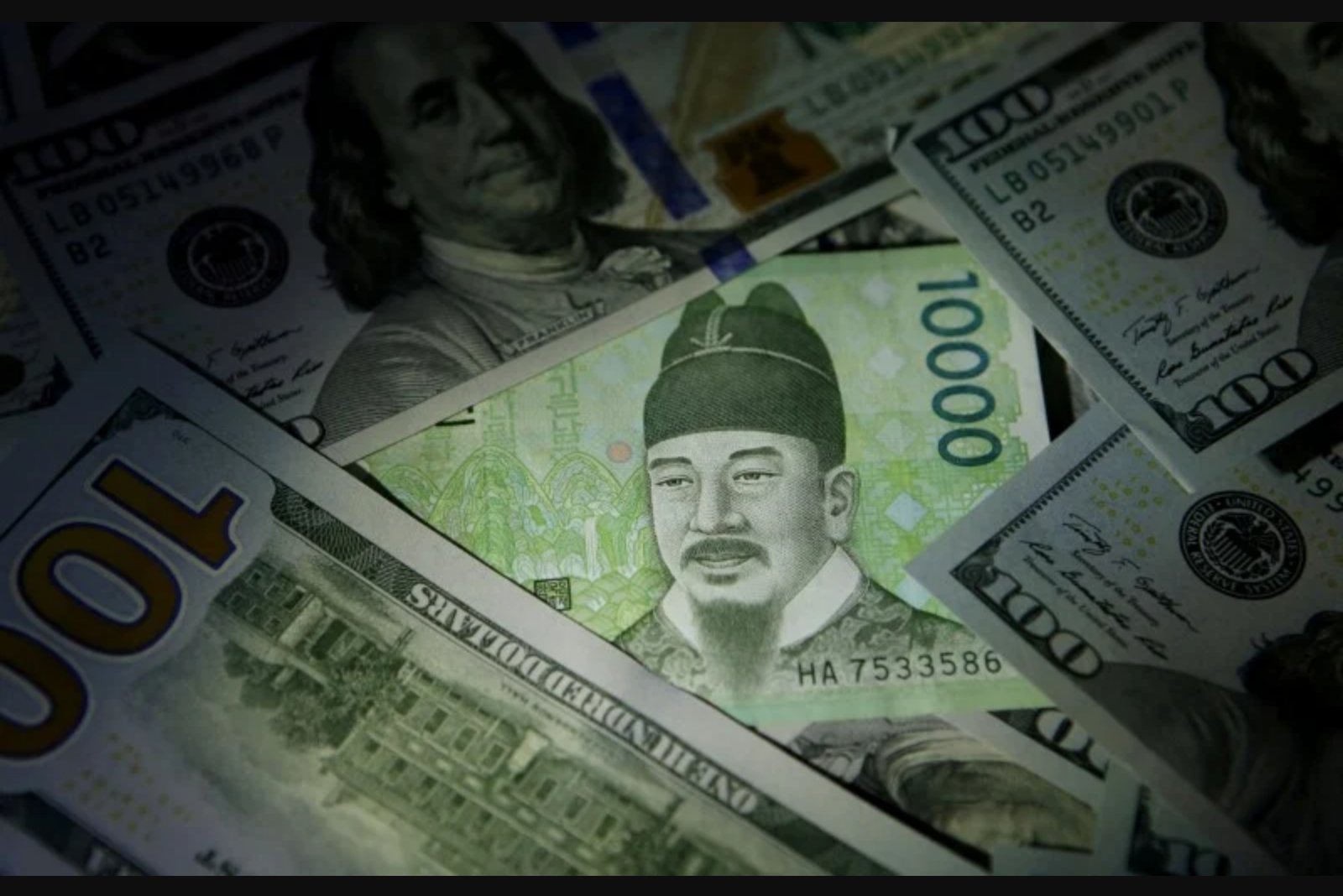
Most Asian currencies have retreated against the U.S. dollar in 2026 as expectations for persistent U.S. inflation and further rate increases kept many traders tilted toward the dollar. Yet a few regional units have bucked the trend, driven by concentrated export strength and central banks that have turned more hawkish.
At the forefront is the South Korean won. Measured by major Asian USD/XXX pairs, where a lower USD/XXX rate indicates a stronger local currency, the won has outpaced peers. USD/KRW is down 5.68% year-to-date, giving the currency the top spot among the major Asian currencies reviewed.
Key currency snapshots
| Pair | Latest rate | YTD | 1M | 3M |
|---|---|---|---|---|
| USD/KRW | 1,358.73 KRW | -5.68% | -4.95% | -11.47% |
| USD/CNY | 6.7183 CNY | -3.94% | -0.51% | -0.76% |
| USD/SGD | 1.2693 SGD | -1.29% | -1.01% | -1.13% |
| USD/MYR | 4.0451 MYR | -0.24% | -1.23% | +1.27% |
| USD/JPY | 157.24 JPY | +0.36% | +0.04% | -1.76% |
| USD/TWD | 31.757 TWD | +1.39% | -2.01% | +0.92% |
| USD/HKD | 7.8421 HKD | +0.76% | ~0.00% | +0.06% |
| USD/THB | 33.009 THB | +4.81% | -1.10% | +0.82% |
| USD/INR | 94.382 INR | +4.92% | -1.00% | -1.39% |
| USD/IDR | 17,677.3 IDR | +6.03% | -1.70% | -1.48% |
| USD/PHP | 62.463 PHP | +6.13% | +2.49% | +1.11% |
Latest rates are as of Thu, Sep 3, 2026 at approximately 2:29-2:33 AM EDT. Year-to-date figures are performance snapshots and may not share the same intraday timestamp.
Why the won is leading
The won's outperformance rests on a rare convergence of strong export momentum, more restrictive domestic monetary policy, and an overall weaker dollar. South Korea's exports rose 68.7% year over year in August, producing a $34.75 billion trade surplus. That surge was concentrated in semiconductors and AI-related demand, which the currency's fundamental support tracks closely.
Policy has reinforced that trend. The Bank of Korea raised its policy rate to 3.00% on Aug. 27, marking its second consecutive hike, and the central bank raised its 2026 growth forecast to 3.3%. Those moves lend additional support to the won, although domestic inflation dynamics complicate the outlook. Headline inflation in August was 3.1%, with core inflation accelerating to 3.4%. Further tightening from the BoK could buttress the currency but may weigh on household consumption.
Wider regional context
Broader movements in the dollar and U.S. yields remain an important external force. Asian currencies would generally benefit from a retreat in U.S. yields and dollar strength, yet markets currently price a 61%-67% probability of a September Federal Reserve rate increase, which creates a near-term headwind for regional units.
China is also a key anchor for the region. USD/CNY is down 3.94% YTD, and forecasts cited in market commentary expect policymakers to favor gradual yuan appreciation in the range of 3%-5% annually. That projected path could provide stabilizing influence across neighboring currencies.
Japan represents a potential wildcard. The yen has been strengthening as markets increasingly price a possible Bank of Japan hike. Stronger yen momentum could reinforce regional currency gains, but the outlook is fragile - rising oil prices or renewed risk aversion could reverse those moves quickly.
Outlook - scenarios
The near-term picture is constructive but mixed:
- Positive scenario - Continued robust chip exports, further Bank of Korea tightening, gradual yuan appreciation and eventual Federal Reserve easing would extend gains for Asian currencies, particularly those with heavy export exposure.
- Negative scenario - A Fed hike, higher energy costs, weaker demand for AI hardware, or renewed geopolitical tensions would strengthen the dollar and reverse regional currency gains.
The dominant theme is clear: currencies tied to export-heavy economies have the most tangible support at present. The won currently displays the strongest momentum among those currencies, but its fortunes remain closely tied to the semiconductor cycle.
Key points
- USD/KRW is down 5.68% YTD, making the South Korean won the strongest major Asian currency so far in 2026.
- Semiconductor and AI-related export strength, evidenced by a 68.7% YoY export rise in August and a $34.75B trade surplus, is the primary fundamental driver for the won.
- Monetary policy support from the Bank of Korea - now at 3.00% after its second consecutive hike - has reinforced the currency's gains, even as inflation pressures have risen.
Risks and uncertainties
- Federal Reserve tightening - Markets price a 61%-67% chance of a September Fed hike, which could strengthen the dollar and pressure Asian currencies.
- Commodity and demand shocks - Higher oil prices or a downturn in AI hardware and semiconductor demand could rapidly reverse gains; export-dependent sectors are especially exposed.
- Domestic trade-offs - Additional Bank of Korea rate hikes could support the won but risk dampening domestic consumption if inflation and borrowing costs rise further.
The won's recent rally is not simply the product of a softer dollar. It is anchored in Korea's improving external balance, which lends credibility to its strength even as the currency remains vulnerable to semiconductor-cycle shocks and global risk factors.