
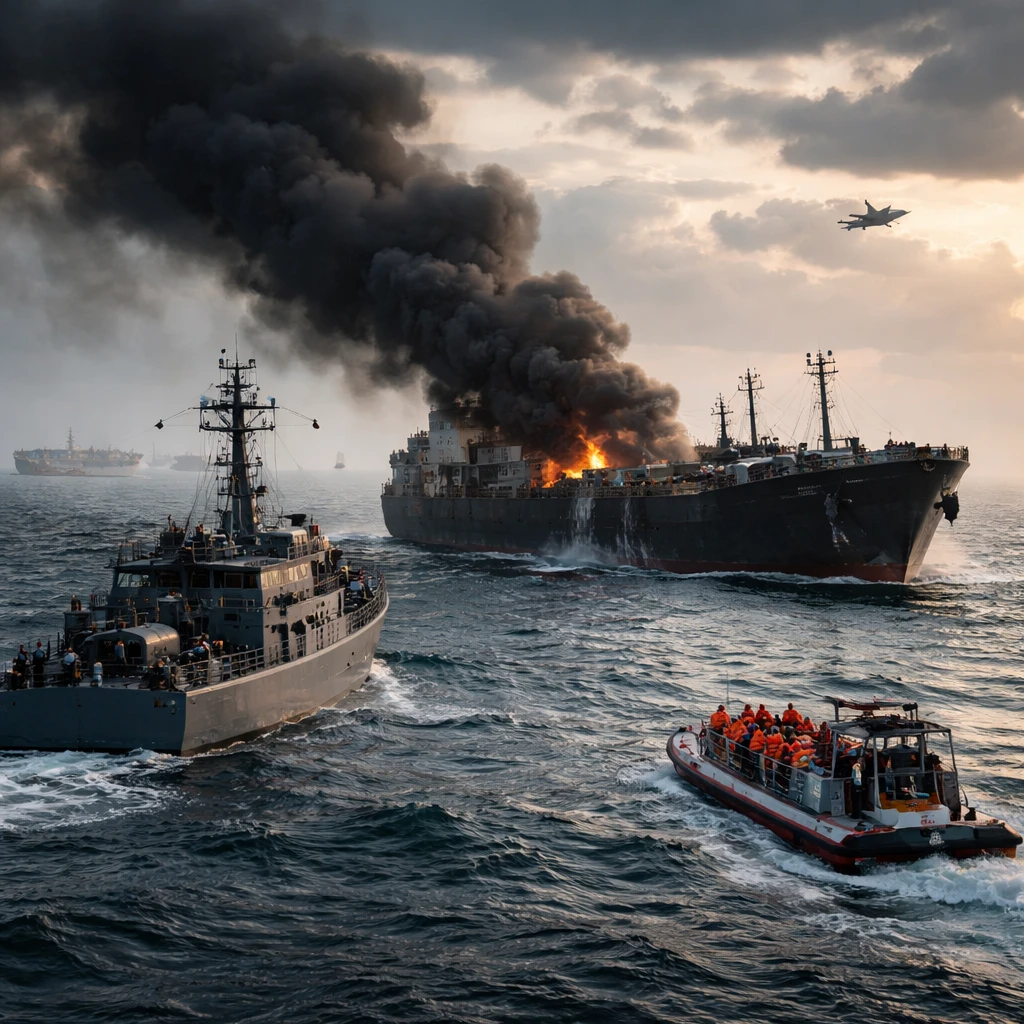
Indian officials confirmed on Thursday that three Indian seafarers were found dead after a U.S. military operation that struck a tanker in the Gulf of Oman. The strike targeted the Palau-flagged oil products tanker Settebello and came within the broader context of U.S. operations aimed at enforcing a blockade on shipping linked to Iran.
Confirmed casualties and rescues
India's Shipping Minister affirmed the deaths after bodies were located and identified. Earlier, New Delhi's foreign ministry said 21 Indian sailors had been rescued in the aftermath of the action on the Settebello.
The vessel was hit by what the U.S. military's Central Command (Centcom) described as a precision strike. Centcom said a U.S. aircraft "fired precision munitions into the ship's engine room after the crew repeatedly failed to comply with directions from American forces".
Immediate response and diplomatic protest
Following the attack, India summoned the U.S. deputy chief of mission to register a "strong protest," according to two Indian sources. The Settebello reported an engine fire after the strike; the Omani Navy answered a distress call from the tanker, Vanguard, a maritime risk management group, reported.
Separately on the same day, the Indian embassy in Oman notified authorities of another incident involving a different tanker operating off Oman.
Context of the U.S. blockade
Centcom said the strike occurred amid a U.S. blockade that began on April 13 with the stated objective of stopping shipments tied to Iran. Centcom said the blockade had disabled eight non-compliant vessels, redirected 134 ships that complied with instructions, and allowed 42 vessels supporting humanitarian aid to pass.
The U.S. disabled another tanker, the unladen Marivex, in the Gulf of Oman earlier in the week after it attempted to sail to an Iranian port; that vessel also had Indian crew aboard, Centcom said.
Human dimension
Family members of one of the deceased seafarers, identified as Shivanand Chaurasia, said he had gone to sea about nine months earlier and that he had told his father earlier in the week that everything was fine.
India is one of the world's largest suppliers of seafarers. Government figures cited by New Delhi place more than 300,000 Indian sailors in global shipping fleets, a factor cited in the country's reaction to the incidents.
Industry and international reaction
Those targeted by the U.S. blockade include vessels linked directly to Iran as well as so-called shadow fleet tankers - older ships typically lacking Western insurance and often sailing under various flags to obscure ownership and movements. Centcom said the Settebello had "violated the ongoing blockade by attempting to transport oil from Iran."
Arsenio Dominguez, secretary-general of the International Maritime Organization, said he "strongly condemn[s] any act from any party that endangers the lives of seafarers and the safety of international shipping," calling such actions "simply unacceptable."
Current known facts and limitations
Indian authorities have confirmed three deaths and 21 rescues from the Settebello incident. India has lodged a diplomatic protest by summoning the U.S. deputy chief of mission. The Omani Navy responded to the tanker’s distress call after an engine fire following the strike, according to Vanguard. A separate tanker incident off Oman was also reported by the Indian embassy the same day. Centcom has described broader enforcement actions tied to the blockade that began on April 13.
Note: Reporting is limited to the information released by Indian authorities, Centcom, the Omani response and the International Maritime Organization as stated above.