
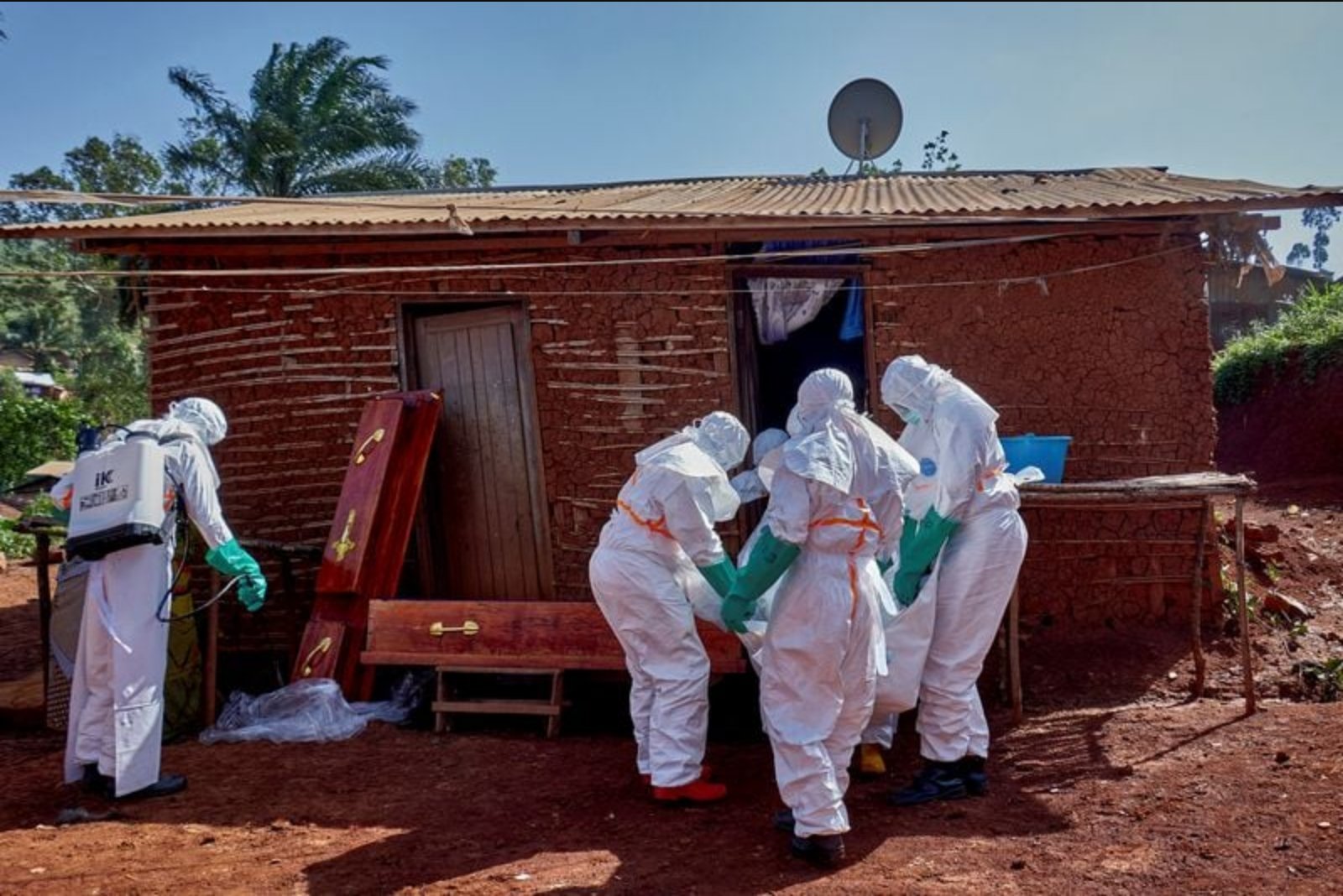
When the vehicle carrying a pastor’s remains left the morgue in Bunia for the three-hour journey to Mongbwalu, the heat on the red dirt road already felt oppressive. Inside the back of an older Nissan SUV, the wooden coffin of the 44-year-old clergyman was wedged between flattened seats; young relatives rode on top of the coffin, squeezed into the cargo area. The rough, four-wheel-drive trip across Ituri province shook the vehicle heavily. By the time it arrived in Mongbwalu, the coffin had collapsed and split under the weight placed upon it.
That damaged casket and what followed surrounding the pastor’s burial are now under scrutiny by a health ministry inquiry seeking the outbreak’s earliest cases - the so-called patient zero - according to four members of the investigative team. Their investigation has identified the February 4 funeral of the man named Paluku Makundi Denis as one of the earliest possible super-spreader events in the emerging epidemic.
Health authorities are racing to respond to an escalating outbreak of a rare Ebola strain called Bundibugyo, which health officials say has a case fatality rate of roughly 30% to 50% and for which there is currently no vaccine or cure. The outbreak has expanded to around 635 confirmed infections and at least 127 deaths across eastern Congo, according to the country’s health ministry. Officials caution the real number of infections and deaths may be considerably higher because of gaps in surveillance and testing.
A surveillance epidemiologist working on the inquiry estimated that the Bundibugyo strain may have been circulating for four to six months before the government publicly confirmed the outbreak on May 15. He emphasized that more investigation is necessary to determine whether Pastor Makundi himself was infected and to identify the true origin of the epidemic - a crucial step to understand its scale and reduce the chance of future flare-ups. The ministry and provincial health authority did not provide comment to requests, and WHO chief Tedros Adhanom Ghebreyesus declined to comment on the pastor’s individual case, saying multiple scenarios remain under investigation.
Reporters reconstructed the sequence of events around the pastor’s death and burial through interviews with medical staff, local officials and relatives of the deceased, and by reviewing hospital, burial and government records. Those accounts establish a chain of actions that investigators consider potentially hazardous if the deceased had been infected with Ebola.
From hospital diagnosis to a new coffin
On February 3, doctors and a nurse at a hospital in Bunia diagnosed Makundi with peritonitis, a serious abdominal infection, according to three clinicians and an attending nurse. No biological samples were collected to test for Ebola; the staff said they were not aware of any outbreak at that time. An infectious-disease professor noted that severe Ebola infection can present with peritonitis among other manifestations, but without laboratory testing it is impossible to confirm the cause of the pastor’s death.
The damaged coffin reached Mongbwalu on the afternoon of February 4. Mongbwalu, a town with an estimated population of about 130,000, is also a transient, gold-mining hub with an active, mobile population. Dozens of mourners gathered at the family compound. Makundi’s father, Pascal Kibali - known locally as Paka - examined the split box and decided it was not a suitable container for his son’s remains. Before eventually relocating to Bunia to serve as a clergyman, Makundi had been a well-known figure in Mongbwalu’s Nande community and a founder of the local charcoal cooperative, his father recalled.
Family members procured a new casket from a local maker. The body was moved into that coffin before sunset, and the family held a wake at their compound prior to burial. At traditional wakes in the region, it is common for mourners to touch and kiss the body. Investigators say it is not clear from accounts whether that custom occurred during this wake, but the transfer of the corpse and the handling of remains are central points of concern given the high infectivity of deceased Ebola victims.
The funeral and a cluster of subsequent deaths
The burial at the local cemetery drew more than 80 relatives, friends and neighbors as dusk fell, according to Edmond Kambale Katuwene, leader of the Nande community in Mongbwalu. A priest led prayers, and participants were urged to reflect on life’s fragility. In the days that followed, local officials reported rising numbers of illnesses and fatalities.
Mongbwalu’s mayor, Sesereki Mandro Israel, said nearly 50 deaths were recorded within two weeks of the funeral, many presenting symptoms consistent with Ebola - fever, vomiting and bleeding. The pastor’s younger brother, Idi, a 36-year-old miner, was among the first to die; provincial health bulletins recorded his death on February 16 as suspected appendicitis. The provincial situation report dated May 16 catalogued other early family fatalities as suspected hemorrhoids and tuberculosis, but flagged them for further investigation.
Those family deaths preceded a larger wave. The provincial health authority reported at least 108 deaths in Mongbwalu between April and May, and listed clusters of patients within families who collapsed with fever, vomiting, diarrhoea and in some instances haemorrhagic symptoms. Investigators treating the pastor’s burial as an early focal point say the disease may have been smouldering undetected in the town for several months. On June 9, the national health ministry reported that at least 40 people had been confirmed to have died of Ebola in Mongbwalu, a figure aid workers warned could be an undercount due to the limits of testing in the area.
A burned coffin, rumours and social media
As the death toll rose, the damaged original coffin became a focal point for confusion and fear. After the burial, word circulated through the town that the broken box had been set on fire. None of the six relatives and local witnesses interviewed for the inquiry said they had directly seen the act of burning, but all reported seeing charred remains attributed to that coffin. The pastor’s father and uncle suggested a group of intoxicated youths might have been responsible, but provided no further specifics. The family said they were bewildered and grieving.
Community leaders reported that the sight of the burned casket was perceived by many as an insult to ancestral traditions. Tensions increased following an episode around the burial of another brother, Tsongo Kenda Kenda, when police intervened after a dispute between relatives over opening a coffin prior to burial. According to the May 16 provincial bulletin, a relative briefly removed the coffin lid in protest before replacing it - an act some saw as disrespectful and that further unsettled neighbours.
Some residents interpreted the sequence of deaths not as the result of a pathogen, but as divine or ancestral retribution for perceived slights during the funerals. Jeremy Rayan Tamelegu, a mining-geology consultant working in the pastor’s neighbourhood, said he watched people fall ill and die in rapid succession and that the unexplained losses strengthened belief in a curse. Those narratives spread widely, moving from word of mouth into online platforms used in and around Mongbwalu. A local music group recorded a song that referenced a coffin roaming the town and causing devastation. That song and other posts contributed to a broader viral trend on social media, with users sharing videos depicting coffins moving along roads or appearing to float above residents - posts that circulated on local social channels and on platforms popular in eastern Congo.
Mistrust, violence and the challenge for response teams
By early May, the investigative team found that suspicion and fear had hardened into hostility for some. Community members grew distrustful of health workers and officials as rumours blamed modern responses for the deaths, echoing patterns seen in previous outbreaks. The epidemiologist on the inquiry said that on May 22 an unspecified group of youths attacked a response team collecting information on a confirmed Ebola case in the nearby village of Mabilindey. The following day, assailants set fire to an isolation tent put up by aid workers at Mongbwalu General Hospital.
Those incidents underscored the difficulty of carrying out surveillance, testing and care in an environment where response teams are sometimes vilified. Makundi’s father, Paka Kibali, said his family had been accused by some residents of triggering the outbreak because of what happened around his sons’ burials. He protested the accusations, saying his family had been victimised: "They vandalized my son’s coffin and blamed me for the deaths that followed," he said, weeping. "Yet I am the victim - it was my son’s coffin that was desecrated." His account illustrates the emotional strain and the sense of injustice felt by relatives who find themselves at the centre of local suspicion.
Where the inquiry stands and the limits of current knowledge
Investigators continue piecing together timelines, household chains of transmission and clinical records to map how the virus might have moved through Mongbwalu and surrounding areas. The surveillance epidemiologist involved in the inquiry cautioned that the data remain incomplete: many suspected cases were never tested, early deaths were attributed to a variety of causes in medical bulletins, and local reporting is inconsistent. Those gaps make it difficult to draw definitive conclusions about who was the first infected person or precisely when the virus arrived in the community.
WHO leadership has declined to comment on the specific case of Makundi, stressing instead that multiple possible scenarios are under evaluation. The international and national response remains focused on tracking chains of transmission, expanding testing where possible, and engaging communities to rebuild trust so that isolation and treatment efforts can proceed without triggering further violence or resistance.
Broader implications for response and surveillance
The events in Mongbwalu underscore several practical challenges for outbreak response in conflict-affected, mobile populations. Rapid, accurate diagnosis was not available early on when the pastor died in Bunia; cultural burial practices and the movement of remains through a transient mining town possibly amplified exposure risks; and social narratives - including accusations of curses and reprisals over disturbed funerary customs - have complicated efforts to engage communities.
Investigators say establishing whether early deaths like Makundi’s were caused by Bundibugyo Ebola is essential to mapping the epidemic’s scale and routes of spread. That mapping in turn would inform public health priorities and help prevent similar events in the future. Until testing and surveillance can fill gaps in the timeline, however, the outbreak’s origins will remain partly obscured by the same mix of limited data, cultural practices and mistrust that have complicated responses to Ebola elsewhere.
What officials are tracing
- Connections between the Bunia hospital diagnosis on February 3 and illnesses that followed in Mongbwalu after the February 4 burial.
- Family clusters and household transmission chains that led to dozens of deaths recorded locally during April and May.
- Reports of the damaged coffin being burned and disputed pre-burial actions that may have inflamed community tensions.
These are among the threads investigators must weave together to clarify how and when Bundibugyo Ebola gained a foothold in this part of Ituri province.
Human consequences
Beyond statistics and epidemiological timelines, the inquiry reveals deep human costs: a family’s grief compounded by accusations and desecration of a loved one’s remains; a community thrown into confusion and fear as deaths mount; and health workers confronting both a dangerous pathogen and the risk of violence. Those human consequences feed back into the practical challenges of stemming transmission as teams try to provide care, isolate cases and find earlier contacts.
The investigative effort aims not only to identify the earliest infections but also to understand how social dynamics and local practices shaped the outbreak’s early trajectory. Only with that fuller picture can public health authorities hope to tailor interventions that reach into communities where suspicion and misinformation have taken root.
Note: All names, dates and figures in this report are drawn from clinical accounts, provincial situation reports and interviews conducted as part of the investigation into the outbreak in Ituri province.