
World February 26, 2026 09:46 PM

Philippines, Japan and U.S. Conduct Joint Naval Exercises in the South China Sea

Multinational drills aim to strengthen interoperability and maritime domain awareness amid competing territorial claims

By Hana Yamamoto
Share
Twitter Reddit Facebook LinkedIn

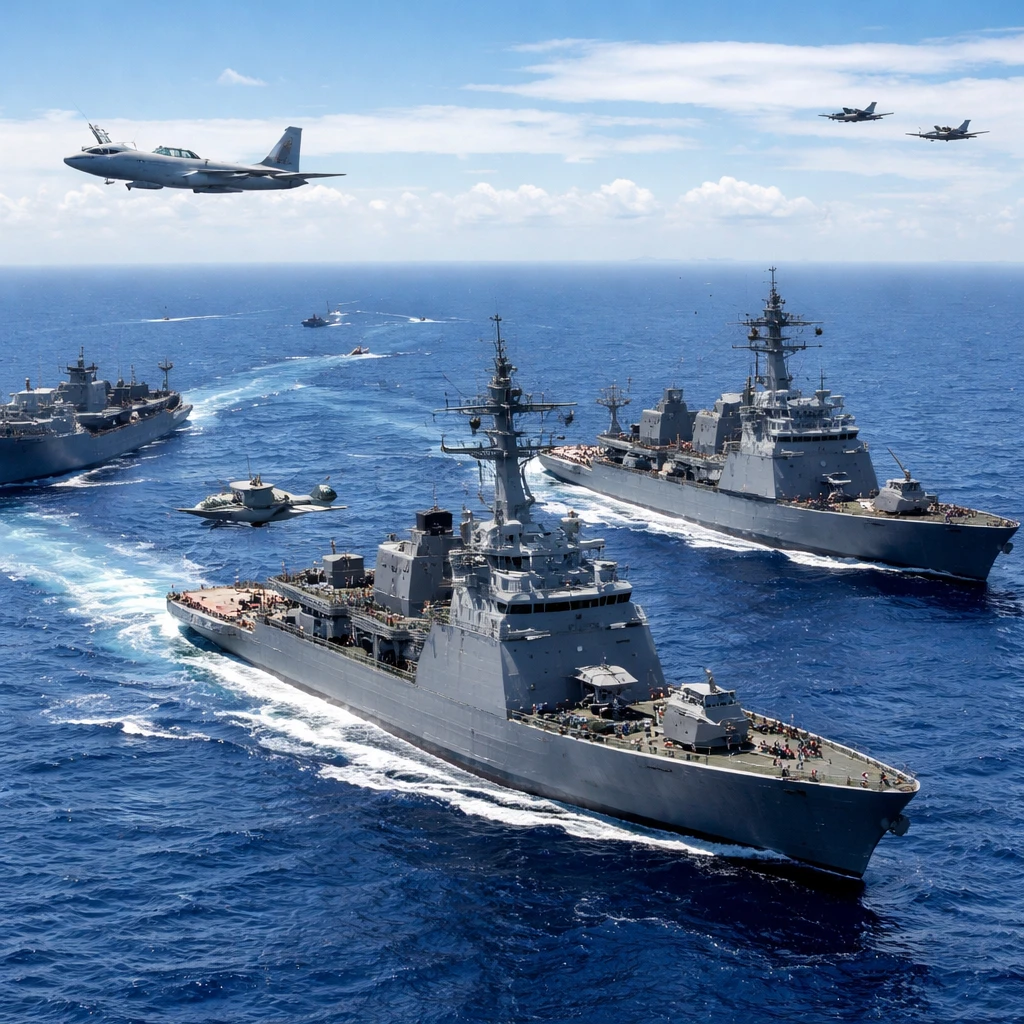
This week the navies of the Philippines, the United States and Japan carried out coordinated exercises in the South China Sea. The Philippine military described the operations as advancing partner interoperability, maritime security and Maritime Domain Awareness. Participating platforms included the Philippine frigate Antonio Luna, helicopters and fighter jets, a Japanese P-3 Orion, the U.S. guided-missile destroyer USS Dewey and a U.S. Poseidon plane. The maneuvers included replenishment at sea, joint air patrols, fly-bys and communications checks. The Philippines has also run similar drills with Australia and the U.S. earlier this month as it works with partners to assert maritime rights amid China’s competing claims to the waterway.

Philippines, Japan and U.S. Conduct Joint Naval Exercises in the South China Sea
Summarize with
ChatGPT Perplexity Claude Grok Gemini

Key Points

  • Trilateral exercises this week saw Philippine, U.S. and Japanese naval and air assets operate together, including the Philippine frigate Antonio Luna, helicopters and fighter jets; a Japanese P-3 Orion; and the U.S. guided-missile destroyer USS Dewey and a Poseidon plane. (Sectors impacted: defense, maritime security)
  • Training activities focused on replenishment at sea, joint air patrols, fly-bys and communications checks to improve interoperability and Maritime Domain Awareness among partner forces. (Sectors impacted: defense, military logistics)
  • The Philippines has increased cooperative operations since 2023 to assert maritime rights and entitlements amid competing claims over the South China Sea, and held similar exercises with Australia and the U.S. on February 15 and 16. (Sectors impacted: regional security, shipping and trade continuity)

MANILA, Feb 27 - Naval forces from the Philippines, the United States and Japan executed coordinated training operations in the South China Sea this week as part of an effort to deepen operational cooperation between the three partners, the Philippine armed forces said on Friday.

In an official statement, the Philippine military framed the activity as a demonstration of allied commitment to collective readiness, saying it "underscores the sustained commitment of partner forces to enhance interoperability, reinforce maritime security, and improve Maritime Domain Awareness in the region." The statement positioned the exercises as part of a broader pattern of cooperation that Manila has pursued since 2023 in asserting its rights and maritime entitlements in the contested waters.

On the Philippine side, the deployment included the frigate Antonio Luna as well as embarked helicopters and fighter jets. Japan contributed a P-3 Orion surveillance aircraft. The U.S. presence comprised the guided-missile destroyer USS Dewey and a P-8 Poseidon maritime patrol plane.

The drills encompassed a mix of at-sea and airborne activities. Participating units carried out replenishment at sea operations, coordinated joint air patrols and fly-bys, and conducted communications check exercises designed to test and refine inter-force information exchange and coordination procedures.

The Philippine armed forces noted that these trilateral activities are one element of a series of cooperative engagements. Earlier in February, the Philippines held comparable exercises with Australia and the United States on February 15 and 16.

The background to these exercises includes overlapping claims in the South China Sea. The statement reiterated that the Philippines has been working with a number of countries since 2023 to assert its maritime rights and entitlements. China maintains claims to most of the resource-rich waterway and has rejected a 2016 arbitral award that found against its historical claims, a factor that underpins the contested nature of the area.

The recent drills underline partner efforts to maintain readiness and shared situational awareness at sea through practical interoperability work - from logistics and air coordination to secure communications - while operating in an environment characterized by competing maritime claims.

Risks

  • Competing territorial claims in the South China Sea, including Chinas rejection of the 2016 arbitral award, create uncertainty for regional maritime security and may affect commercial shipping and resource exploration.
  • Greater frequency of multinational drills and closer military cooperation among regional partners could raise diplomatic friction or heighten geopolitical tensions, with potential implications for defense spending and market sentiment in related sectors.

More from World

Millennium-Old Kyiv Monastery Severely Damaged as Nationwide Attacks Kill 10 Jun 16, 2026 Lukashenko Urges Compromise as Stalemate Persists in Russia-Ukraine War Jun 15, 2026 Ecuadorean Candidate for U.N. Secretary-General Urges Responsible Downsizing of the Organization Jun 15, 2026 Bolivia Moves Toward Floating Currency as FX Unification Nears Jun 15, 2026 EU Keeps Three-Hour Rule for Flight Delay Compensation After Years of Talks Jun 15, 2026