
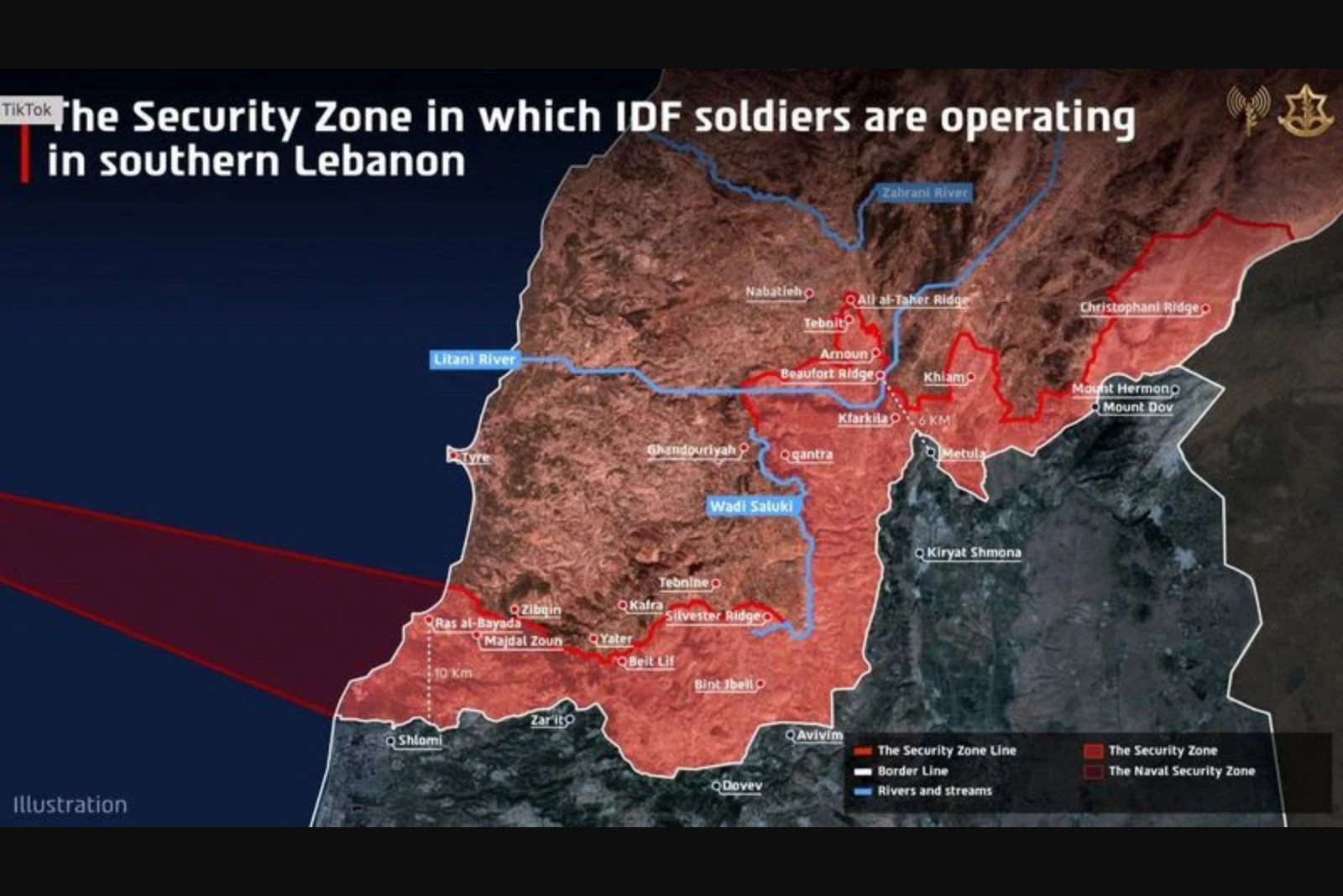
Israel's military published a new map on Thursday that delineates an enlarged zone of operations for its forces in southern Lebanon, showing troops several kilometres deeper into Lebanese territory than earlier public guidance. At the same time, two Israeli officials, one described as close to Prime Minister Benjamin Netanyahu, said Israel is engaged in talks with the United States about whether its deployment in southern Lebanon will continue.
The interim agreement signed on Wednesday to bring an end to the U.S.-Israeli war with Iran includes provisions calling for a halt to hostilities on all fronts - explicitly including Lebanon - and urges parties to uphold "the territorial integrity and sovereignty of Lebanon." Despite that language, Israeli authorities have rejected demands to withdraw their forces from southern Lebanon. Israel initially entered parts of southern Lebanon in March, in response to rocket fire it attributes to the Iran-backed Hezbollah militia.
Military operations and strikes attributed to Israel, along with the destruction of villages in the area, have resulted in thousands of deaths and triggered a displacement crisis. Hezbollah, for its part, has continued to attack Israeli positions in southern Israel in recent days. Those attacks have included the use of explosive drones that have caused fatalities and injuries among Israeli troops.
Officials directly involved in sensitive discussions with Washington, speaking on condition of anonymity, said Israel is pressing to maintain its troop deployment. A senior official close to Mr. Netanyahu described the negotiations with the United States as "stubborn." The outcome, one of the anonymous officials said, may hinge on whether U.S. leadership decides to escalate pressure by threatening repercussions if Israel does not comply with the terms of the interim pact.
The new map, released on Thursday, follows an earlier map published by the military in April that marked a so-called buffer zone in southern Lebanon. The updated map, with territory marked in dark red, identifies "the security zone in which IDF (Israel Defense Forces) soldiers are operating in southern Lebanon." It shows Israeli forces operating several kilometres deeper inside Lebanon than the previous public map, including areas near Nabatieh north of the Litani River. Military officials said troops have been active in some of these locations for several weeks, but had not previously published a map documenting the expanded zone of control.
Tensions between Israeli leadership and the U.S. president have become more visible since the interim agreement with Iran was announced. The U.S. president has been attempting to extricate American involvement from the war with Iran that the two governments had jointly pursued, and this effort has produced repeated clashes with Mr. Netanyahu. Israeli officials have expressed anger with the terms of the U.S.-Iran pact signed on Wednesday, saying it does not sufficiently address Israel's concerns about Iran's nuclear program and could limit Israeli military freedom in Lebanon.
The U.S. president has publicly criticized some Israeli military tactics in Lebanon, saying, in his view, it was unnecessary to bomb entire apartment buildings in operations aimed at locating Hezbollah militants. There has been no indication so far that the president's public comments will be followed by concrete measures - such as withholding military aid or slowing arms shipments - that could compel Israel to alter its military approach.
Israeli officials maintain that their troops will remain deployed in southern Lebanon. One official noted that whether the talks with Washington lead to any change will depend on whether the United States "decides to force the issue" by imposing consequences if Israel fails to adhere to the interim pact's terms.
The territory Israel has seized in recent operations in Lebanon, Gaza and Syria is described by Israeli authorities as "buffer zones" designed to separate the country from hostile actors - a central element of Israel's recent security policy. Observers have noted the language in the interim pact could be interpreted in more than one way. Jonathan Rynhold, a senior researcher at Bar-Ilan University, said the reference to Lebanon's territorial integrity and sovereignty implies Israel will be required to withdraw, but that the same language could be read as supporting efforts to prevent Hezbollah from retaining weapons on Lebanese soil because that is seen as a threat to Lebanese sovereignty.
Summary
Israel's military map shows forces operating deeper into southern Lebanon, while confidential talks with the United States are ongoing over whether those troops will remain. An interim U.S.-Iran agreement calls for an end to fighting and protection of Lebanon's sovereignty, creating a point of contention between U.S. and Israeli leaders.
Key points
- Israel released a new map marking a larger security zone in southern Lebanon, showing operations several kilometres deeper into the country and near Nabatieh north of the Litani River.
- Israeli officials say they are negotiating with the United States about continuing the troop deployment in southern Lebanon; senior Israeli sources describe talks as "stubborn."
- An interim pact linked to the U.S.-Iran conflict requires an end to fighting on all fronts and calls for the protection of Lebanon's territorial integrity and sovereignty, a provision that may constrain Israeli operations.
Risks and uncertainties
- Diplomatic uncertainty - Whether the United States applies tangible pressure on Israel to withdraw or modify deployments remains unclear; this could affect military assistance and bilateral coordination. (Impacted sectors: defense contractors, foreign military sales)
- Security escalation - Continued exchanges between Hezbollah and Israeli forces, including lethal explosive drone attacks, present a risk of further escalation and continued displacement of civilians. (Impacted sectors: regional trade routes, insurance for shipping and logistics in adjacent waters)
- Operational ambiguity - The interim pact's language on Lebanon's sovereignty leaves room for differing interpretations, creating uncertainty over the legal and operational limits of Israeli forces in Lebanon. (Impacted sectors: defense planning, risk assessment services)
As the negotiations with Washington proceed, Israel's publicly posted operational map marks a concrete shift in how the military is presenting its footprint in southern Lebanon. The coming days will reveal whether diplomatic pressure or political calculation determines the duration and scope of that presence.