
Zymeworks Inc (NASDAQ:ZYME) saw its shares rise 4.2% in premarket trading on Thursday after the company revealed a partnership with Gandeeva Therapeutics to produce cryo-electron microscopy-based structural data to support antibody drug discovery efforts.
According to a press release issued Thursday, the collaboration will concentrate on obtaining high-resolution images of antibody-antigen interfaces. Both companies are headquartered in Vancouver.
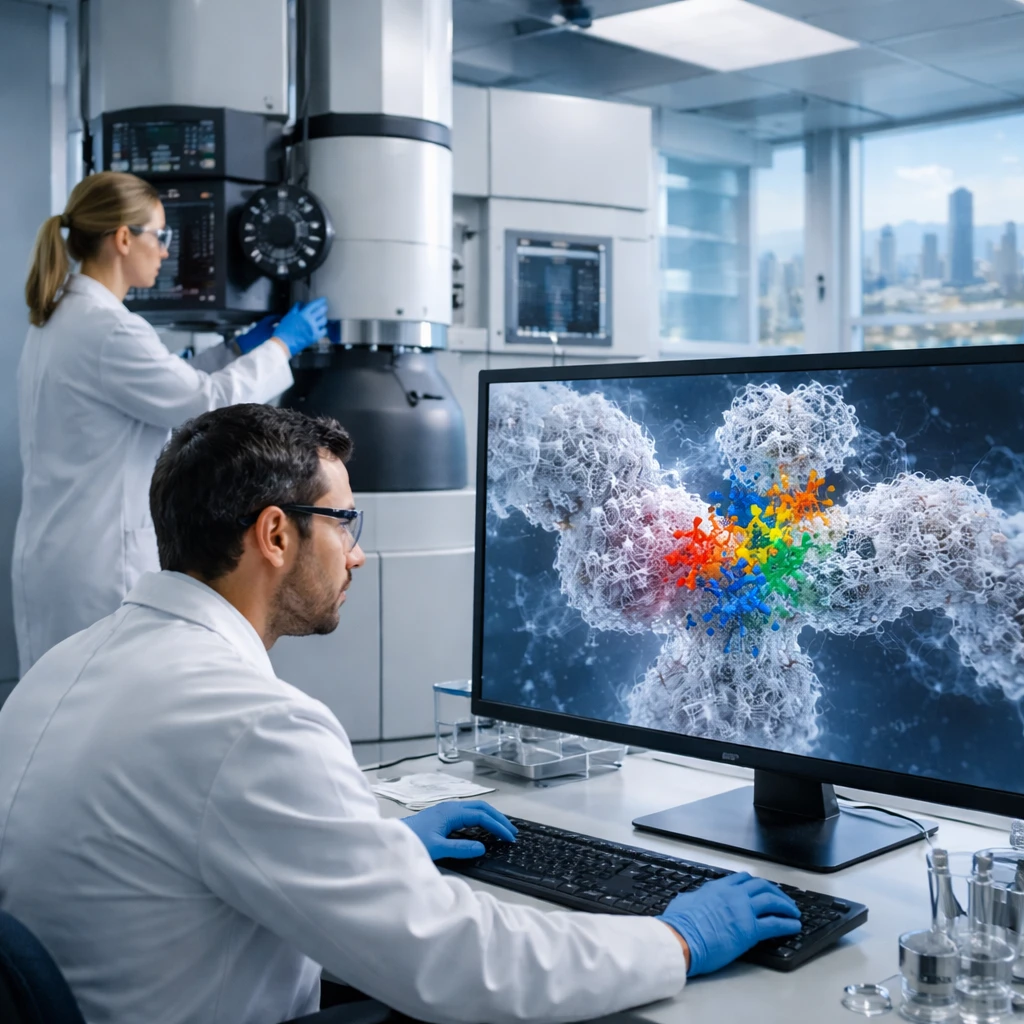
Gandeeva reported that its scientists were able to resolve the structure of a small, flexible antigen at 2.6 Å resolution. In that reconstruction the team successfully visualized the nine amino acids that constitute the antibody-binding epitope; however, the remainder of the antigen was described as highly flexible and did not appear in the final reconstruction.
The announcement frames the partnership as a response to a persistent technical challenge in the field - mapping the footprints of antibodies on small, flexible antigens. While cryo-EM is already a standard tool for determining structures of antibody complexes with compact, well-folded antigens, the work described by Gandeeva extends the technique into more conformationally variable targets.
"Knowledge of the precise interactions at the binding interface of these types of challenging targets is incredibly useful for us in selecting antibody leads and provides us with crucial insights for the optimization of biologics," said Dr. Paul Moore, Chief Scientific Officer of Zymeworks.
Gandeeva Therapeutics is described as a specialist in cryo-electron microscopy-driven drug design. The company’s platform is said to offer both high-resolution and high-throughput cryo-EM capabilities aimed at testing and validating antibodies that arise from immunization campaigns and from computational design approaches.
The partnership links Zymeworks' antibody discovery and biologics optimization goals with Gandeeva’s structural biology platform. The immediate technical highlight from Gandeeva - resolving an epitope of nine amino acids at 2.6 Å while the rest of the antigen remained unresolved due to flexibility - illustrates both the potential gains and the current limitations when applying cryo-EM to small, dynamic targets.
Investors responded quickly in premarket trading, pushing Zymeworks shares higher following the announcement. The collaboration is presented as a targeted effort to improve lead selection and downstream optimization for biologics, leveraging structural insights at the atomic level where attainable.
While the press release emphasizes the expanded capabilities enabled by Gandeeva’s approach, it also makes clear that highly flexible regions of some antigens may remain unresolved in reconstructions, a technical limitation highlighted by the single example provided.