
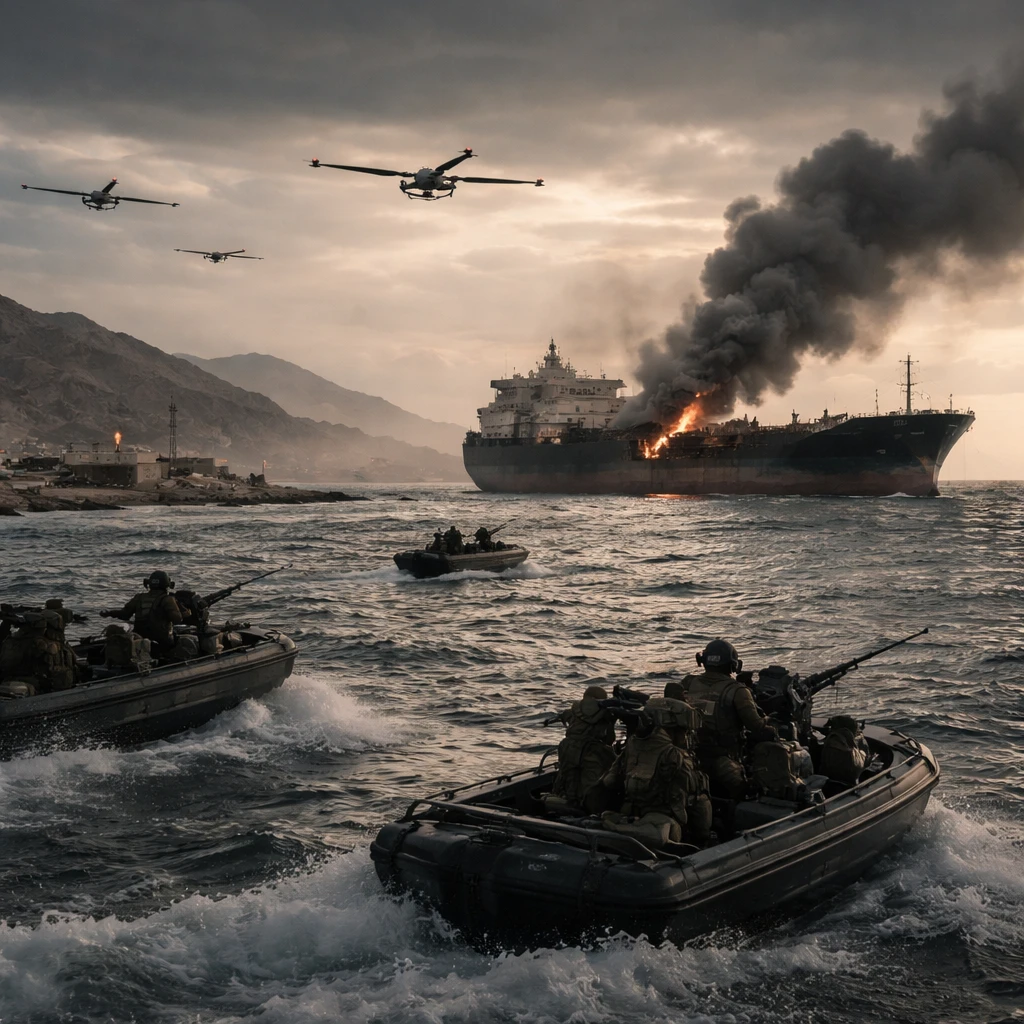
Yemen’s Iran-aligned Houthi forces carried out a new round of strikes on Saudi territory and were reported to be fortifying positions along Yemen’s western Red Sea coast, Yemeni officials said, as Saudi authorities and international partners weighed how to respond to the group’s rapid advances.
On Monday the Houthis announced they had fired dozens of missiles and launched drones at a military airbase in Khamis Mushait in southern Saudi Arabia. They said the strike targeted aircraft hangars, radar installations, runways and ammunition depots in what the group described as retaliation for Saudi air attacks in Yemen. Saudi civil defence agencies issued emergency alerts for Khamis Mushait and three additional cities in the country’s south.
The Saudi-led coalition in Yemen reported that 13 civilians were wounded in the Houthi strikes. At the same time, officials aligned with Yemen’s internationally recognised government said the Houthis have retained near-total control of the country’s western coastline along the Red Sea and were digging into defensive positions.
The Houthi push in recent days has included the capture of Perim Island at the entrance to the Red Sea. That development, along with an earlier aerial attack that knocked Saudi Arabia’s east-west pipeline offline, has intensified pressure on Saudi oil export routes. Riyadh has attributed the pipeline strike to Iranian-backed militias in Iraq. The pipeline in question stretches 1,200 kilometres (745 miles) across Saudi territory and was originally built in the 1980s to provide an alternative to the Strait of Hormuz when that waterway was threatened.
Traders warned that if pipeline operations remain suspended for an extended period, as much as 4% of global oil supply could be removed from the market while the Strait of Hormuz is largely blockaded. Saudi authorities have not announced a timeline for restoring the pipeline to service.
In response to the Houthi offensive, Saudi and Yemeni air forces have intensified strikes on Houthi positions, including areas around the port of Mocha, a site of historical and strategic significance on the Red Sea. Despite aerial bombardment, Yemeni government-aligned officials reported that the Houthis continue to exert effective authority over nearly the entire western seaboard.
“The Houthis are being put under heavy pressure. They in turn are putting more and more pressure on the Saudis, increasing their campaign of missile and drone attacks,” one Yemeni official said, describing a cycle of escalatory strikes and counterstrikes.
Global crude benchmarks reacted to the heightened risk, rising more than 4% at one point on Monday before settling roughly 1% higher by the end of the trading session.
Diplomatic efforts aimed at de-escalating tensions in the vital shipping lane have faltered. Oman had been set to host talks between Iran and Gulf states focused on reopening the Strait of Hormuz - which prior to the outbreak of hostilities carried roughly 20% of global oil exports. Oman announced the meeting would be postponed, and Iran said the postponement followed a request from Saudi Arabia.
U.S. President Donald Trump reiterated his contention that Iran was seeking a quick diplomatic deal, but Mohsen Rezaei, secretary of Iran’s Supreme National Security Council, dismissed the comment as a distraction on the social platform X, writing, “No talks until Iran’s conditions are met.”
The interruption to planned diplomacy comes as conflicting accounts emerged about damage to an oil tanker transiting near the Strait of Hormuz. Iran’s Revolutionary Guard Corps, without specifying a date, said the Panamanian-flagged oil tanker El Gaia was struck by sea mines while passing through a prohibited zone south of the Strait, according to Iran’s Fars news agency.
The U.S. military’s Central Command countered that account, saying the report was incorrect and asserting the tanker was “struck by an Iranian missile last month and rendered inoperable.” The International Maritime Organization said El Gaia was damaged on Saturday but did not specify the cause and reported that two seafarers were missing. Reuters was unable to immediately reach the ship’s owners in Dubai to verify the differing versions of the incident.
The strategic importance of the Strait of Hormuz has been undercut since the conflict began on February 28, with Iran declaring maritime restrictions and issuing threats to vessels transiting the channel without its authorisation. The Revolutionary Guards declared in a statement that “The IRGC Navy firmly declares that the Strait of Hormuz is closed and still under our smart control.”
As Riyadh convened urgent discussions on how to respond to the latest Houthi advances, the United States so far appears hesitant to commit to direct military intervention beyond intelligence support, according to three sources. Those sources said Washington had resisted Saudi requests for broader direct military involvement. President Trump said over the weekend that he had spoken with the Saudi crown prince and noted that the Houthis had appealed to Washington to remain on the sidelines.
Saudi state media reported that Crown Prince Mohammed bin Salman met with U.S. regional commander Admiral Brad Cooper in Jeddah on Monday, as the Saudis continue to seek international support while conducting operations with partners.
The conflict in Yemen, which Saudi Arabia has been engaged in since 2015 with a coalition fighting the Houthi movement, had been relatively subdued under a ceasefire in recent years. That relative calm has broken down this month as the Houthis have pushed back forces loyal to the internationally recognised government, capturing strategic positions and increasing attacks on Saudi infrastructure and military sites.
With the Red Sea coastline and critical shipping lanes at risk, market participants and regional capitals are watching closely for further developments that could affect oil flows, shipping security and the stability of neighbouring states.