
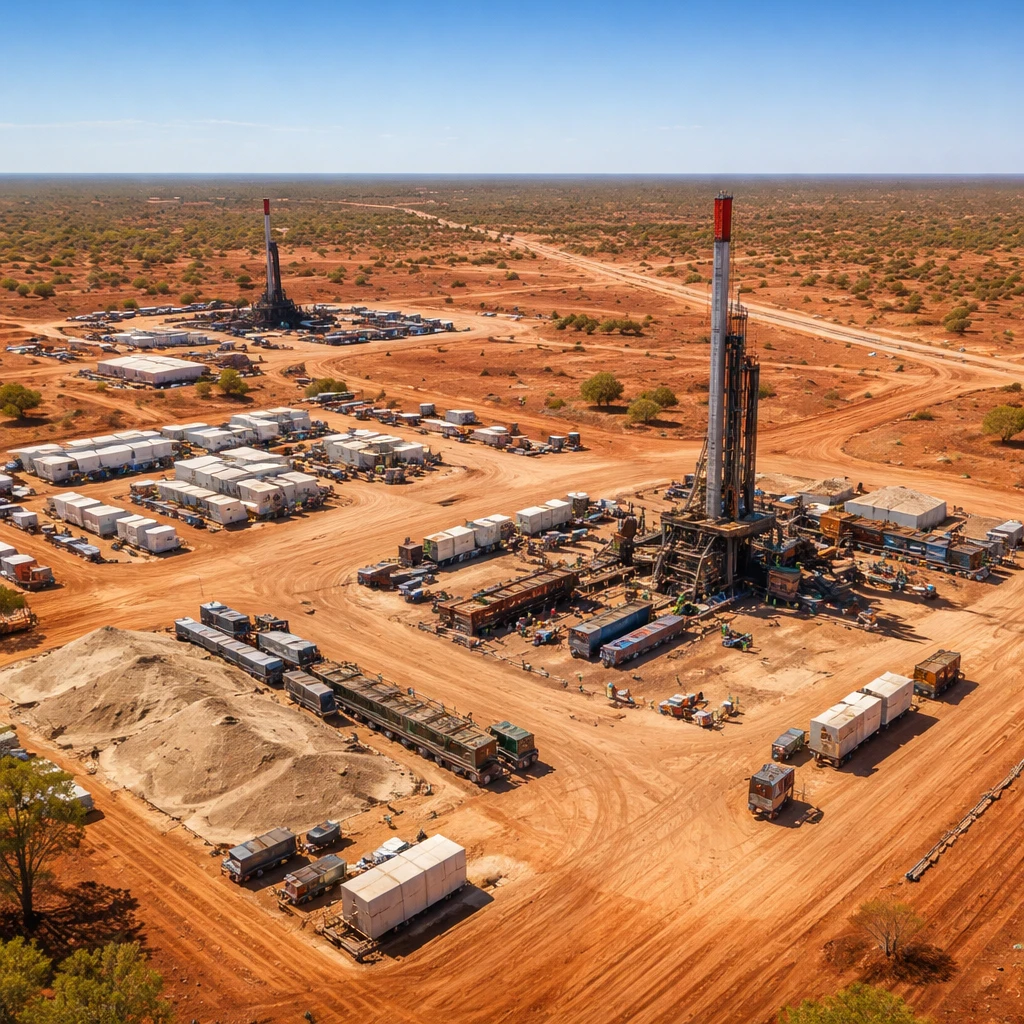
The companies developing the Beetaloo Basin have turned to U.S. capital, technology and operational experience as they seek to transform a remote Northern Territory shale play into a commercially viable source of gas. The formation produced its first gas this month, a milestone that developers say is only the start of a much larger build-out that will require substantial cost declines and major infrastructure investment.
Comparisons to the prolific Marcellus shale in the United States are common among industry participants, but the Beetaloo’s isolation amplifies economic challenges. Building the pipelines and related infrastructure to connect the basin to export facilities will require billions of dollars, developers say, while the region currently lacks the deep supplier networks and infrastructure of mature U.S. basins.
To bridge that gap, Australian project partners have imported U.S.-made rigs and sought U.S. financing and services. Tamboran Resources, one of the operators, said it received initial support from U.S.-based fracking and services firms and has deployed high-powered rigs sourced from Helmerich & Payne. Tamboran and its partners also count financial and operational backing from entities linked to U.S. oilfield services players.
At a recent ceremony marking the delivery of an inaugural 40 terajoules of gas to Darwin, Tamboran’s chief executive - a Texan with extensive U.S. shale experience - described the local regulatory and political environment as unusually supportive, citing the Northern Territory government’s strong backing for development.
Even with political support, developers say the basin must reduce first well costs materially to reach its full potential. Industry executives estimate well costs need to fall by roughly 40% to 60% relative to current levels in the Beetaloo before large-scale development and reliable LNG feedstock from the basin are economically realistic. Some developers aim for production of 1,000 terajoules a day, a level they say could supply two liquefied natural gas trains, but they are treating that target cautiously while they assess well performance.
Operational discipline is a stated priority. Companies active in the basin say they are applying lessons learned from U.S. shale development - particularly the pitfalls of prioritising drilling volume at the expense of sales and cash flow. Rather than open the taps and scale immediately, Tamboran and partners are focused on initial gas sales intended to shed light on well decline rates and reservoir behaviour before committing to broader development plans.
Formentera Partners, a Texas-based operator with a stake in the Beetaloo project, has emphasised that early-stage activity has been shaped by a desire to emphasise cash flow and EBITDA discipline. Formentera reported plans to drill its own acreage in the basin next year and noted the parties involved in appraisal and early production have spent about A$1 billion, equivalent to $722 million, on exploration and appraisal work so far.
Cost control and supply chain development are central to the next phase. Drilling and completion costs in the Beetaloo remain substantially higher than those in mature U.S. shale basins. Halliburton’s Eastern Hemisphere president pointed to an evolution in U.S. rig utilisation and efficiency that has reduced rig counts as productivity rose, noting that U.S. rig use had fallen about 30% as efficiency improved. Industry participants in the Beetaloo are targeting similar efficiency gains.
Developers and service providers report measurable improvements between drilling campaigns in the basin - roughly a 25% improvement in completion efficiency, according to operators. One service provider estimated that adopting continuous drilling practices alone could cut rig-related costs by about 30%.
Another element of the cost-reduction strategy is developing local supplies for hydraulic fracturing inputs, including sand. Expanding local supplier capacity and growing the regional workforce would reduce the need to haul equipment and materials over long distances, trimming logistics costs and improving project economics.
Industry leaders have urged greater collaboration across operators and service companies to sustain the pace of efficiency gains. As one senior executive put it, the basin has reached a stage where cooperation across the industry will be necessary to scale up activity while controlling costs.
Context for investors and markets
- The Beetaloo Basin’s first gas mark is an operational milestone but far from proof of economic success; developers are emphasising early discipline to understand reservoir behaviour before large-scale capital deployment.
- U.S. equipment and expertise are being deployed to transfer technology and operational practices, while developers and service firms discuss significant cost reduction targets to reach commercial scale.
- Major infrastructure needs - notably pipelines - mean the basin’s development will require substantial additional capital beyond current exploration and appraisal expenditures.