
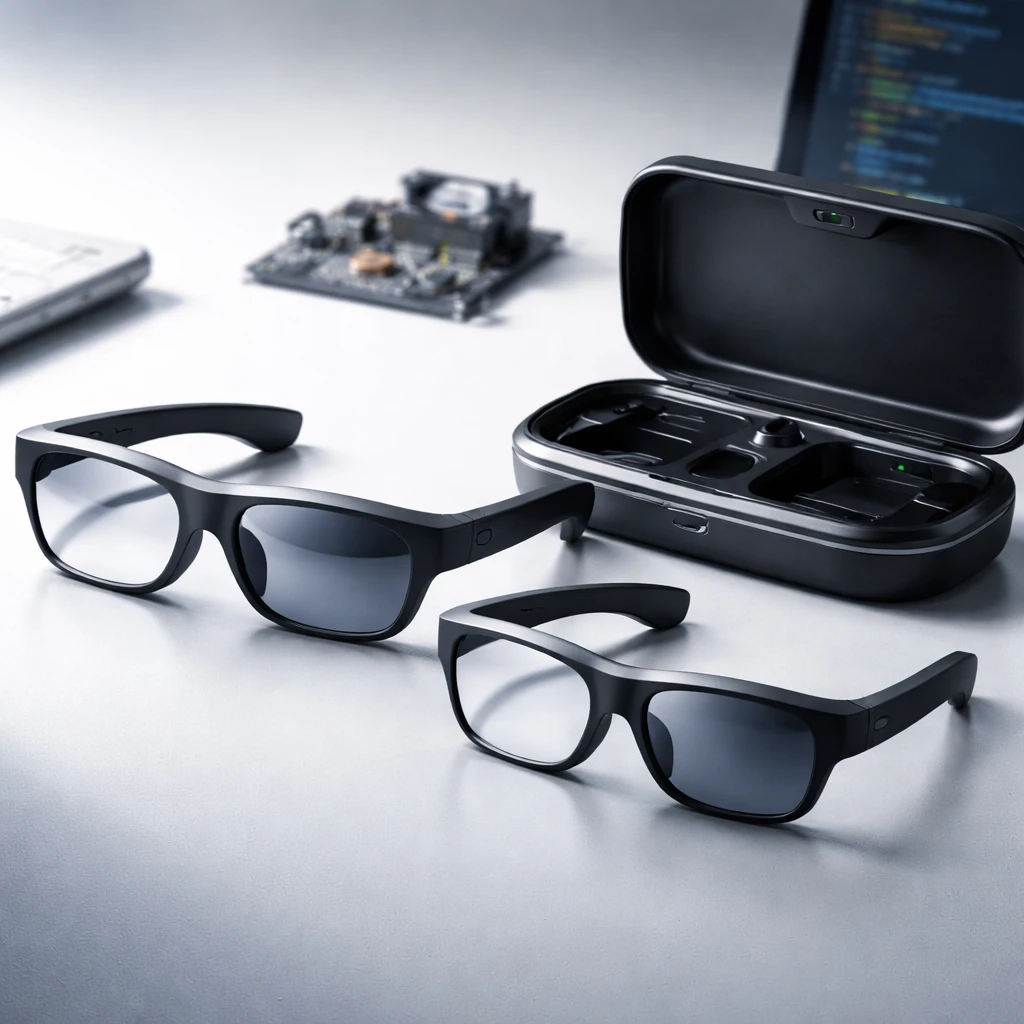
Snap Inc. shares rose by more than 3% on Tuesday following the company's public unveiling of SPECS, a new standalone augmented reality glasses product introduced at Augmented World Expo 2026.
SPECS are available to pre-order at $2,195 with a refundable deposit of $200. Snap said the glasses are expected to ship this fall in three initial markets: the United States, the United Kingdom and France.
The product is designed to operate independently, without relying on an external processing unit or tether to a smartphone or other device. Customers may choose between two frame sizes - a 47 mm model and a 52 mm model - with the smaller variant weighing 132 grams and the larger one weighing 136 grams. Both frames are constructed from Swiss TR90 polymer and accept removable prescription inserts.
For visual rendering, Snap is using its proprietary liquid crystal on silicon (LCOS) display technology. The company reported a 51-degree field of view and color support of 16 million colors. Snap described the viewing experience as comparable to a 24-inch desktop monitor for productivity tasks and the equivalent of a 115-inch screen for video playback. The SPECS lenses incorporate electrochromic technology that transitions from clear to tinted in about 10 seconds.
Hardware details include two Qualcomm Snapdragon processors on board: one processor dedicated to computer vision workloads and a second devoted to running Snap's AR applications, known internally as Lenses. Snap reported motion-to-photon latency of 7 milliseconds. The company quoted battery life of up to four hours of mixed use for the glasses themselves, and the supplied charging case provides four additional full charges, extending total possible device usage to as much as 20 hours.
On the software and developer front, Snap said it has filed more than 7,000 patents related to SPECS development. Over the past 18 months the company delivered 10 Snap OS updates, adding in excess of 40 new features and application programming interfaces. Developers have published hundreds of Lenses compatible with the SPECS platform.
Snap also announced a set of developer tools aimed at accelerating third-party content and functionality for SPECS. These include a preview of an agentic development framework for building SPECS Lenses within Lens Studio, and stated compatibility with AI coding tools such as Claude Code, Codex and Cursor. The company released a SPECS Spatial Benchmark to aid developers in evaluating how AI models handle spatial tasks, and a Native Development Kit that permits C and C++ code to be integrated directly into Lenses.
Several partners and integrations were highlighted: Niantic Spatial is using the Native Development Kit to bring its Visual Positioning System to SPECS, and Mapbox ported its Navigation Engine to the platform in under two hours, according to Snap.
Commerce functionality will be available at launch via a Commerce Kit that enables purchases and subscriptions from within Lenses. The hardware also includes an LED indicator that activates while recording is in progress.
Market reaction - The company’s share-price movement followed the product announcement and availability details disclosed at the expo.