
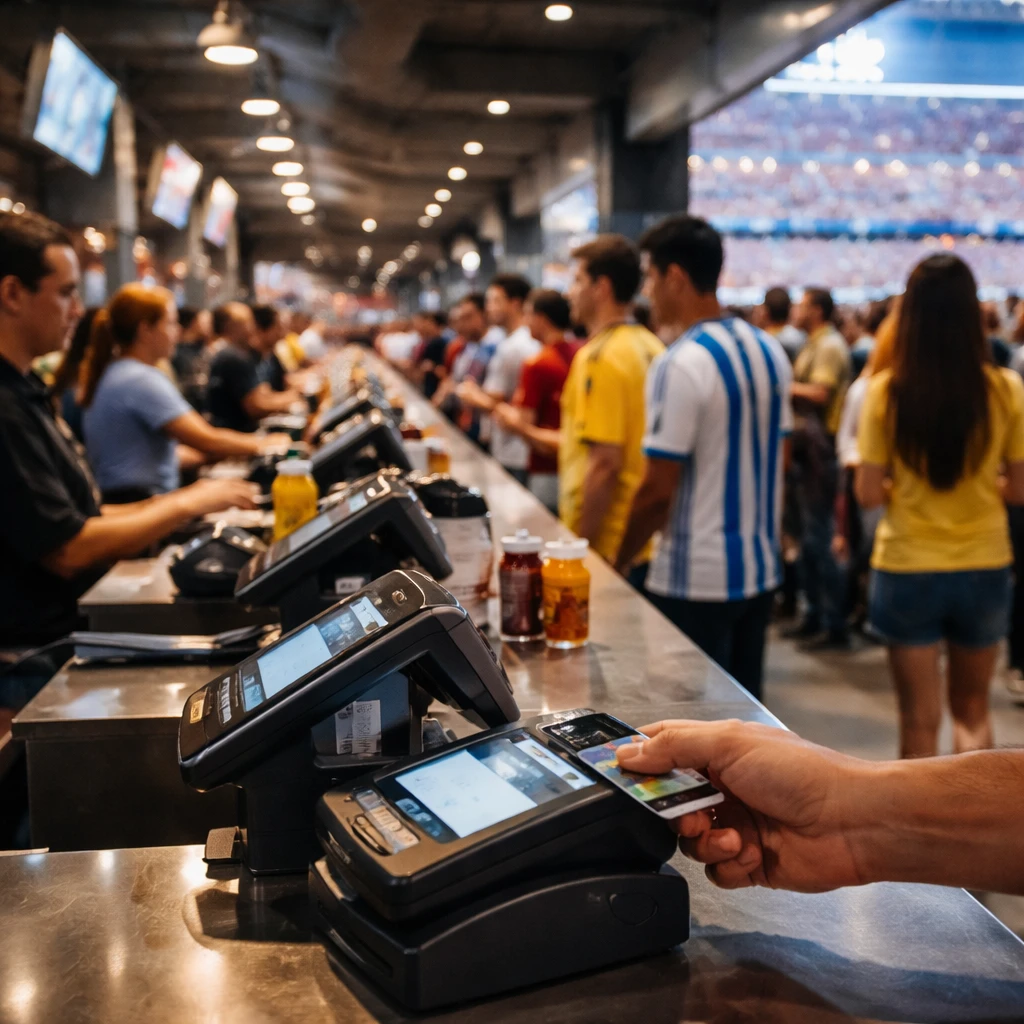
The 2026 FIFA World Cup, staged across venues in the United States, Canada and Mexico, is one of the most widely viewed sporting events on the global calendar. Beyond the spectacle for fans, the tournament places intense attention on the payments and commerce systems that keep stadiums, hotels and restaurants operating. One of the firms deeply involved in that plumbing is Shift4, which processes transactions at MetLife Stadium - the site of the World Cup final - and at Hard Rock Stadium in Miami, in addition to supporting a broad mix of hotels and smaller merchants.
In an exclusive question-and-answer session, Shift4 CEO Taylor Lauber discussed how the company views the tournament, what it means for product capabilities, and how the event ties into the company’s recent strategic moves and financial trajectory.
Built for spikes, not built for panic
Millions of attendees moving through stadiums, restaurants and hotel lobbies generate transaction patterns that differ sharply from ordinary daily volume. Yet Shift4 regards handling bursts of traffic as an intrinsic part of its operating model. When asked whether the World Cup required incremental capital spending or special preparations, Lauber characterized the tournament as not fundamentally different from other high-demand occasions.
"A popular concert can often attract as many or even more fans than a sold-out sporting event, so supporting sharp spikes in transaction volume is already core to what we do at Shift4," he said. The implication from Lauber’s remarks is that the same systems the company deploys for large-scale entertainment and retail moments are what will be in service at World Cup venues, and that no exceptional investments were necessary to accommodate the tournament’s scale.
Lauber framed the World Cup as amplifying the visibility of already-deployed capabilities rather than introducing new technical risk or material cost burdens. "The World Cup is perfectly suited to showcase our strengths," he said, adding that the tournament highlights "the infrastructure and capabilities we've already built."
International visitors and the Global Blue effect
A surge of overseas attendees alters the transactional mix and draws attention to take rate dynamics - the share of each transaction a payments company retains. Lauber acknowledged that shifts in customer mix have an influence, but he described the firm's position as stable.
"While international expansion and larger merchants can augment that, we feel good about where we are today and where we're going," Lauber said. The confidence he cited is linked to the company’s acquisition of Global Blue, completed in July 2025. Lauber highlighted capabilities brought by that deal, stating that "Global Blue has also introduced new capabilities like dynamic currency conversion, which can both enhance spread and reduce costs for merchants."
According to Lauber, Global Blue adds functionality that both improves the merchant value proposition and creates potential synergies in how international transactions are handled. With millions of foreign fans using the company's infrastructure during the tournament, the World Cup becomes a live setting in which to validate those capabilities and assess any uplift to a blended take rate.
Stadiums as demonstrations for a broader product story
While stadium deployments are likely to draw the most immediate attention during the World Cup, Lauber emphasized that such high-profile use cases serve as demonstrations for Shift4’s broader suite of services. "When customers see our platform perform during moments of peak demand, like during the World Cup or at halftime during the Super Bowl, it gives them confidence that Shift4 can scale alongside their businesses," he said.
That real-time visibility, Lauber argued, converts into a clearer sales narrative. "You can explain the benefit of integrated commerce but seeing it in real time is like a light bulb moment," he said. The practical effect, he suggested, is that prospective clients see the platform operating under stress conditions and gain conviction that the company can support their customer experiences and operational demands.
Addressing the stock's performance
Lauber did not avoid questions about the company’s recent share-price weakness. He acknowledged a disconnect between the operational progress the company reports and its market valuation. "We agree that the recent performance of the stock doesn't reflect the underlying performance of the business," he said, noting in that context historical revenue growth and adjusted profitability trends.
He attributed part of the stock's pressure to a broader environment of skepticism and concerns about how artificial intelligence may affect businesses across sectors. "I believe the current environment reflects a general skepticism in the sector and a broader fear of how AI will impact businesses across industries," Lauber observed. Despite these external headwinds, he said the company remains internally focused: "For now, we continue to generate strong cash flow and are focused on what we can control: executing on our strategy, the ongoing integration of Global Blue, and creating long-term value for shareholders."
Bottom line
For Shift4’s leadership, the World Cup functions less as an existential test and more as a public demonstration. It provides a concentrated window in which the firm can display high-volume reliability, international payment features, and a payments ecosystem that reaches beyond stadium gates to hotels and smaller merchants. The company sees the event as a chance to validate recent product additions and to reinforce sales conversations with tangible, real-time proof points.
As Lauber put it, the tournament is an opportunity to show, in a high-profile venue, the capabilities the company says it has been building for years.