
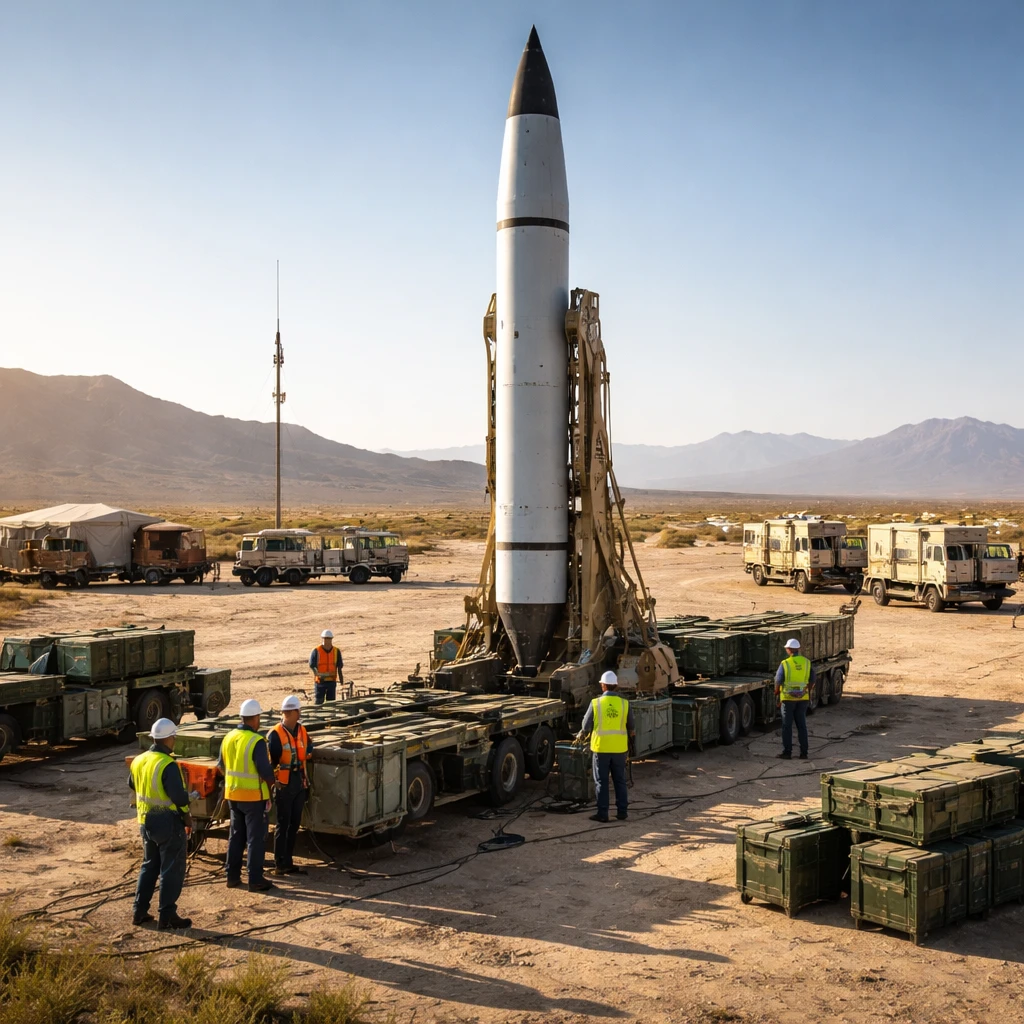
Northrop Grumman Corp. (NYSE:NOC) has been contracted by the U.S. Department of Defense to provide extended flight-test support for ballistic missile targets and to deliver integrated logistics support for Missile Defense System testing, the department announced today. The award is valued at $508.5 million and was made on a noncompetitive basis.
The work covered by the missile-support contract will include services for remaining Intermediate Range Ballistic Missile (IRBM) and Intercontinental Ballistic Missile (ICBM) targets. Contract performance is scheduled to take place in Chandler, Arizona; Corinne, Utah; and Elkton, Maryland, with activity running from September 2026 through August 2035.
The Missile Defense Agency, based in Huntsville, Alabama, awarded the missile-support tasking and has obligated $8.8 million in fiscal 2026 research, development, test, and evaluation (RDT&E) funds toward the effort.
In a separate award, Northrop Grumman Systems Corp. - Marine Systems received a $111.4 million contract to provide maintenance, overhaul, repair, and long-lead material for ship service turbine generators used by the Virginia-class nuclear-powered attack submarine fleet. That agreement is structured as a firm-fixed-price and cost-only, indefinite-delivery/indefinite-quantity contract and carries options that could raise the total contract value to $253.3 million.
Work on the submarine turbine contract is to be carried out across multiple locations: Sunnyvale, California (40%); Norfolk, Virginia (15%); Kittery, Maine (15%); Bremerton, Washington (15%); and Pearl Harbor, Hawaii (15%). The schedule anticipates completion by August 2031, or by August 2034 if all options are exercised.
The Naval Sea Systems Command in Washington, D.C., issued the submarine award on a sole-source basis under 10 U.S. Code 3204(a)(1). At the time of the award, no funds were obligated; funding will be provided on individual orders as they are issued under the contract.
The pair of awards cover distinct elements of defense procurement: one focused on supporting flight testing for ballistic missile targets and missile defense evaluations, and the other on sustaining key propulsion-related equipment for an active submarine class. Contract structures differ between the two awards, with the Missile Defense Agency obligating a portion of RDT&E funds up front for the missile-support work, while the submarine contract will receive funds when individual task orders are placed.
These contracts establish multi-year work streams across several U.S. sites and span both logistics and technical maintenance scopes, with potential option-driven extensions in total value and performance duration.