
Shares of Laser Photonics Corporation (NASDAQ:LASE) jumped 22.6% on Tuesday following the company's announcement that it delivered an approximately $0.8 million robotic laser cleaning cell to Vander-Bend Manufacturing, a precision sheet metal supplier serving the data center supply chain.
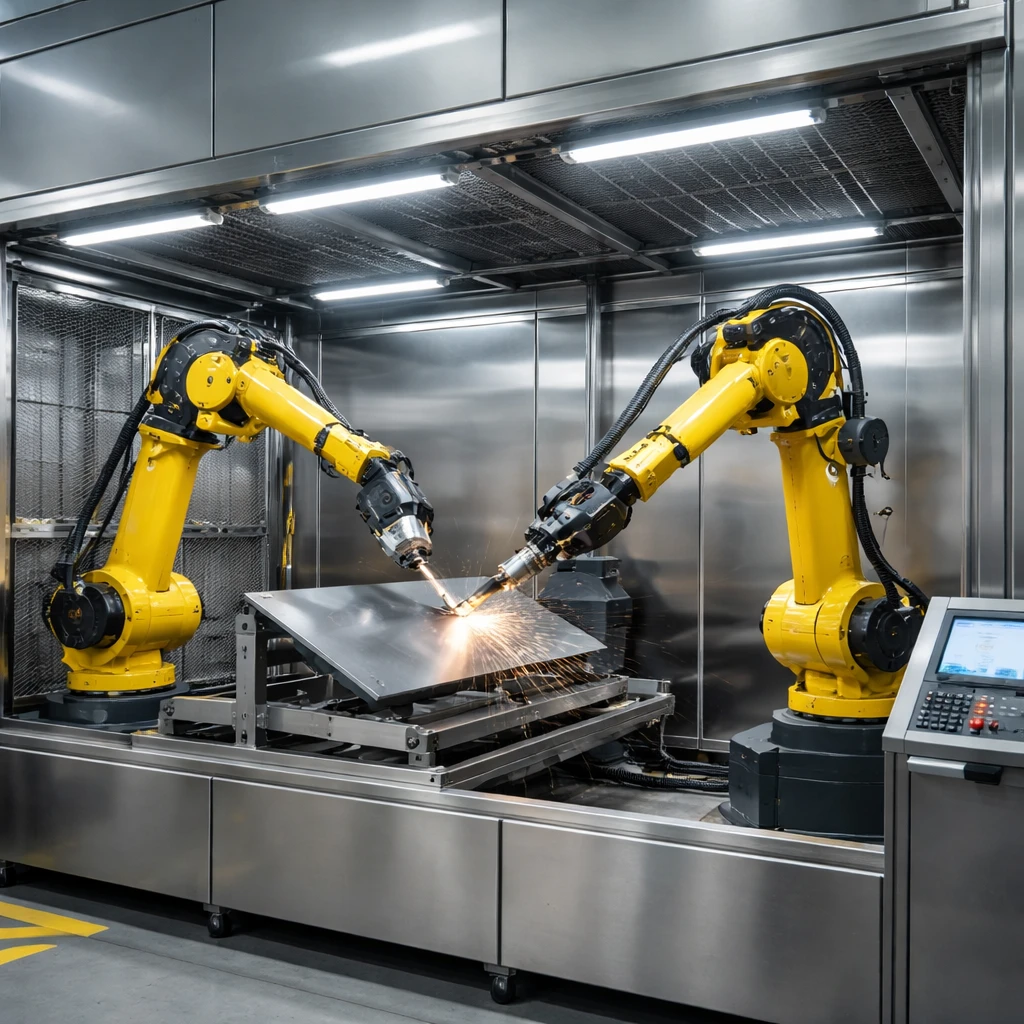
The order represents Laser Photonics' initial foray into the data center infrastructure supply chain. The company said the delivered unit is a fully enclosed robotic cell designed to automate pre-weld surface preparation of zinc-coated sheet metal panels that are used in data center manufacturing.
According to the company, the system operates with two coordinated robots. One robot positions parts at the cleaning station, while the other guides a laser ablation head to remove coatings from weld zones. Laser Photonics described the manual approach previously used at such stations as slow and inconsistent, creating production bottlenecks.
Key to the system's design is programmability by part type rather than a single, dedicated application. That allows Vander-Bend to route different components through the same cell by selecting the appropriate program, rather than needing a distinct machine for each part. Laser Photonics characterized this versatility as a horizontal capability that can be deployed across operations.
"This delivery marks our entry into the data center infrastructure supply chain, one of the most dynamic and capital-intensive sectors in the U.S. economy today," said Wayne Tupuola, Chief Executive Officer of Laser Photonics. "Data center demand is accelerating, and the constraint for the suppliers building this infrastructure is increasingly labor and consistency on manual processing steps."
The company noted that the cell format is applicable to manufacturers that perform surface preparation ahead of welding, coating, or bonding. It identified potential opportunities across defense, semiconductor, medical device, and electric vehicle battery markets. Laser Photonics manufactures laser systems for industrial and defense applications.
While the disclosed order is roughly $0.8 million in value and represents a first supply chain entry for data center-related work, the company framed the cell as a broadly applicable tool for surface preparation tasks where manual methods have constrained throughput or consistency.
Implications for manufacturers include reduced reliance on manual pre-weld cleaning steps and the ability to process multiple part types on a single automated cell. For the data center equipment supply chain, the cell targets a known production choke point by automating a previously slow and inconsistent process. The broader markets cited by the company - defense, semiconductor, medical devices, and EV battery manufacturing - could also see applicability if adoption extends beyond this initial delivery.