
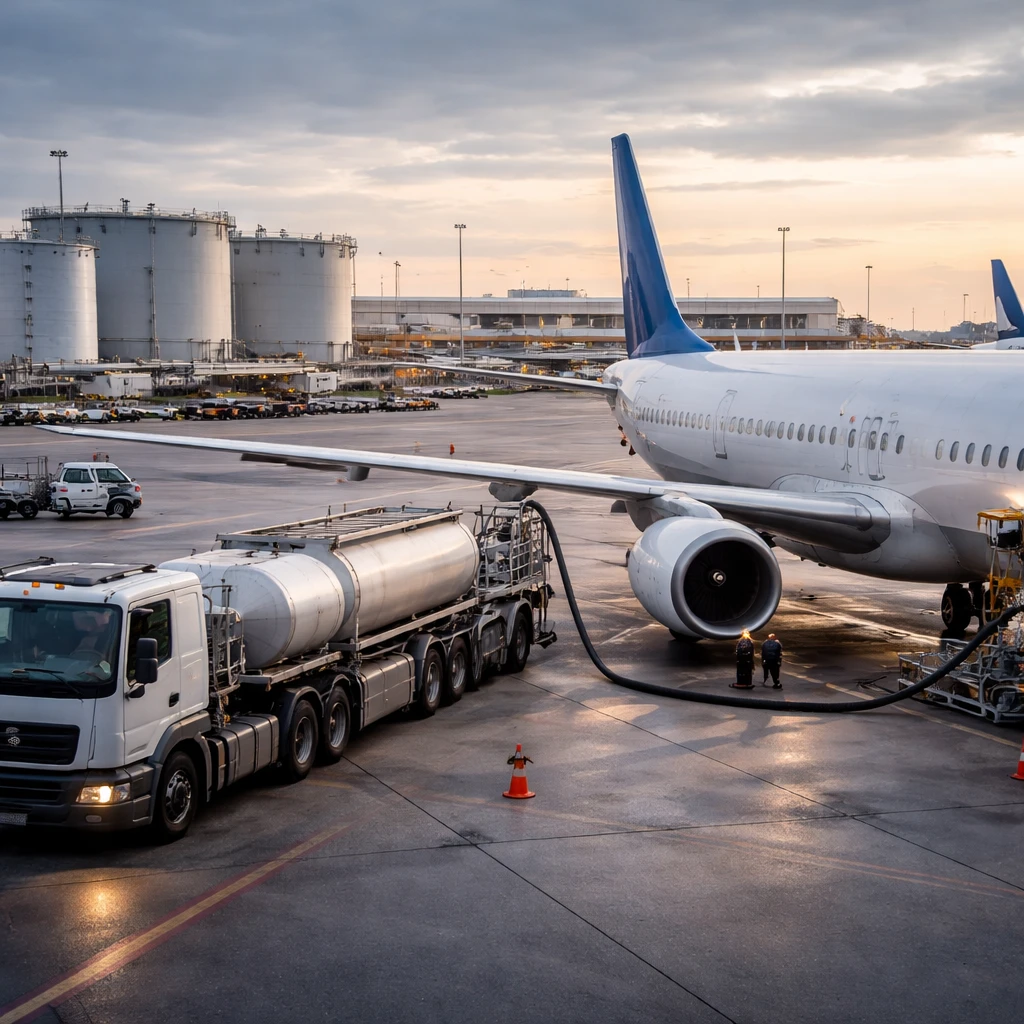
JPMorgan has reduced its earnings estimates for European airlines by an average of 23% for the current financial year, pointing to a sharp rise in jet fuel prices tied to the ongoing conflict in the Middle East. The bank’s analysts warn that marking costs to current spot and forward fuel rates would substantially squeeze sector profitability.
Using spot and forward jet fuel prices in their first-year modelling, JPMorgan calculates that, before any mitigation measures, the average impact on sector EBIT would be a decline of about 35% - a figure that excludes Wizz Air from the average. The analysts note a worst-case scenario in which spot prices stay elevated for the remainder of 2026 would push the average EBIT hit to around 54%.
To reflect differing business models, JPMorgan applied differentiated pass-through assumptions. For low-cost carriers it assumed zero incremental fuel cost pass-through in the first year, whereas for flag carriers it modelled 75% pass-through through higher ticket prices. That assumption narrows the estimated EBIT impact for flag carriers to about 16% on average in the first year.
For the second year of their forecast horizon, JPMorgan assumes fuel prices remain roughly 10% above their prior projections.
Beyond the elevated price level, availability of jet fuel has emerged as a significant operational risk. The analysts report that European airlines and airports currently have visibility of only four to six weeks of fuel supply. They cite ACI Europe’s warning that airports could face shortages within three weeks if the Strait of Hormuz remains closed.
The United Kingdom is identified as particularly vulnerable to supply disruption, with about 60% of its jet fuel imports coming from Gulf countries. Analysts led by Harry Gowers highlighted that Jet2, easyJet and IAG have the largest share of U.K. point-of-sale exposure, increasing their relative risk if supplies through the Strait of Hormuz are interrupted.
On demand, JPMorgan’s team describes conditions as broadly resilient for the moment. They point to strength on Transatlantic and Europe-Asia routes, partly driven by the rerouting of traffic away from Middle Eastern carriers. Conversely, demand weakness is largely concentrated in countries close to the conflict zone - specifically Turkey, Egypt and Cyprus - where carriers including Jet2 and easyJet have their highest capacity exposure.
Given the expected fuel impact and the differences in business models, the analysts say they now prefer flag carriers to low-cost airlines. The rationale is that flag carriers are assumed to be better able to pass fuel-related costs on to passengers, have stronger positioning on long-haul and premium routes, and face competition from peers that are generally less hedged globally.
Within that preference, IAG was identified as a potential buying opportunity. The stock is down about 15% since before the conflict, and JPMorgan wrote that IAG "may have 'over-corrected' versus our estimate changes, and offers exposure to more supportive supply-demand dynamics, idiosyncratic margin drivers and high FCF generation."
JPMorgan also maintained an Overweight rating on Ryanair, describing it as "most defensive in any downturn or ongoing uncertainty given its hedging, cost structure and balance sheet." easyJet was retained at Underweight, while Lufthansa, Wizz Air and Jet2 were left at Neutral.
Analyst context
JPMorgan’s actions combine updated spot and forward fuel pricing with differentiated pass-through assumptions across carrier types, producing materially lower earnings expectations for the sector in the near term. The balance of risks spans commodity price levels, short-term supply access and concentrated regional demand weakness.