
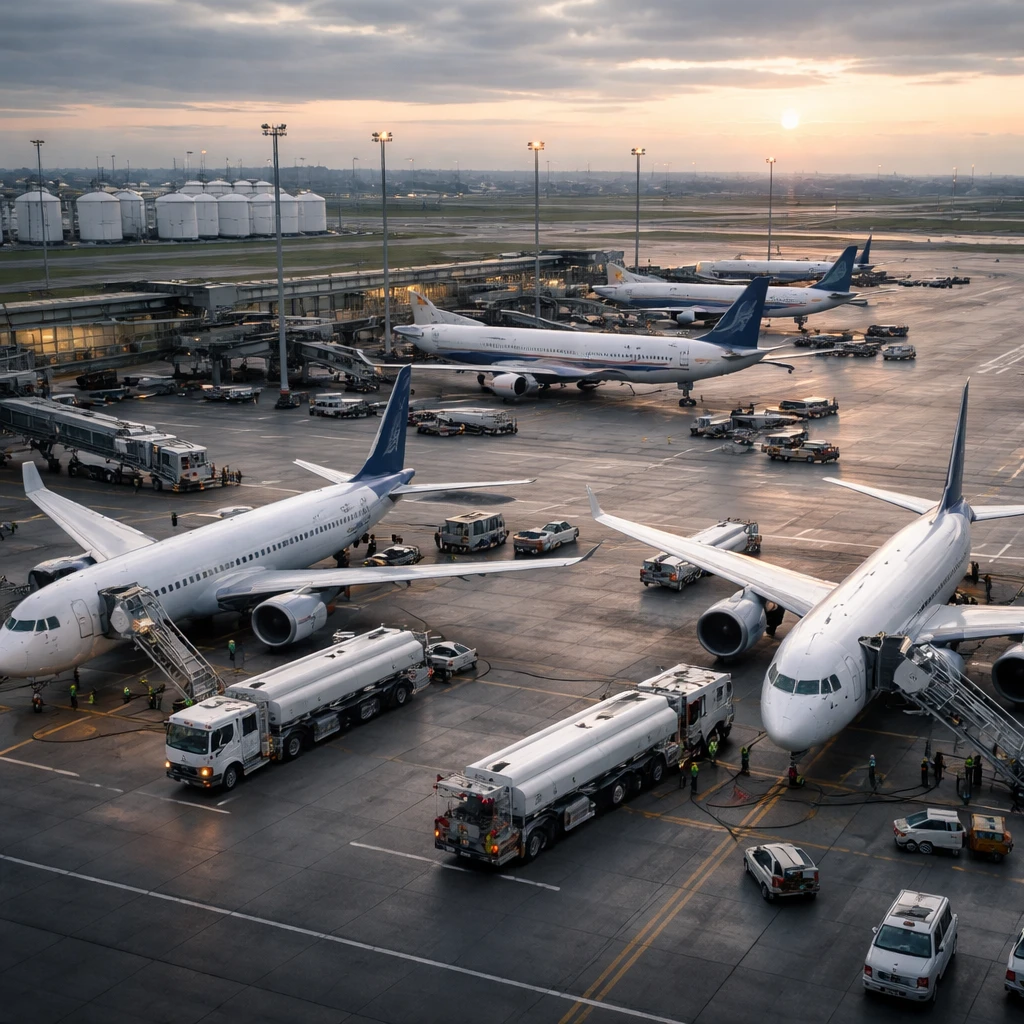
JPMorgan analysts are warning that a shortage of jet fuel could create significant operational strain for European airports and airlines over the summer months. The bank’s assessment points to a combination of low pre-conflict stock levels and heavy dependence on Middle Eastern imports as the main vulnerabilities, with Frankfurt’s Fraport operations and Vinci’s U.K. airports among those judged most exposed in the near term.
Europe sources more than 30% of its jet fuel from overseas, and roughly 70% of those imports originate in the Middle East. With the Strait of Hormuz remaining closed, JPMorgan notes that commercial jet fuel inventories before the conflict were already below 40 days of cover in aggregate, and in some countries those stocks were as low as 20 days - levels the analysts say could trigger wider shortages.
JPMorgan models several supply-replacement scenarios. If only half of the lost Middle Eastern imports are replaced, inventory cover could fall below critical thresholds as early as June. Even with a 75% replacement of lost volumes, the bank’s scenario analysis suggests the breach would occur by August. Those outcomes reflect the limited buffer in Europe’s aviation fuel stockpiles going into the period.
Exposure varies markedly across airports. Aena and ADP are judged relatively insulated because their fuel supply chains draw on refineries fed by crude from outside the Middle East - ADP’s facilities benefit from North American crude sources, while Aena’s Spanish operations receive crude from Africa, Brazil and North America. Switzerland’s Zurich Airport has an additional safeguard, supported by at least three months of aviation fuel reserves.
Conversely, Frankfurt is more vulnerable. The airport maintains roughly one week of contingency supplies and depends heavily on the NATO pipeline system, which JPMorgan notes has experienced disruption due to military usage. Fraport’s Greek airports carry even slimmer contingency stocks - around half a week. Vinci’s U.K. assets, including the likes of Gatwick and Edinburgh, are singled out as high risk because the U.K. sources about 60% of its jet fuel imports from the Middle East and has limited domestic refining capacity.
The picture for airlines is uncertain. JPMorgan reports that fuel supply is contractually assured only through mid-to-late May, after which visibility deteriorates sharply. If shortages occur, the bank expects airlines to begin cutting capacity in June, focusing first on domestic and marginal routes where load factors and revenue per seat tend to be weaker.
From a financial perspective, JPMorgan estimates that each 1% reduction in summer flying capacity could translate into roughly a 2% reduction in full-year EBIT on average. The impact would therefore be asymmetric across operators depending on network mix and geography.
U.K.-centric carriers are highlighted as particularly at risk. Jet2 has about half of its flying capacity allocated to the U.K., easyJet has just over 30% and IAG has over 20% exposure to the U.K. market. Separately, Ryanair’s chief executive has described a low-to-moderate risk that between 10% and 25% of Ryanair’s fuel supply could be at risk during May and June.
JPMorgan also notes that the conventional distinction between flag carriers and low-cost airlines may not reliably indicate vulnerability. Hub airports could enjoy supply-chain advantages over smaller regional facilities, which may benefit some flag carriers relative to parts of low-cost carriers’ networks, but the bank stresses that risk is often dictated by country-level supply chain structures rather than airline business model alone.
From a route perspective, the bank expects flag carriers to prioritize cuts to short-haul flying first because those segments generally have a smaller contribution to overall group profitability. Nevertheless, flag carriers are not immune: Air France-KLM and Lufthansa each carry roughly 15-20% of their capacity toward Asia, where JPMorgan says localised fuel shortages are already appearing.
Air cargo capacity is assessed as more resilient. Dedicated freighters typically have the ability to pass higher fuel costs on to customers through fuel surcharges and can reconfigure networks more flexibly than passenger services, so JPMorgan does not expect reductions in dedicated freighter capacity despite the broader fuel pressures.
The bank’s analysis therefore paints a differentiated risk landscape across Europe’s aviation sector: some airports and carriers have structural shields based on supply chain and inventory positioning, while others face acute short-term exposure if replacement supplies from the Middle East are not restored at scale. The timing and severity of disruption depend on the degree to which lost Middle Eastern volumes can be replaced in the coming weeks and months.