
Summary: HSBC has moved Puma to a Buy rating from Hold and raised its price target to €35 from €26, pointing to opportunities in Greater China created by Anta Sports' investment. The bank characterizes 2026 as a transition year for Puma, with inventory clean-up, reductions in unwanted wholesale activity and tightened cost controls that will likely keep sales recovery uneven through the year. HSBC nonetheless views Anta's stake as a material catalyst for unlocking growth in China beginning in late 2027.
Shares in the German sportswear company climbed 3.1% by 10:09 GMT following the upgrade, reflecting investor receptivity to HSBC's view that Anta's involvement could change Puma's trajectory in a key market.
Analyst view and short-term outlook
HSBC analysts Akshay Gupta and Anne-Laure Bismuth describe 2026 as a transitional period for Puma. They point to several ongoing initiatives that will weigh on results in the near term: an inventory clean-up, efforts to pare back undesirable wholesale arrangements, and implementation of cost controls. Given those dynamics, the bank expects sales recovery to be non-linear across the year, anticipating a softer second quarter compared with the first before a stronger second half.
For the full year, HSBC models a 2% organic sales decline. That sits within Puma's own guidance range - Puma provided a low-to-mid single-digit decline at constant currency - and the bank forecasts an EBIT loss of €50 million, which it notes is at the favorable edge of management's guided €50-150 million loss range.
Role of Anta and the China thesis
HSBC highlights Anta Sports' 29.06% stake in Puma, acquired in January, as a strategic lever that could accelerate Puma's recovery in China. The investment remains subject to regulatory approval, which HSBC expects by the end of 2026. Analysts argue Anta has a history of repositioning international names in China by focusing on strategic repositioning, boosting direct-to-consumer (DTC) retail, applying local market know-how and installing seasoned leadership teams.
The bank points to Anta's prior work with brands under its ownership as precedent. Under Anta's stewardship, the Amer Sports brand Salomon increased its share of Greater China sales from a low single-digit share in 2021 to 25% in 2025, and Arc'teryx reportedly became a defining global outdoor label in China. HSBC says those examples support its expectation that Anta could similarly help Puma expand its presence.
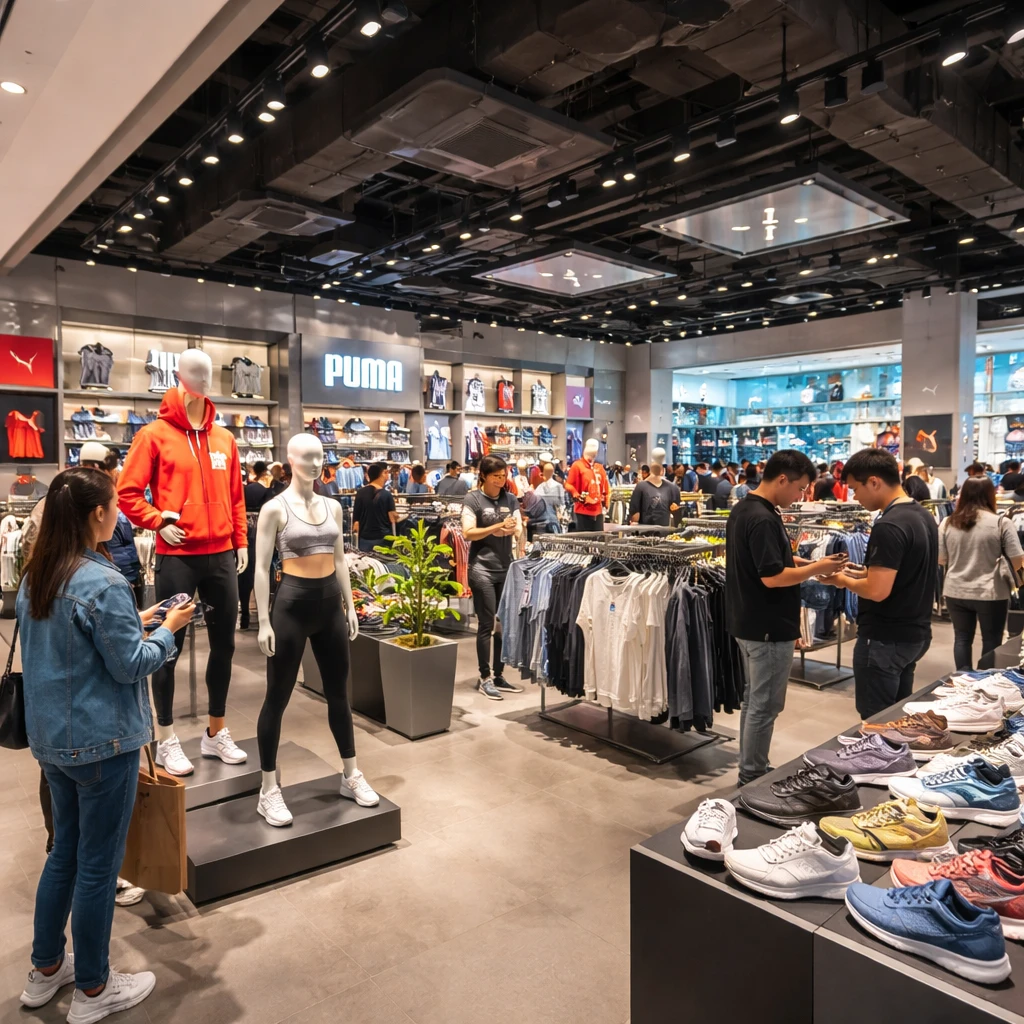
Puma currently holds about 1.3% market share in China, operating roughly 150 owned-and-operated stores alongside about 770 franchise locations. HSBC's analysts see substantial room for expansion, with China DTC singled out as the first area where Anta's support is likely to have an immediate impact - DTC represents about 70% of Puma's China sales.
Revenue and margin trajectories in Greater China
Greater China accounted for 7% of Puma's group sales in 2025, down from 15% in 2020. HSBC projects this share can climb to 10% by 2028, assuming the region grows at a 23% compound annual growth rate over 2026-28. The analysts also expect a recovery in the region's profitability: regional EBIT margin peaked at 33.3% in 2019 but fell to 5.5% in 2025 after years of market share erosion. HSBC models a rebound to mid-teens EBIT margin by 2028.
Other commercial considerations
Puma is the official kit sponsor for 11 of the 48 national teams participating in the 2026 FIFA World Cup. HSBC cautions that the sponsorship is unlikely to yield a meaningful financial contribution because Puma currently sponsors only two of the top-10 ranked national teams, reducing the immediate commercial upside from global tournament exposure.
Key risks
- Slower-than-expected progress on Puma's brand turnaround could limit the upside from HSBC's thesis - this would affect retail and consumer apparel sectors most directly.
- Regulatory delays for Anta's stake purchase remain a risk; a prolonged approval process would delay anticipated strategic initiatives in Greater China, impacting international investment and cross-border M&A sentiment in the sector.
- Weaker-than-expected consumer demand in mainland China would constrain the recovery in both sales and regional margins, with implications for Puma's retail, wholesale and DTC channels.
Conclusion
HSBC's upgrade reflects a view that short-term headwinds in 2026 are balanced by a credible, Anta-enabled path to growth and margin recovery in Greater China by late 2027 through 2028. The bank's forecast of a modest full-year organic sales decline and an EBIT loss at the lower end of the guided range acknowledges the near-term drag from inventory, wholesale rationalization and cost measures. The longer-term upside hinges on Anta's ability to replicate prior turnarounds in China and to expand Puma's DTC footprint and owned retail presence.