
Stock Markets June 22, 2026 10:03 AM

Goldman Says Rapid EV Uptake Could Cut Oil Demand by as Much as 0.32 mb/d by 2027

Bank models two EV-penetration scenarios and flags a greater-than-expected downside risk to oil, while stressing caveats and geopolitical upside risks

By Sofia Navarro
Share
Twitter Reddit Facebook LinkedIn
LCO CL

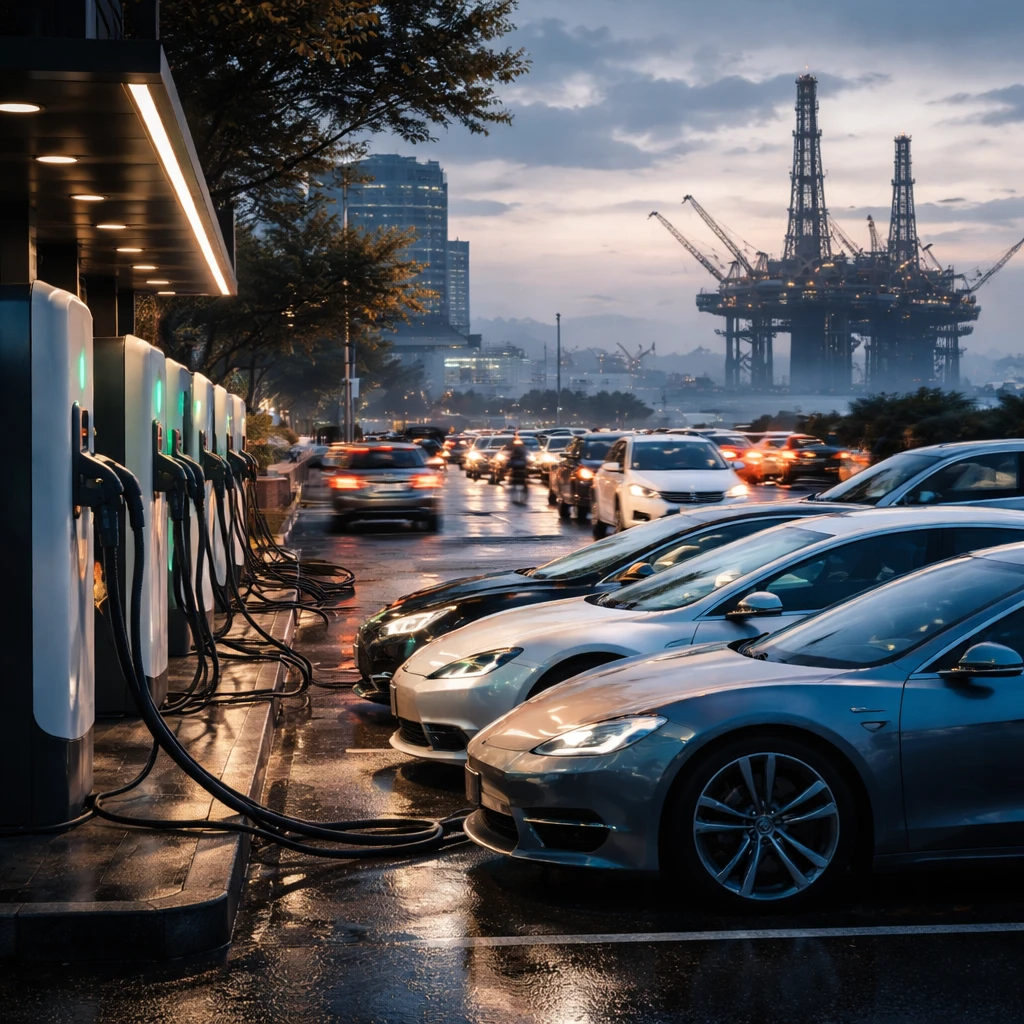
Goldman Sachs warns that the recent jump in electric vehicle sales has introduced a fresh downside risk to global oil demand. The bank's analysis, led by analyst Alexandra Paulus, finds that rising EV penetration could reduce oil consumption by 0.13 million barrels per day in a temporary scenario or by 0.32 million barrels per day if current trends persist through December 2027. The study notes it likely understates the total effect because it omits two- and three-wheeler EVs and non-road fuel oil demand, while also acknowledging geopolitical factors could push prices higher.

Goldman Says Rapid EV Uptake Could Cut Oil Demand by as Much as 0.32 mb/d by 2027
LCO CL
Summarize with
ChatGPT Perplexity Claude Grok Gemini

Key Points

  • Goldman Sachs finds rising EV penetration could reduce global oil demand by 0.13 mb/d under a temporary scenario and by 0.32 mb/d under a persistent-acceleration scenario by December 2027.
  • EV car sales penetration rose 3.4 percentage points since February to 26.1% last month, excluding a September 2025 spike tied to a U.S. tax credit expiry; 12 of the 15 largest EV markets saw higher penetration, with China up 11.4 percentage points.
  • The analysis omits two- and three-wheeler EVs and about 55% of oil demand that is not tied to road fuels, suggesting the modeled impact likely understates total EV-driven oil displacement; energy and oil markets are directly affected, with potential knock-on effects for related financial assets.

Goldman Sachs has identified accelerating electric vehicle adoption as an emerging downside driver for global oil consumption. In research led by analyst Alexandra Paulus, the bank quantified the recent surge in EV sales and modeled how that trend could shave demand from the oil market by late 2027.

Goldman estimates that the jump in EV penetration could reduce oil demand by up to 0.32 million barrels per day by December 2027 under a scenario in which EV adoption continues to accelerate. The firm also modeled a less aggressive outcome - a "Temporary Acceleration" case - where regional EV penetration rates hold at May 2026 levels and global oil demand falls by 0.13 million barrels per day by the end of 2027.

Paulus highlighted that EV car sales penetration has increased by 3.4 percentage points since February, reaching an all-time high of 26.1% last month, excluding an isolated September 2025 spike driven by a U.S. tax credit expiry. Of the 15 largest EV markets, Goldman found 12 recorded rising penetration rates, with China accounting for the largest single-country gain of 11.4 percentage points.

The bank cautioned that its passenger-car-focused analysis does not capture the entire shift to electric mobility. It excludes two- and three-wheeler electric vehicles - segments that represent 92% of total EV sales in India and 80% in Vietnam - and it does not factor in roughly 55% of global oil demand that is unrelated to road fuels. Because of those exclusions, Goldman says the calculated demand impact likely understates the full magnitude of EV-driven oil displacement.

Goldman also connected the EV acceleration to its oil price outlook. The bank noted that faster EV uptake increases the plausibility of its downside price path, in which Brent could fall to the mid-$50s per barrel in late 2027. At the same time, Goldman emphasized that potential longer-lasting constraints on flows through the Strait of Hormuz remain an important source of upside price risk.


Contextual note - The bank presented two distinct penetration scenarios to illustrate the range of potential demand impacts rather than a single forecast. The figures and country-level penetration changes are derived from Goldman Sachs' internal modeling and the EV sales data cited by the firm.

Risks

  • The study excludes two- and three-wheeler EVs, which are a dominant share of EV sales in markets like India and Vietnam, so the reported demand impact may understate the true reduction in oil consumption; this creates uncertainty for oil demand forecasts and energy sector revenue estimates.
  • Roughly 55% of global oil demand is unrelated to road fuels and is not captured in the passenger-car analysis, limiting the scope of the estimated impact and leaving industrial and aviation fuel demand as potential offsets.
  • Geopolitical developments - specifically potentially persistent constraints on flows through the Strait of Hormuz - remain a material upside risk for oil prices, counterbalancing the downward pressure from EV-driven demand loss.

More from Stock Markets

Warsaw benchmark slips as banks, tech and chemicals weigh on market Jun 22, 2026 Data Dump at Tata Electronics Raises Questions Over Apple and Tesla Parts Designs Jun 22, 2026 Copenhagen benchmark climbs as consumer goods, health and financials lead gains Jun 22, 2026 Istanbul market edges lower as select sectors weigh on BIST 100 Jun 22, 2026 Roblox Shares Drop After User Metrics Disappoint; Engagement Still Under Pressure Jun 22, 2026