
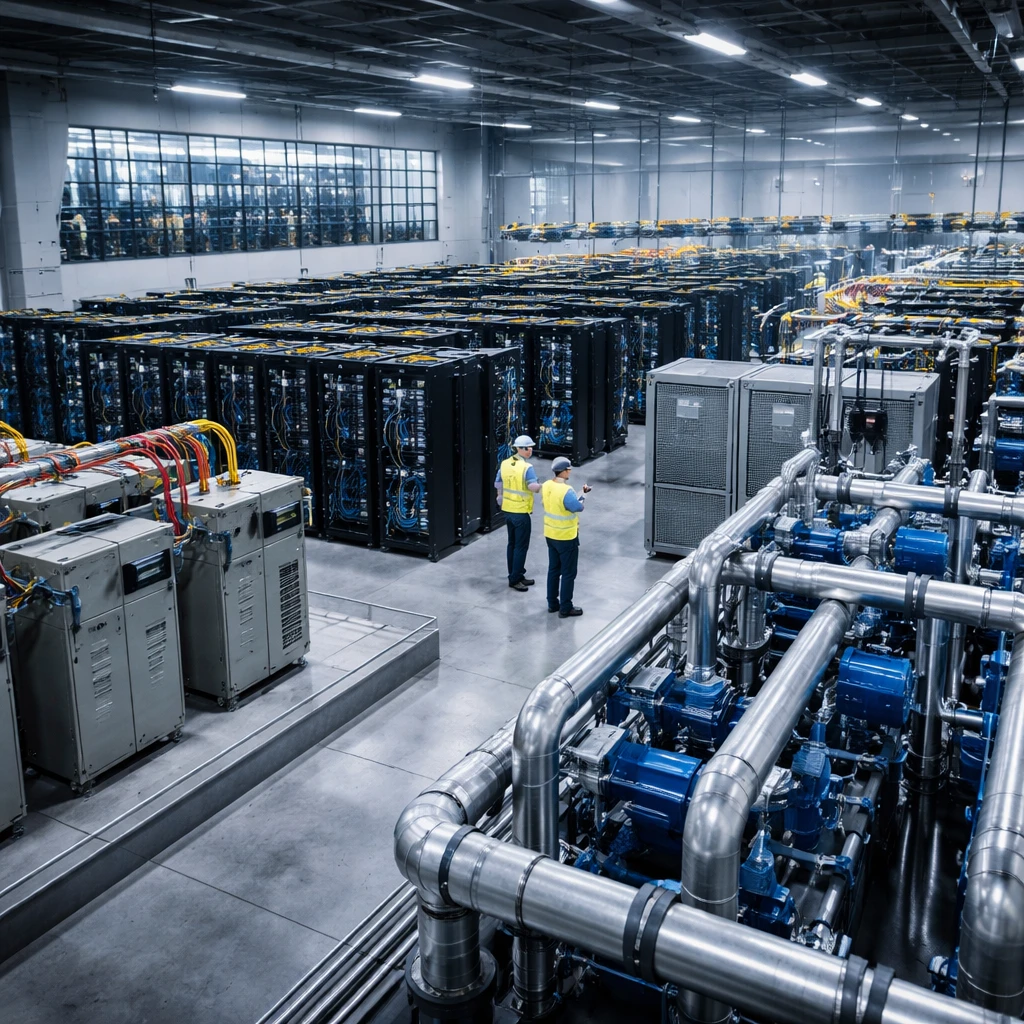
While graphics processing units have become the public face of the artificial intelligence expansion, a parallel and less visible market is expanding rapidly: makers of power distribution and cooling equipment for data centres. Developers under pressure to deliver facilities fast enough to meet demand are turning to transformers, generators, and advanced thermal-management systems to avoid infrastructure bottlenecks, creating winners across Asia's industrial supply chain even as some earlier stock-price gains cool.
Consultancy estimates and corporate disclosures underscore the scale of the build-out. McKinsey has projected nearly $7 trillion of data-centre investment globally by 2030, and large AI-chip vendors have signalled sustained spending on AI infrastructure. That creates strain on the physical elements that bring electricity and cooling to racks of servers - and on the supply chains that provide them.
Speed is a central challenge. Hyperscale operators often expect new facilities delivered in about six months, yet grid connection timelines vary widely and can be substantially longer. Consultancy Pivotale AI has highlighted grid-connection delays stretching to 24 months in some emerging markets and extending to more than eight years in major developed markets. The mismatch between construction schedules and grid readiness has focused industry attention inward - not on GPUs but on components that determine how quickly a site can be powered and cooled.
"Outside the industry circle, people are talking about (graphics processing units), but within the circle, people most certainly question you about the lead time for generators and transformers," said Wing Kin Cheung, the CEO of digital infrastructure service provider BodaData.
Transformers perform the fundamental task of converting high-voltage grid electricity into levels suitable for server racks, cooling plants and power distribution hardware. That basic electrical function is now central to the economics and timing of new AI-capable data centres.
Power-equipment demand and corporate order books
Leading transformer suppliers have reported strong bookings linked to AI infrastructure projects. South Korea's HD Hyundai Electric and China's Hainan Jinpan Smart Technology said demand surged in the first half of 2026, notably from projects tied to North American hyperscalers. HD Hyundai Electric reported rising demand in Europe as U.S. hyperscalers expanded into markets including Finland, Germany and Britain, while demand in the Middle East remained strong. Its order backlog rose 23% to $8.5 billion at the end of June compared with six months earlier. The company said it expects data centres to represent 16% of new orders in its power business next year, up from 6.3% this year.
Hainan Jinpan reported that new data-centre orders in the first half of the year more than quadrupled from the prior year, while its related backlog nearly tripled.
Efficiency technologies and solid-state transformers
As AI accelerators consume ever more electricity, equipment manufacturers are prioritising technologies that improve efficiency and reduce environmental impacts. Estimates cited by lenders suggest power draw per AI rack could reach more than 1.5 megawatts by the end of 2030 - roughly 100 times that of a conventional rack, according to research referencing an AI-chips vendor roadmap. That trajectory elevates the importance of power-conversion and distribution innovations.
One technology attracting attention is the solid-state transformer, or SST. Unlike traditional transformers that rely on magnetic coils and copper windings, SSTs use semiconductor-based electronics to transform and route electricity. Analysts at UBS estimate SSTs can lift power efficiency by about 4% while lowering costs; they project SST penetration could climb to 40% by 2030 and expect Chinese manufacturers to capture share because of technological strengths and cost advantages.
Manufacturers are responding. HD Hyundai Electric and Jinpan said they are deepening development of SST technology. Taiwan's Delta Electronics, a major supplier of power infrastructure, said a small data centre is already using its SSTs. Delta's chairman, Ping Cheng, cautioned in July that the device represents "an energy gateway, which requires a different overall design and power architecture," and that adoption will therefore take time.
Cooling intensifies as AI chips get hotter
Thermal management is emerging as a parallel battleground because increased power input produces commensurate heat output. "Power and cooling basically go hand in hand; so basically the more power you use, the more cooling you need to use because you generate heat," said Matty Zhao, Bank of America's Asia-Pacific head of research for basic materials, oil and gas.
Bank of America forecasts that liquid cooling will account for 70% of new AI data-centre installations by 2030, up from roughly 30% today. Research from McKinsey indicates liquid cooling can cut energy consumption by more than 27% versus conventional air cooling. In response, operators and engineers are also testing unconventional deployments - including floating facilities, underwater sites and colocations in caves or tunnels - which broaden the supplier base and create niche demand for marine and medium-speed engine solutions.
HD Hyundai Electric noted that with the expansion of data-centre self-generation and a nascent floating data-centre market, opportunities are opening for suppliers of marine medium-speed engines. Thermal-management product demand is helping lift firms such as Delta, Asia Vital Components and Auras Technology, along with Shenzhen Envicool Technology in China. These companies supply components within the broader AI-hardware ecosystem.
Investor reaction and supply-chain risks
Despite the wave of orders and technical momentum, investor returns for many equipment suppliers have moderated. Share-price moves earlier in the cycle have cooled as analysts and market participants weigh elevated valuations and intensifying competition.
Delta's shares have risen by more than 90% year to date, while HD Hyundai Electric's stock is broadly flat after surging by more than 100% last year. China's Jinpan and Envicool have reversed earlier rallies and are down nearly 30% and 20%, respectively, following gains of 118% and 244% in 2025.
Delta's Ping Cheng said even if revenue grows, gross margins may stay roughly where they are today because of multiple variables in the market. "There are many variables in the market, including new product platforms, deployment delays and component shortages. These issues may become somewhat more serious in the second half of this year," he said.
Bank of America's Matty Zhao flagged the selection risk for investors, noting that not all suppliers will prosper. "Not everyone can win," she said. "You have to be cherry-picked for the leaders who actually get the customers."
Key takeaways are that rapid AI-driven data-centre growth is lifting demand for power and cooling hardware, but timelines, technology adoption rates and supply-chain dynamics will shape which suppliers capture sustainable shares of the market.