
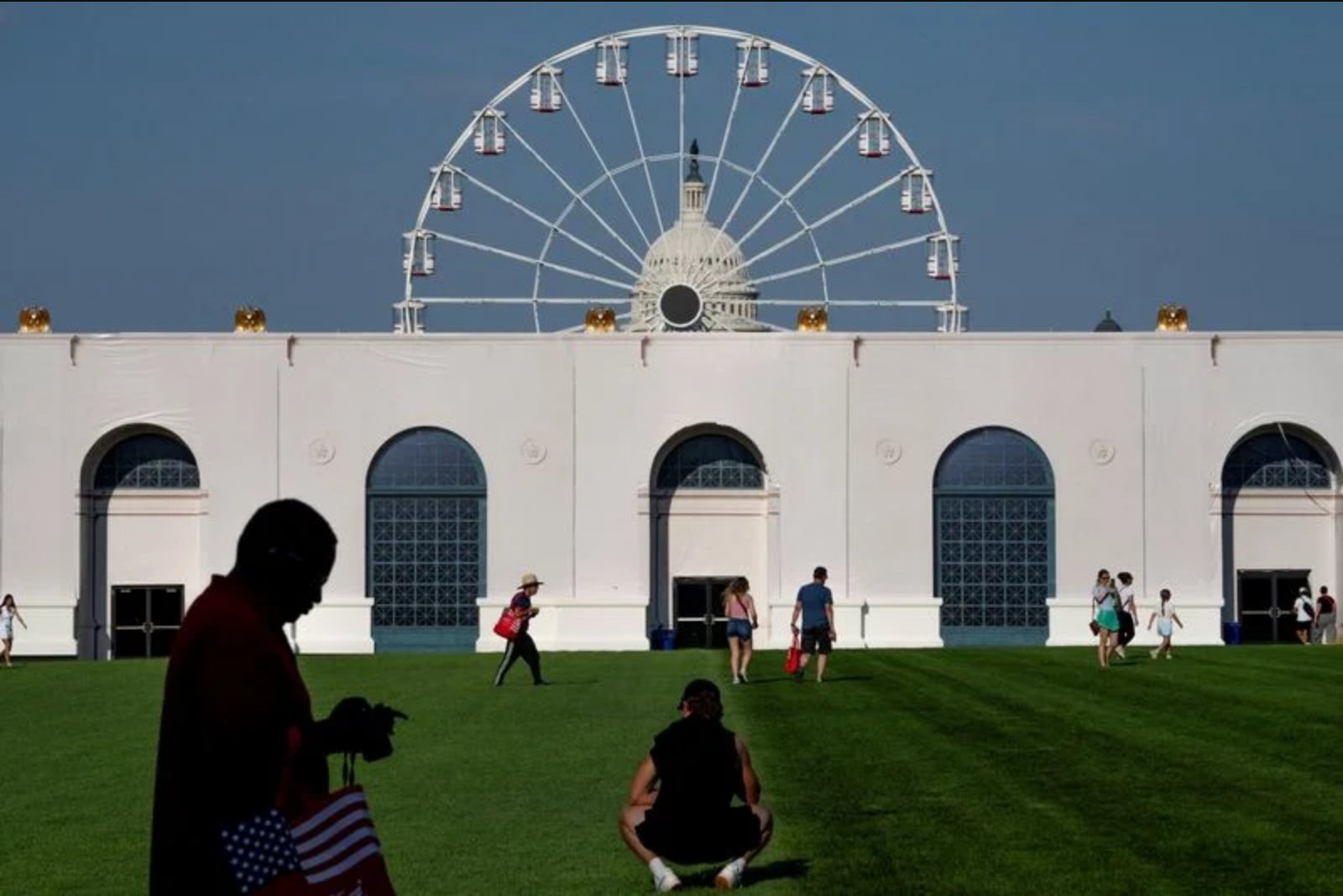
WASHINGTON, June 27 - A carnival-style exposition featuring a 110-foot (33.5-meter) Ferris wheel, a rodeo demonstration and wide-ranging concessions opened on the National Mall on Thursday as organizers launched "The Great American State Fair," a 16-day series of events intended to mark the country's 250th anniversary.
The fair occupies much of a 1.5-mile (2.5-km) stretch between the U.S. Capitol and the Washington Monument, where temporary pavilions have been erected along promenades between Smithsonian museums. Fencing restricts access to portions of the Mall for the duration of the festivities.
Attendance during the initial days was scattered rather than dense, and organizers acknowledged uncertainty about crowd levels heading into the July 4 holiday week. U.S. Interior Secretary Doug Burgum told Fox News on Saturday that the administration was planning what he described as the "greatest and biggest celebration of fireworks ever." It remains to be seen how that will translate into turnout and public response.
President Donald Trump formally opened the anniversary events Wednesday night with a rally that had the character of a campaign-style gathering. The event was organized after many scheduled performers withdrew, citing concerns that the observance was taking on a partisan tone.
Attendees on the Mall described a focus on family-oriented activities and spectacle. One visitor, who gave her first name as Ashley and said she was traveling from Ohio, noted that her children were excited for the aerial view from the Ferris wheel. "We are here to just celebrate America, a long journey that she has had," she said, declining to provide a last name.
Another visitor, Sarah Parker, who came with her husband from neighboring Virginia, said she saw the fair largely as a summer family outing. "It’s a good family time on a nice summer day is how I see it," she said. "It’s a good way to get a feel of the country."
The fair is styled as a homage to state fairs that traditionally display homemade quilts, butter sculptures and giant pumpkins, and it is one component of a broader slate of local and national events leading up to Independence Day, which marks the 1776 Declaration of Independence.
Organizers branded the initiative Freedom 250, a public-private partnership formed to coordinate the 250th anniversary observances alongside federal agencies. Freedom 250 officials said they intended for all 50 states to be represented at the Mall.
Still, seven states declined to send official delegations to the Great American State Fair. All seven are governed by Democrats, and one of the states opting out was Oregon. A spokesman for Oregon Governor Tina Kotek said the state would not participate "due to both the cost of participating in the Fair and growing concerns that the event in Washington, D.C., is shaping up to be a more partisan affair than originally presented."
Political symbolism and controversy have followed the anniversary planning beyond the fair footprint. The administration has pursued more permanent changes in Washington that include a proposed 250-foot arch near Arlington National Cemetery, a renovation of the National Reflecting Pool facing the Lincoln Memorial described as hasty, and plans to remove the East Wing of the White House to create a large ballroom.
Civil rights advocates and other critics have accused the administration of promoting a revisionist account of the nation's past, one that downplays painful chapters such as slavery, the abuse of Native Americans and negative impacts of U.S. foreign policy. Observers noted that those topics received little attention at the fair.
A recent poll cited by organizers and commentators indicated a perception among many Americans that the anniversary events have become politicized. The survey found that a majority of respondents - including roughly three-quarters of Democrats and about half of Republicans - believe the 250th-anniversary celebrations have taken on too political a tone.
Despite the controversy, early visitors appeared principally focused on the attractions, weather and time with family rather than political debates. Concessions, live performances and fairground rides have been the immediate draw for those attending the opening days, while the trajectory of national sentiment and official participation through the July 4 holiday week remains uncertain.
Context and logistics
The temporary nature of the Mall installations contrasts with the administration's plans for more permanent alterations to the capital's landscape. Freedom 250 positions the fair as a temporary tribute to state fairs across the country, while several proposed and ongoing projects seek longer-term changes to federal property and ceremonial sites.
Public reaction
Public reaction has been mixed: some visitors emphasize family recreation and celebration, while others and some state officials worry that the events have been politicized. The refusal of several states to send official delegations and the withdrawal of performers from the opening rally have contributed to questions about tone and inclusiveness.
The fair will continue through the run-up to Independence Day, and organizers, state officials and the public will be watching for how attendance, programming and political commentary evolve over the next two weeks.