
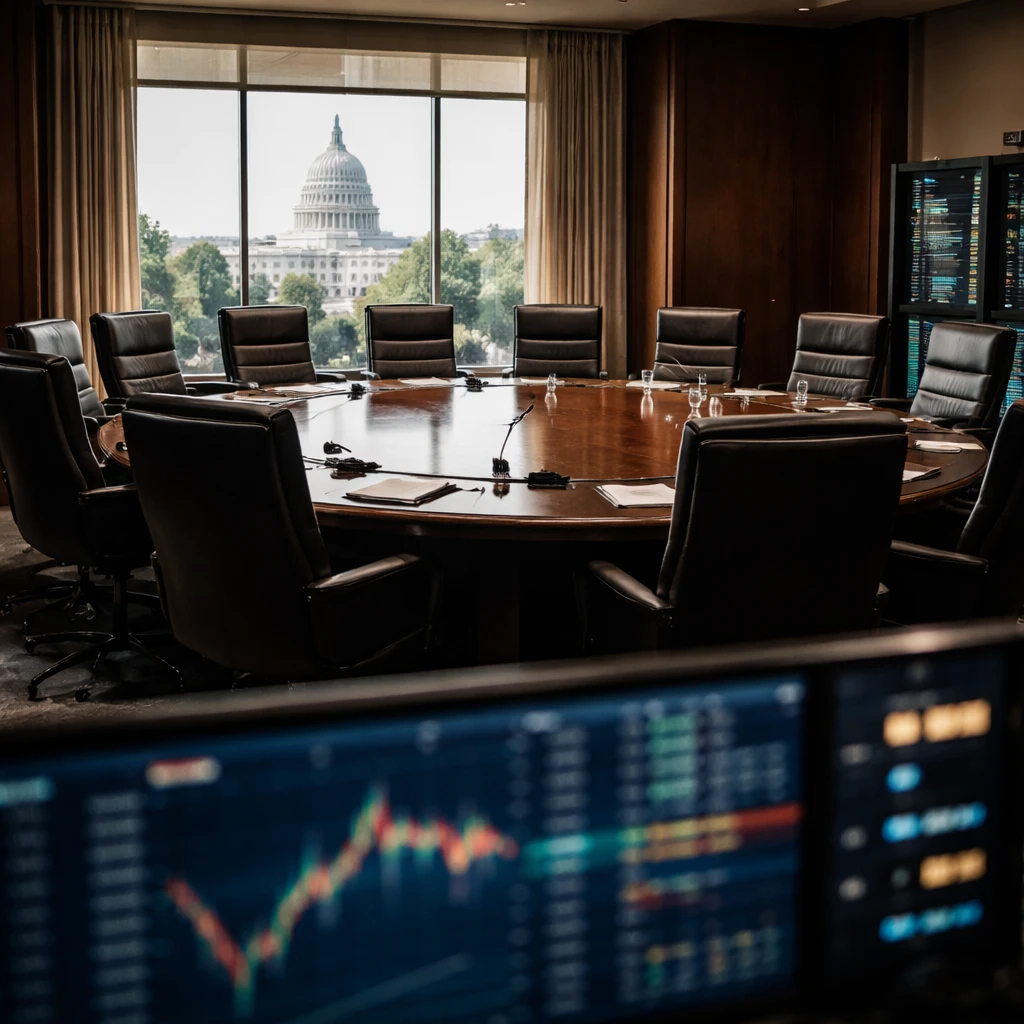
Investors are focused on a cluster of policy events that could move markets in the weeks before the midterm elections, led by Federal Reserve Chair Kevin Warsh’s first Federal Open Market Committee meeting and ongoing legislative activity in Congress.
Federal Reserve spotlight
Warsh’s initial FOMC meeting is not widely expected to produce immediate changes to policy, but market participants are looking for indications of the central bank’s future direction. One area under scrutiny is whether the Fed will remove the easing bias from its post-meeting statement in response to firmer economic readings and easing energy-related inflation pressures noted after the end of the U.S.-Iran conflict.
Another closely watched question is whether Chair Warsh will present his own interest-rate outlook on the Fed’s dot plot. He has previously criticized overly prescriptive forward guidance, and electing not to provide a formal projection could preserve flexibility for him and other policymakers as they evaluate incoming data. Investors will also be attentive to any hints about adjustments to the Fed’s communication approach. Warsh has advocated for a review of the central bank’s forecasting models and for reducing the frequency of official policy messaging, although analysts do not expect immediate changes to messaging practice.
Regulatory and legislative flashpoints
Outside the Fed, market attention has turned to recent government action against an advanced AI product and to negotiations in Congress on several high-profile measures. The Commerce Department’s restrictions on Anthropic’s Fable AI model forced the firm to withdraw the model and signaled the government’s readiness to intervene when advanced AI systems raise national security concerns. That episode has become a focal point for investors assessing regulatory risk in the AI sector.
In Congress, lawmakers continue to negotiate the CLARITY bill intended to establish market structure rules for digital assets and to clarify regulatory responsibilities between the Securities and Exchange Commission and the Commodity Futures Trading Commission. The measure still confronts unresolved disagreements, and Wolfe Research has estimated that the probability of passage has fallen below 50 percent as the legislative calendar tightens ahead of the midterm elections.
Meanwhile, a bipartisan housing package appears to have found firmer footing after House and Senate leaders agreed on a compromise version. The proposal contains provisions designed to encourage construction and to relieve supply constraints in the housing market.
Defense spending and election dynamics
Expectations for a major, across-the-board increase in defense spending remain limited despite calls for additional military funding. Observers see Congress as more likely to approve a supplemental package tied to costs related to the Iran conflict and other priorities later in the year rather than a large standalone boost to the defense budget.
Wolfe Research also argued that the end of the U.S.-Iran war would likely have limited impact on Republican prospects in the midterm elections, saying broader political headwinds predate the conflict.
Key takeaways
- Markets are watching Warsh’s first FOMC meeting for signaling on policy direction and potential removal of an easing bias from the statement - this affects interest-rate sensitive sectors such as banking, housing and fixed income.
- Legislative uncertainty around the CLARITY crypto bill and the Commerce Department’s intervention in AI products are raising regulatory risks for crypto and AI sectors.
- A bipartisan housing compromise improves prospects for measures aimed at boosting construction and easing supply constraints, with implications for homebuilders and related industries.
Risks and uncertainties
- The FOMC could signal policy shifts without immediate rate moves, creating volatility in bond and equity markets sensitive to interest-rate expectations.
- Unresolved disagreements on the CLARITY bill mean the likelihood of crypto market-structure reform before the midterms is uncertain, exposing digital-asset markets to regulatory ambiguity.
- Defense spending is unlikely to see a major across-the-board increase; instead, funding may come via a supplemental package tied to specific costs, which could affect defense contractors and related suppliers differently depending on the package scope.
Investors will be parsing statements from the Fed and watching congressional progress on these items closely in the weeks ahead.