
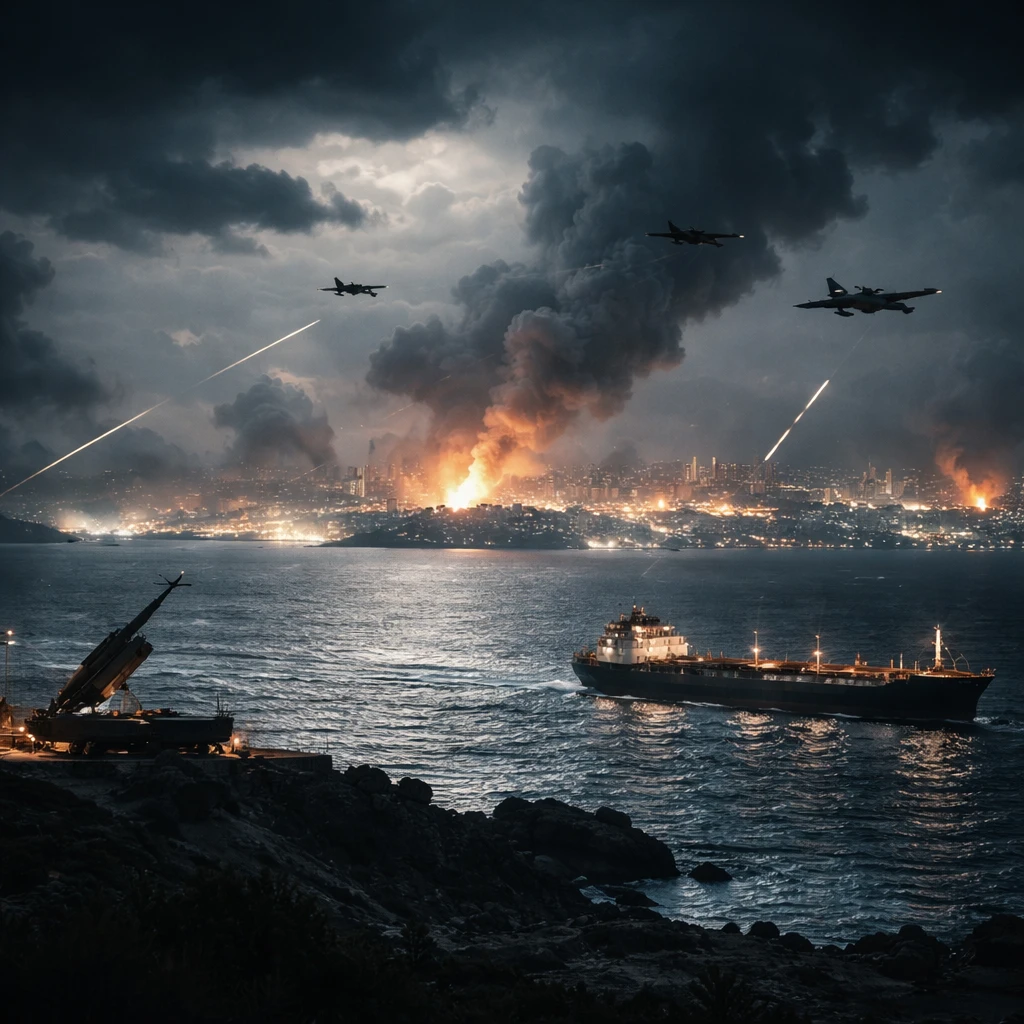
Summary: U.S. President Donald Trump publicly urged Israel and Iran to cease firing after a fresh bout of cross-border strikes spilled into Monday, threatening to derail talks Washington said were close to producing a final agreement. Media accounts said the sequence of attacks began with an Israeli strike on Beirut and spiraled into reciprocal actions by Tehran and Israel, with additional reports of explosions in several Iranian cities and air-defence alerts inside Israel. Brent crude climbed amid the tensions.
President Trump posted on social media on Monday that "Israel and Iran must immediately stop 'shooting,'" as the latest volley of strikes marked the first time the two countries had directly attacked one another since a tenuous U.S.-brokered truce took effect in April.
Multiple media reports traced the most recent escalation to an initial Israeli strike on the Lebanese capital of Beirut. Israel has been engaged against Iran-backed Hezbollah militants in Lebanon, though the conflict had largely produced only skirmishes in recent weeks. Tehran then launched strikes in response, and Israel carried out retaliatory strikes that its military said struck targets in central and western Iran.
On Monday Israeli authorities reported that alarms warning of further waves of attacks had been sounded, and that they had intercepted a ballistic missile launched from Yemen, the Wall Street Journal reported. Iran’s Islamic Revolutionary Guard Corps also said it had attacked airbases in southern Israel, according to the Wall Street Journal. Iranian state media separately reported explosions in Tehran, Tabriz and Isfahan.
Despite the renewed violence, Mr. Trump said the exchanges would not necessarily scuttle White House efforts to finalize a deal with Iran. An Iranian official with knowledge of the talks, however, told MS NOW that a deal was "no longer feasible at this stage."
According to reporting by Axios prior to Israel’s Sunday strikes, Mr. Trump said he would call Israeli Prime Minister Benjamin Netanyahu to urge him "not to attack Iran in response" to Iranian missile strikes, warning that Israeli retaliation would prolong conflict "like the last 47 years, or the last 3,000 years." Mr. Trump told Axios: "We're very close to a final deal with Iran. It'll be a good deal. I don't want it to blow up because of what's happening now."
He also stressed that both parties had already traded blows: "Israel had its strike and Iran had its strike. We don't need another one." Two Israeli sources told CNN that Israel had vowed a "powerful" response to the Iranian attack, yet Mr. Trump's direct intervention signaled an effort by Washington to contain further escalation.
Iran accused the United States and Israel of breaching the ceasefire, particularly after U.S. attacks on Iran in the prior two weeks. Tehran said it had retaliated by launching air strikes on Kuwait. Various reports showed Iran warning against any Israeli retaliation for its Sunday strikes, and Tehran condemned Israel’s strikes on Lebanon, pressing for Israel to be included in any ceasefire agreement.
Separately, an Israel-Lebanon ceasefire collapsed last week after Iran-backed Lebanese group Hezbollah objected to the terms and said it would continue to retaliate against what it described as Israeli aggression.
Mr. Trump said he was displeased that Israel’s strikes in Lebanon had not been coordinated with Washington, and he said he had expected a deal to be signed on Monday, Tuesday or Wednesday before the strikes disrupted negotiations, Fox News reported.
Negotiations between the U.S. and Iran continued to hinge on Iran's nuclear program, with Tehran resisting requests from Mr. Trump to surrender its enriched uranium stockpiles. Iran has also sought sanctions relief and the unfreezing of overseas assets held by the United States, as part of broader demands in talks.
Tehran was reported to be maintaining control over the Strait of Hormuz, a strategic waterway off Iran's southern coast through which roughly a fifth of global oil flows. The U.S. has kept its blockade on Iranian ports in place in response to Tehran's actions in the strait.
The market reacted to the tensions: Brent crude, the global oil benchmark, last rose 4.0% to $96.78 a barrel, a level below previous peaks above $100 a barrel but still well above prices seen prior to the outbreak of war-related disruptions.
(Ambar Warrick contributed reporting.)