
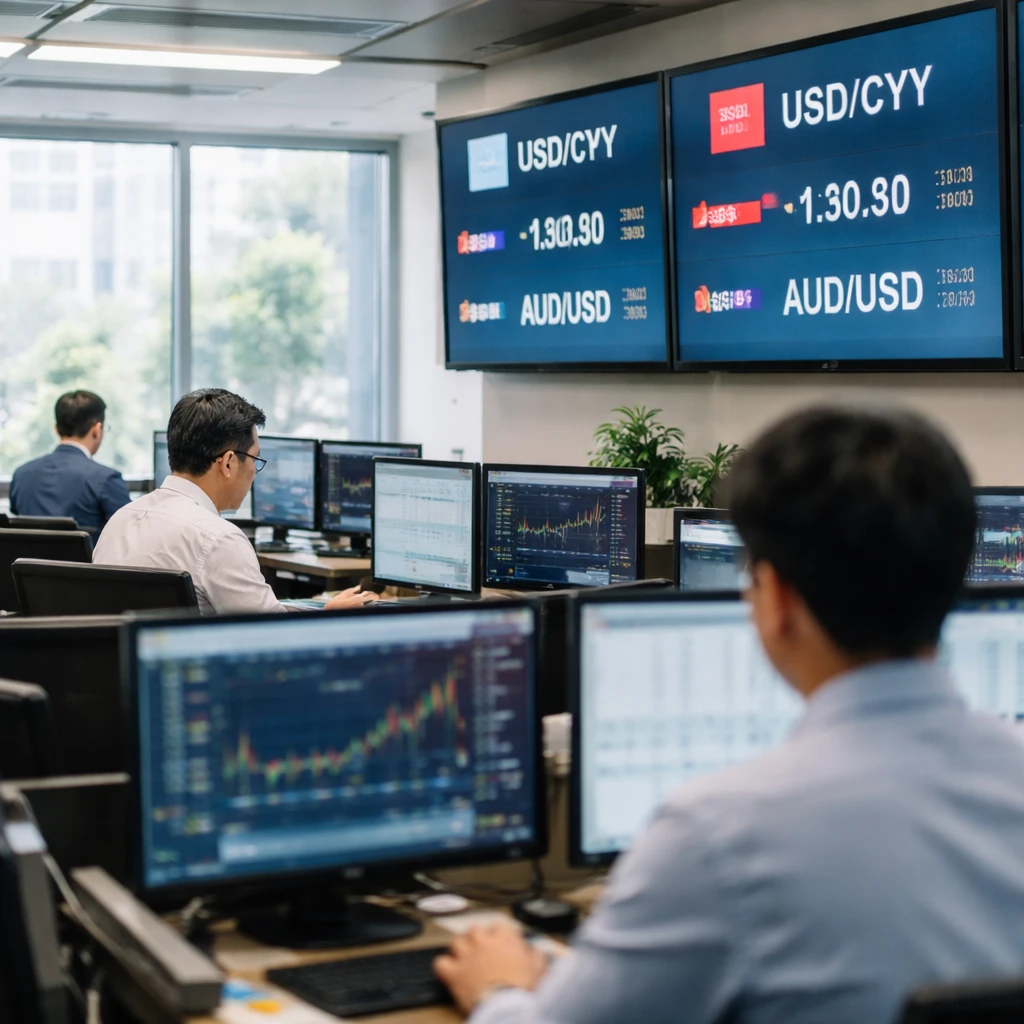
Most Asian currencies remained confined to a tight trading range on Wednesday as the U.S. dollar edged higher and market participants took a cautious stance ahead of a planned summit in Washington between U.S. President Donald Trump and Chinese President Xi Jinping.
Trading in the region was subdued in part because Japan observed a market holiday, leaving liquidity thinner than usual. The yen held its ground but showed some weakness versus the dollar, with the USD/JPY pair rising 0.2%.
The dollar index and dollar index futures each gained around 0.1% in Asian trade, while the onshore Chinese exchange rate saw the USD/CNY mark move about 0.05% higher. Those moves came as optimism from falling oil prices was largely counterbalanced by investor caution ahead of the U.S.-China meetings.
President Xi was due to arrive in Washington later on Wednesday for bilateral talks with President Trump. The agenda for the talks is wide-ranging, with participants and market watchers specifically attentive to any advances on artificial intelligence cooperation and trade arrangements. Reports suggest the two leaders are likely to prolong an existing trade truce that is scheduled to expire in early-November, and negotiators will also be looking at rare earth exports and agricultural purchases as part of the discussions.
This visit marks Xi’s first official trip to the United States during the course of Mr. Trump’s second presidency. In addition to trade and technology, Trump and Xi are expected to touch on the situation in Iran after the U.S. president said officials from both sides held some level of communication with Iranian counterparts on the sidelines of a United Nations meeting held in New York City earlier in the week. News that those talks had taken place helped push oil prices sharply lower, a dynamic that delivered some relief to currency markets sensitive to energy-driven inflation and external balances.
Against this backdrop, the Australian dollar underperformed its regional peers. AUD/USD fell about 0.15% after a set of purchasing managers index readings for September showed a notable deterioration in manufacturing activity and a sharp slowdown in services growth. While the overall composite business activity reading remained in expansion, the PMI details pointed to mounting pressure on the Australian economy stemming from persistent inflation and higher interest rates.
Those PMI outcomes have fed into market speculation about the Reserve Bank of Australia’s future rate path and whether the central bank will retain sufficient policy space to continue tightening. The RBA is widely expected to enact a 25 basis point increase at its meeting next week, the fourth such hike this year. A number of RBA officials, including Governor Michele Bullock, have publicly warned that inflation pressures are becoming more entrenched.
Elsewhere in the region, the USD/SGD pair rose approximately 0.08% as markets awaited Singapore’s consumer price index inflation figures for August, due later in the day. The USD/INR pair was largely unchanged, while USD/KRW ticked up about 0.1%.
With several central bank decisions and the U.S.-China summit on the near-term calendar, market participants are balancing relief from lower oil prices against the potential for policy and geopolitical announcements that could alter capital flows and currency valuations.