
Ricardo de Lima Filho, 34, who has consistently supported left-wing candidates and backed President Luiz Inacio Lula da Silva in the 2022 runoff, says he will vote for a right-wing president in October. A video game translator by profession, he reflected on his political evolution with a simple observation: "I’ve lived most of my adult life under Workers Party governments," he said, adding that amid sluggish economic performance, worsening public safety and recurring corruption scandals, "I couldn’t feel the improvement that I expected."
That experience - disappointment after repeated votes for the left - helps explain why a portion of younger Brazilians who once helped deliver Lula victory in 2022 are now among his most hesitant supporters. Lula had relied on the vote of people aged 16 to 34 to beat far-right former President Jair Bolsonaro two years ago. Today, however, national polling shows the former union leader retains solid popularity overall and is widening his lead across the electorate, even as he faces disproportionately higher disapproval among younger adults in some surveys.
A June survey by Quaest found that young adults were the only age cohort in which disapproval of Lula’s government outstripped approval. That finding aligns with other research indicating a rightward tilt among many younger Brazilians. In a 2024 survey conducted by a foundation linked to Germany’s Social Democratic Party, 38% of young Brazilians identified as right-wing - among the highest shares of right-leaning youth across Latin America in that dataset. A December poll by AtlasIntel showed older generations were more inclined to identify as left or center-left.
Gender differences are also visible in the data: the conservative tendency is stronger among men, who were two percentage points more likely to identify on the right in the foundation-linked survey, and who have consistently leaned toward conservative alternatives in presidential polling. Observers note that the rise of a young male conservative is not limited to Brazil - there are parallels in other regions - but the Brazilian context is shaped by a generation that encountered a sequence of economic disappointments over the past dozen years while associating the left with those outcomes.
Right-wing presidential hopeful Renan Santos, 42, has tapped into this frustration and attracted early backing from disaffected younger voters, a constituency he prefers not to label as "conservative." In an interview at the Sao Paulo studio where he records daily social media posts, he framed their orientation differently: "They are anti-left. It’s different," he said. "The left is the establishment."
Internal reflection among progressive activists
In a May meeting in Sao Paulo, young leaders from the Workers Party and other progressive groups gathered to analyze why support among young voters has eroded. Participants debated factors ranging from potential bias on digital platforms to the hostile tone often found on social media. They also brainstormed policy measures intended to resonate with younger voters' immediate concerns - from ideas for shortening the workweek to adapting housing programs for young adults.
"Are people ashamed of saying they are left-wing?" one young man asked during the session, highlighting a concern among organizers that public expression of left-leaning identity may have become stigmatized for some.
Quaest's director, Felipe Nunes, told Reuters that the polling among young Brazilians does not necessarily reflect a straightforward shift to conservative ideology. Rather, he noted, many young voters still support expanded public services, including broader access to higher education. The disconnect lies in expectations for economic returns after educational attainment, expectations that have not been met as hoped.
Government data show the number of Brazilians holding a university degree nearly doubled over the last decade. Yet, according to polling and labor-market measures cited by analysts, inflation-adjusted income for university graduates remains lower than it was in 2014. Graduates still earn more, on average, than those with only high school diplomas, but the income gap has narrowed. "Young people went to university ... and when they returned to the job market, they didn’t see real economic result," Nunes said.
That sense of unfulfilled promise has pushed many young voters toward candidates with more market-oriented platforms or those promising sharper responses to crime and corruption - positions often associated with right- and center-right contenders.
Street mobilization, pension fund fears and a new political generation
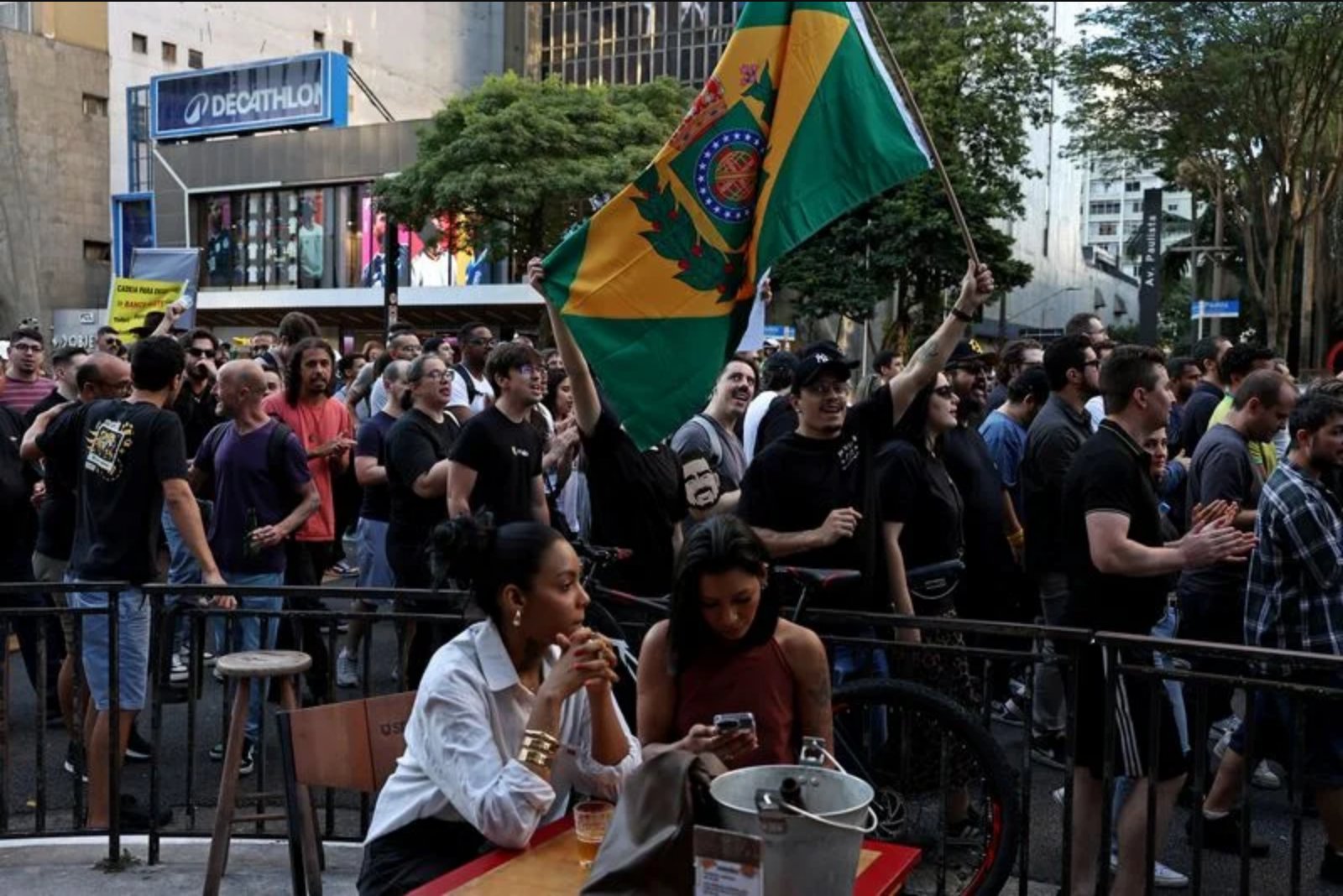
At an April demonstration on Avenida Paulista in Sao Paulo, 28-year-old journalism student John Vitor Lima and dozens of peers gathered to protest a large banking fraud scandal viewed as jeopardizing public pension funds. Most protesters were young men demanding an end to corruption and stronger penalties for criminals. The event was organized by Missao, the right-wing party led by presidential hopeful Renan Santos; it was the second demonstration Lima had attended.
Santos has proposed measures such as making it easier to arrest suspected gang members and tying the use of federal funds that support political parties to the performance of their mayors. For many young attendees, he represents a break from the older political class: "Our generation is not in positions of power," one protester reflected on Santos' appeal. "Santos brings hope ... In general, people in positions of power are older."
Polling highlights the intensity of Santos' support among certain youth segments. In a May AtlasIntel survey, he captured 36% of voters aged 16 to 24, surpassing both Lula and his principal rival on the right, Senator Flavio Bolsonaro, the son of former President Jair Bolsonaro. Nevertheless, Santos remains in the single digits in nationwide voting intentions across all age groups, underscoring a gap between concentrated youth enthusiasm and broader electoral reach.
The renewal of right-leaning parties has included many of the youngest federal lawmakers in Brasilia, a development that mirrors the generational discontent feeding into Santos' base. At the top of the ticket, Flavio Bolsonaro is 45, while President Lula, at 80, is Brazil’s oldest president - a contrast campaign strategists are mindful of as they appeal to younger voters seeking new faces and different approaches.
Campaign responses and messages to youth
The Workers Party has said it continues to court younger voters, engaging on issues such as climate change - a topic the party argues young people will feel most acutely - while reminding voters of the environmental record during Jair Bolsonaro’s administration. Lula has acknowledged youth frustration, telling audiences in April he understands there is a perception of corruption but urging young people not to disengage: "Even when you think no politician is good enough, don’t give up on politics, get involved in politics."
Meanwhile, Flavio Bolsonaro has used social media to appeal directly to younger voters, posting videos encouraging turnout and addressing those he described as "doing everything right, yet going nowhere."
As the October election approaches, the divergence between overall approval ratings for the incumbent and pronounced discontent within the younger cohort presents both a political challenge and an organizational puzzle for parties of all stripes. Campaigns will need to translate policy proposals into tangible economic and security results that speak to a generation whose experiences have left many skeptical of established political promises.
What to watch
- Whether left-leaning parties can close the gap with younger voters by demonstrating concrete economic progress and responsive public safety measures.
- The ability of candidates like Renan Santos to convert concentrated youth enthusiasm into broader electoral support across other demographics.
- How narratives around corruption and pension fund security evolve in public debate, given the protests sparked by a banking fraud scandal.